Current Yield: Definition, Formula, and Bond Investment Analysis
Master current yield calculations and understand how to evaluate bond investments effectively.
Current Yield: Understanding Bond Yield Fundamentals
Current yield is one of the most fundamental concepts in bond investing, providing investors with a straightforward measure of the annual income generated by a bond relative to its current market price. Unlike more complex yield calculations, current yield offers a simple snapshot of the cash return an investor can expect to receive annually from holding a bond. This metric serves as an essential tool for bond investors to evaluate investment opportunities and make informed decisions about whether a particular bond offers adequate compensation for its risk.
For investors new to fixed income securities, understanding current yield is often the first step toward comprehending how bonds generate returns. Whether you’re evaluating corporate bonds, government securities, or municipal bonds, current yield provides a quick and accessible way to compare the income-generating potential of different fixed income investments.
What Is Current Yield?
Current yield represents the annual coupon payment of a bond divided by its current market price. In essence, it answers the question: “What percentage return will I receive on my investment if I buy this bond at today’s price?” This calculation provides a real-time measure of the bond’s income yield based on what you would actually pay for it in the market today, rather than what was paid when the bond was originally issued.
The importance of current yield lies in its recognition that bond prices fluctuate constantly due to changing market conditions, interest rate movements, and economic factors. When market interest rates rise, existing bond prices typically fall, and vice versa. This inverse relationship means that a bond’s current yield changes daily as its market price adjusts, making current yield a dynamic measure rather than a static figure.
Current Yield Formula and Calculation
The formula for calculating current yield is straightforward and can be expressed as:
Current Yield = Annual Coupon Payment ÷ Current Bond Price
To illustrate this calculation with a practical example, consider a bond with a $1,000 par value and an annual coupon payment of $50. If this bond is currently trading in the market at $950, the current yield would be calculated as follows:
Current Yield = $50 ÷ $950 = 5.26%
This result indicates that an investor purchasing the bond at $950 would receive an annual income return of approximately 5.26% based on the bond’s current market price. If that same bond were trading at $1,050, the current yield would be lower:
Current Yield = $50 ÷ $1,050 = 4.76%
These calculations demonstrate a critical principle: as bond prices rise, current yields fall, and as bond prices decline, current yields rise. This inverse relationship is fundamental to understanding how bond markets function.
Current Yield vs. Coupon Rate
It’s essential to distinguish between current yield and the bond’s coupon rate, as these are often confused but represent different concepts. The coupon rate is the fixed percentage of the bond’s par value that the issuer pays annually and never changes throughout the bond’s life. Once a bond is issued with a specific coupon rate, that rate remains constant.
Current yield, by contrast, changes constantly as the bond’s market price fluctuates. A bond with a 5% coupon rate will always pay 5% of its $1,000 par value ($50 annually), but its current yield will vary depending on the price at which it trades. If purchased at a discount below par value, the current yield will be higher than the coupon rate. If purchased at a premium above par value, the current yield will be lower than the coupon rate.
Current Yield vs. Yield to Maturity
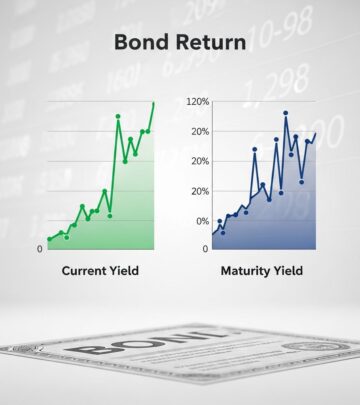
While current yield provides a useful measure of annual income, yield to maturity (YTM) offers a more comprehensive picture of a bond’s total return potential. Current yield only considers the annual coupon payment relative to the purchase price, ignoring both the time value of money and any potential capital gain or loss when the bond matures or is sold.
Yield to maturity, conversely, accounts for all future coupon payments and calculates their present value, incorporating the bond’s purchase price, par value, coupon rate, and time to maturity. YTM assumes that all coupon payments will be reinvested at the same rate and held until maturity, providing a more complete picture of expected returns than current yield alone.
For investors holding bonds until maturity, YTM represents the more accurate measure of total return. However, for evaluating the current income generation of a bond, current yield remains the more relevant metric. Many investors use both measures in conjunction—current yield for immediate income assessment and YTM for comprehensive return analysis.
Practical Applications of Current Yield
Income Comparison Across Bonds
Current yield proves particularly useful when comparing the income-generating potential of multiple bonds. Consider an investor evaluating several corporate bonds with different coupon rates and prices. By calculating current yield for each, the investor can quickly compare which bonds offer the most attractive annual income relative to their current market prices.
Identifying Market Opportunities
When bond prices fall significantly due to market sell-offs or economic concerns, current yields rise accordingly. This can create attractive entry points for income-focused investors. A bond that previously yielded 4% might yield 5.5% after a significant price decline, potentially representing a compelling opportunity for investors seeking higher income.
Portfolio Yield Assessment
Bond portfolio managers use current yield to evaluate the overall income generation of their portfolios. By calculating the weighted average current yield across all holdings, managers can track how effectively their portfolio is generating income and compare performance against benchmarks and other fixed income managers.
Limitations of Current Yield
Despite its usefulness, current yield has several important limitations that investors should understand. First, it ignores capital appreciation or depreciation. An investor who purchases a bond at a discount may receive substantial capital gains upon maturity, but current yield doesn’t reflect this potential profit. Conversely, an investor purchasing a bond at a premium will experience capital loss at maturity, a cost not captured in the current yield calculation.
Second, current yield provides a one-year perspective. It assumes an investor will hold the bond for exactly one year, which may not reflect actual investment timelines. For bonds held for longer periods or sold before maturity, current yield becomes an incomplete measure of actual returns.
Third, current yield ignores reinvestment risk. It doesn’t account for the rate at which future coupon payments can be reinvested, which can significantly impact total returns over time.
Current Yield in Different Market Conditions
| Market Condition | Bond Price Impact | Current Yield Impact |
|---|---|---|
| Rising Interest Rates | Bond prices decline | Current yield increases |
| Falling Interest Rates | Bond prices rise | Current yield decreases |
| Improving Credit Quality | Bond prices may rise | Current yield may decrease |
| Deteriorating Credit Quality | Bond prices may fall | Current yield may increase |
Examples of Current Yield Calculations
Example 1: Government Bond
Consider a U.S. Treasury bond with a $10,000 par value, 3% coupon rate, and current market price of $9,800:
Annual Coupon Payment: $10,000 × 3% = $300
Current Yield: $300 ÷ $9,800 = 3.06%
The investor would earn 3.06% annually on their investment at the current market price.
Example 2: Corporate Bond
A corporate bond issued with a $1,000 par value and 6% coupon rate is currently trading at $1,100:
Annual Coupon Payment: $1,000 × 6% = $60
Current Yield: $60 ÷ $1,100 = 5.45%
Despite the 6% coupon rate, the current yield is only 5.45% because the bond is trading at a premium.
How to Use Current Yield in Your Investment Strategy
For income-focused investors, current yield should be a primary metric when evaluating bond investments. Calculate the current yield for any bond under consideration and compare it against alternatives. However, don’t rely solely on current yield; also consider the bond’s credit quality, time to maturity, and whether the issuer’s financial condition might change before you plan to exit the investment.
Additionally, compare current yields across different bond types—government bonds typically offer lower yields but greater safety, while corporate and high-yield bonds offer higher current yields with greater risk. The appropriate current yield for your portfolio depends on your risk tolerance and income requirements.
Frequently Asked Questions
Q: Why does bond price move inversely to current yield?
A: Since current yield equals the annual coupon divided by price, as price increases, the yield decreases mathematically. When bond prices fall due to rising interest rates, their current yields rise to remain competitive with new bonds offering higher coupon rates.
Q: Is current yield the same as interest rate?
A: No. Current yield is the annual income return on your actual investment at the current market price. Interest rates refer to the broader market rates that influence bond pricing and the coupon rates on newly issued bonds.
Q: Should I always buy the bond with the highest current yield?
A: Not necessarily. A high current yield might indicate higher risk or a bond trading at a discount due to credit concerns. Always evaluate credit quality, maturity, and overall portfolio fit alongside current yield.
Q: How often does current yield change?
A: Current yield changes daily as bond prices fluctuate in response to market conditions, interest rate movements, and economic news. The coupon payment remains fixed, but the market price—and therefore current yield—adjusts continuously.
Q: Can current yield be negative?
A: In normal circumstances, no. However, in unusual market conditions or with bonds trading significantly above par value with very low coupon rates, current yield could theoretically approach zero but would not turn negative under standard calculations.
Key Takeaways
Current yield is a fundamental metric for bond investors that measures the annual income return relative to a bond’s current market price. It’s calculated simply by dividing the annual coupon payment by the current bond price. While current yield provides valuable insight into a bond’s income-generating potential, it should be used alongside other measures like yield to maturity for comprehensive investment analysis. Understanding current yield empowers investors to make more informed decisions about bond investments and compare income opportunities across different fixed income securities.
References
- Investopedia Video: Bond Yields – Current Yield and YTM — Investopedia. December 11, 2013. https://www.investopedia.com/
Similar Articles








Read full bio of medha deb