Current Assets: Definition, Examples, and Importance
Understanding current assets: Essential guide to short-term financial resources and liquidity management.

Current Assets: Definition, Examples, and Importance in Financial Analysis
Current assets represent the most liquid portion of a company’s balance sheet, comprising resources that can be converted into cash within one year or one operating cycle, whichever is longer. These assets are fundamental to understanding a company’s short-term financial health and operational efficiency. For investors, creditors, and financial analysts, current assets provide crucial insights into whether a business can meet its immediate financial obligations and maintain smooth operations.
The distinction between current and non-current assets is vital for financial planning and analysis. While current assets focus on immediate liquidity, non-current assets represent long-term investments that may take years to convert into cash. Understanding this classification helps stakeholders evaluate financial stability and make informed decisions about credit, investment, and business partnerships.
What Are Current Assets?
Current assets are company resources expected to be converted into cash, sold, or consumed within twelve months or during the company’s normal operating cycle. This classification appears at the top of the balance sheet because of its high liquidity and importance to daily operations. The primary purpose of categorizing assets as current is to provide a clear picture of the company’s ability to pay short-term liabilities and fund operational needs.
The concept of the operating cycle refers to the time required for a company to convert its investments back into cash. For most companies, this is one year, but some industries have longer cycles. For example, a construction company or brewery might have operating cycles exceeding twelve months, and their current assets would be classified accordingly.
Key Characteristics of Current Assets
- High Liquidity: Current assets can be quickly converted to cash or are already in cash form
- Short-Term Nature: Expected to be used or converted within one year or one operating cycle
- Operational Importance: Essential for day-to-day business operations and meeting immediate obligations
- Balance Sheet Priority: Listed first on the balance sheet, reflecting their accessibility and importance
- Working Capital Component: Form the basis for calculating working capital and liquidity ratios
Types of Current Assets
Current assets encompass various forms of company resources. Understanding each type helps investors and analysts comprehensively evaluate financial conditions and operational efficiency.
Cash and Cash Equivalents
Cash is the most liquid current asset and includes physical currency, deposits in bank accounts, and cash equivalents. Cash equivalents are short-term investments that can be quickly converted to known cash amounts with minimal risk of value change. Examples include money market funds, treasury bills, and commercial paper with maturity dates within three months.
Accounts Receivable
Accounts receivable represent money owed to the company by customers for goods or services delivered on credit. This asset is crucial for businesses operating on credit terms. Companies typically establish an allowance for doubtful accounts to reflect the realistic cash collection amounts, accounting for customers who may not pay their invoices.
Inventory
Inventory includes raw materials, work-in-progress, and finished goods awaiting sale. For retail and manufacturing companies, inventory often represents a significant portion of current assets. The valuation method used (FIFO, LIFO, or weighted average) can significantly impact financial statements and tax implications.
Prepaid Expenses
Prepaid expenses are payments made in advance for services or goods to be received within the current period. Common examples include insurance premiums, rent paid in advance, and subscription services. These represent current assets because they reduce future cash outflows.
Marketable Securities
Short-term investments in stocks and bonds that can be sold quickly are classified as current assets if expected to be converted to cash within one year. These provide companies with opportunities to earn returns on excess cash reserves.
Current Assets vs. Non-Current Assets
Understanding the distinction between current and non-current assets is essential for financial analysis and reporting. This classification affects how stakeholders interpret financial health and operational efficiency.
| Aspect | Current Assets | Non-Current Assets |
|---|---|---|
| Timeframe | Convertible within 1 year | Held for more than 1 year |
| Liquidity | High liquidity | Low liquidity |
| Purpose | Operational and short-term needs | Long-term growth and stability |
| Examples | Cash, accounts receivable, inventory | Equipment, real estate, patents |
| Impact | Immediate financial obligations | Long-term financial strategy |
Importance of Current Assets in Financial Analysis
Current assets play a critical role in financial analysis and decision-making for various stakeholders. Their analysis reveals much about a company’s operational efficiency and financial stability.
Liquidity Assessment
Current assets form the basis for calculating liquidity ratios, which measure a company’s ability to meet short-term obligations. The current ratio (current assets divided by current liabilities) is a fundamental indicator of financial health. A ratio above 1.0 generally suggests that a company has sufficient current assets to cover its current liabilities.
Working Capital Management
Working capital, calculated as current assets minus current liabilities, indicates the capital available for daily operations and business growth. Positive working capital is essential for maintaining operations, paying employees, and purchasing inventory. Companies with inadequate working capital may struggle to meet operational needs or seize growth opportunities.
Investment Decisions
Investors examine current assets to assess financial safety and operational efficiency. A company with substantial current assets and positive working capital is generally considered less risky than one with minimal liquid resources. This analysis helps investors evaluate dividend sustainability and growth potential.
Credit Evaluation
Creditors scrutinize current assets when assessing creditworthiness. Companies with strong current asset positions are more likely to secure favorable loan terms and higher credit ratings. Banks and suppliers use current asset analysis to determine whether to extend credit and at what interest rates.
Examples of Current Assets in Different Industries
Retail and E-Commerce
Retail companies typically have substantial inventory as their largest current asset. Cash, accounts receivable from corporate customers, and prepaid expenses for store operations are also significant components. Companies like Target or Amazon maintain large inventory reserves to meet consumer demand during peak seasons.
Financial Services
Banks and investment firms hold marketable securities and cash equivalents as primary current assets. Accounts receivable from loans and interest owed to the institution represent additional current assets. The composition differs significantly from manufacturing companies due to the nature of financial services.
Manufacturing
Manufacturing companies typically maintain current assets across multiple categories: raw materials inventory, work-in-progress inventory, finished goods, accounts receivable from customers, and cash reserves for operations. The relationship between these components reflects the production cycle and customer payment terms.
Calculating and Optimizing Current Assets
Effective management of current assets is crucial for business success. Companies must balance the need for sufficient liquidity with the opportunity cost of holding excessive cash.
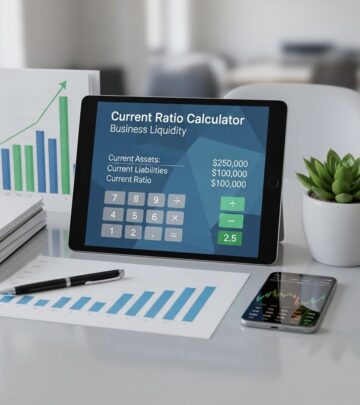
Current Ratio Formula
Current Ratio = Current Assets ÷ Current Liabilities
This fundamental metric indicates how many times a company can cover its current liabilities with current assets. A ratio of 1.5 to 3.0 is often considered healthy, depending on the industry.
Quick Ratio Formula
Quick Ratio = (Current Assets – Inventory) ÷ Current Liabilities
The quick ratio provides a more conservative measure of liquidity by excluding inventory, which may take longer to convert to cash.
Cash Conversion Cycle
The cash conversion cycle measures how efficiently a company manages current assets by calculating the time between cash outflow for inventory and cash inflow from sales. A shorter cycle indicates efficient operations, while a longer cycle may signal inefficiencies requiring attention.
Frequently Asked Questions About Current Assets
Q: How do current assets differ from fixed assets?
A: Current assets are short-term resources convertible to cash within one year, while fixed assets are long-term investments like property, equipment, and buildings that provide value over multiple years. Fixed assets depreciate over time, whereas current assets maintain their value or are consumed in operations.
Q: Why is inventory classified as a current asset?
A: Inventory is classified as a current asset because it is expected to be sold and converted into cash within the normal operating cycle, typically one year. This classification reflects the company’s intention to sell inventory in the near term as part of regular operations.
Q: What is a healthy current ratio?
A: A healthy current ratio typically ranges from 1.5 to 3.0, indicating the company has sufficient current assets to cover current liabilities. However, the ideal ratio varies by industry. A ratio below 1.0 suggests potential liquidity problems, while ratios above 3.0 may indicate underutilized assets.
Q: How do prepaid expenses affect current assets?
A: Prepaid expenses reduce future cash outflows and are recorded as current assets because they will be consumed within the current period. As time passes, these are expensed on the income statement, reducing the current asset balance. This accounting treatment matches expenses with the periods in which services are received.
Q: Can accounts receivable become a liability?
A: Accounts receivable remain an asset until collected or written off as uncollectible. If a customer disputes an invoice or the company must reverse a sale, accounts receivable would decrease. However, the debt doesn’t become a liability unless the company owes money to creditors or customers for returned goods.
Q: How do seasonal businesses manage current assets?
A: Seasonal businesses maintain higher inventory levels before peak seasons and draw down inventory afterward. They often secure lines of credit or revolving credit facilities to manage cash flow fluctuations. Careful cash flow forecasting helps these businesses maintain adequate current assets throughout the year.
Conclusion
Current assets represent the most accessible and immediately useful portion of a company’s resource base. Understanding their composition, calculating relevant liquidity ratios, and monitoring their trends are essential practices for investors, creditors, and business managers. By carefully managing current assets and maintaining healthy working capital, companies ensure operational continuity, financial stability, and the ability to capitalize on growth opportunities. Whether analyzing a potential investment or assessing creditworthiness, current assets provide fundamental insights into financial health and operational efficiency.
References
- Financial Accounting Standards Board (FASB) – Accounting Standards Codification (ASC) 210: Balance Sheet — FASB. 2024. https://www.fasb.org/
- International Accounting Standards Board (IASB) – IAS 1: Presentation of Financial Statements — IASB. 2024. https://www.ifrs.org/
- U.S. Securities and Exchange Commission – Forms and Filings — SEC.gov. 2024. https://www.sec.gov/cgi-bin/browse-edgar
- Corporate Finance Institute – Working Capital and Liquidity Analysis — CFI. 2024. https://corporatefinanceinstitute.com/
- Journal of Financial Analysis – Current Asset Management and Business Performance — Peer-reviewed research. 2023. https://www.jstor.org/
Similar Articles








Read full bio of Sneha Tete