Currency Trading Basics: A Beginner’s Guide
Master the fundamentals of forex trading and start your currency market journey today.
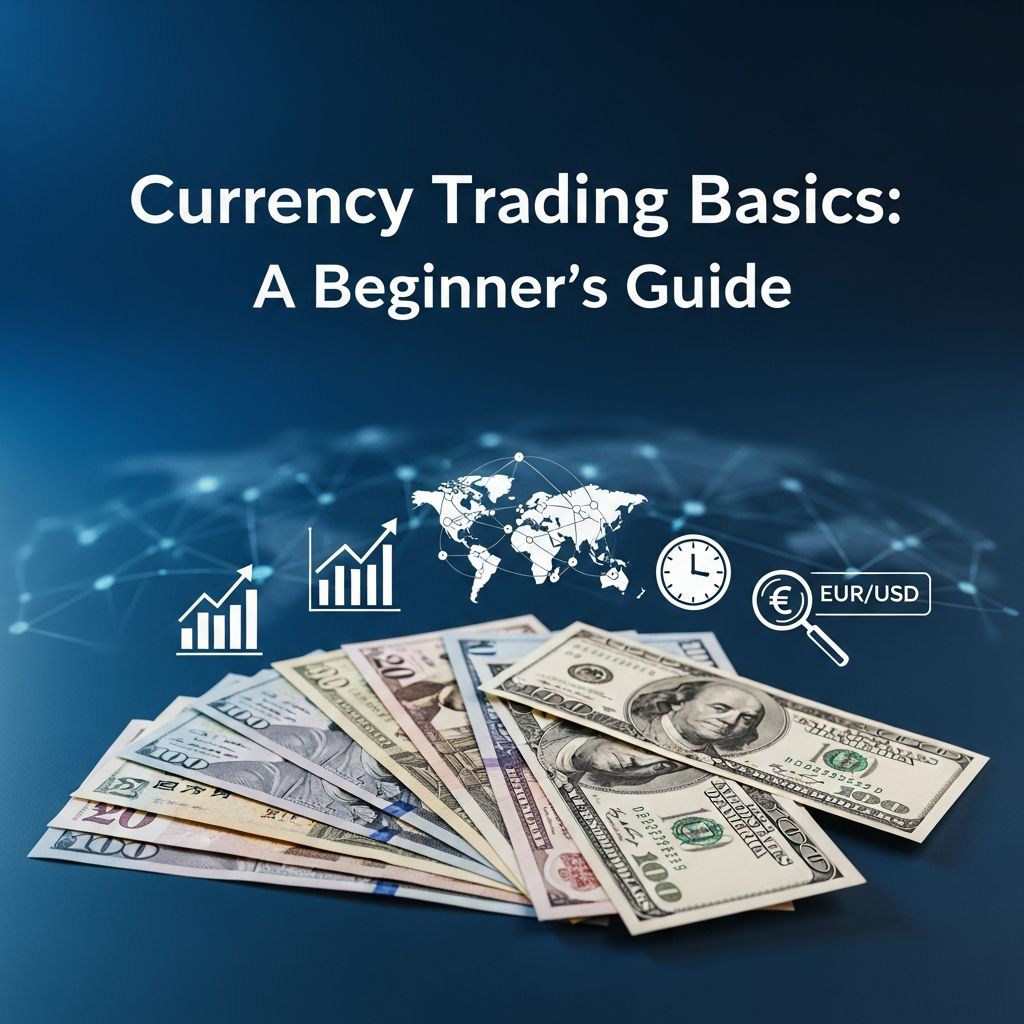
Currency trading, also known as forex (FX) trading, represents one of the largest and most liquid financial markets in the world. With trillions of dollars exchanged daily, the foreign exchange market offers unique opportunities for traders looking to diversify their investment portfolios. Understanding the fundamentals of currency trading is essential before entering this dynamic and fast-paced market.
What is Currency Trading?
Currency trading involves the simultaneous purchase of one currency and sale of another. Unlike stock markets, which operate during specific hours, the forex market operates 24 hours a day, five days a week across major financial centers including Tokyo, London, and New York. This continuous operation means that opportunities exist around the clock for traders worldwide.
The primary purpose of currency trading extends beyond speculation. Businesses engage in forex trading to convert revenues from international operations, hedge against currency fluctuations, and manage their global financial risks. Central banks also participate in currency markets to influence monetary policy and stabilize their national currencies.
Understanding Currency Pairs
In currency trading, currencies are always quoted in pairs. The first currency in the pair is called the base currency, while the second is the quote currency. For example, in the EUR/USD pair, the euro is the base currency and the U.S. dollar is the quote currency. The exchange rate represents how much of the quote currency is needed to purchase one unit of the base currency.
Major Currency Pairs
The forex market includes several major currency pairs that dominate trading volume and liquidity:
- EUR/USD (Euro/U.S. Dollar) – The most traded pair globally, representing the world’s two largest economies
- GBP/USD (British Pound/U.S. Dollar) – Highly liquid pair reflecting trade between the UK and United States
- USD/JPY (U.S. Dollar/Japanese Yen) – Important pair for Asian market traders and representing the world’s largest and third-largest economies
- USD/CHF (U.S. Dollar/Swiss Franc) – Known for lower volatility due to Switzerland’s stable economic and political environment
- AUD/USD (Australian Dollar/U.S. Dollar) – Reflects commodity prices and Asian economic development
- USD/CAD (U.S. Dollar/Canadian Dollar) – Closely tied to commodity markets and North American trade
Major pairs typically offer the tightest spreads (the difference between bid and ask prices) and the highest liquidity, making them ideal for beginning traders.
How the Forex Market Works
The forex market operates as a decentralized network of financial institutions, banks, brokers, and individual traders. Unlike stock exchanges, there is no central physical location; instead, trading occurs electronically over-the-counter (OTC). Prices are determined by supply and demand dynamics, with factors such as interest rates, economic data, geopolitical events, and market sentiment influencing currency valuations.
Market Participants
Several key participants drive the forex market:
- Central Banks – Intervene to stabilize or influence their national currency values
- Commercial and Investment Banks – Account for the largest portion of daily trading volume
- Hedge Funds and Asset Managers – Trade currencies for portfolio diversification and speculation
- Corporations – Engage in forex trading for business operations and risk management
- Retail Traders – Individual investors trading through brokers
Reading and Interpreting Exchange Rates
Exchange rates are quoted with two prices: the bid price (what buyers will pay) and the ask price (what sellers want). The difference between these prices is called the spread. For example, if EUR/USD is quoted as 1.1050/1.1052, the bid price is 1.1050 and the ask price is 1.1052.
Understanding pip movement is crucial in currency trading. A pip (percentage in point) represents the smallest price movement in a currency pair. For most major pairs, one pip equals 0.0001, though for JPY pairs, one pip equals 0.01. Profitable forex trading often depends on managing small pip movements effectively.
Key Factors Affecting Currency Values
Currency values fluctuate based on numerous economic and political factors. Understanding these drivers helps traders make informed decisions:
Interest Rate Differentials
Central banks’ interest rate decisions significantly impact currency values. Higher interest rates typically strengthen a currency by attracting foreign investment seeking better returns. Conversely, lower rates may weaken a currency as investors seek opportunities elsewhere.
Economic Data
Key economic indicators influence currency movements:
- Gross Domestic Product (GDP) growth rates
- Inflation and consumer price indices
- Employment data and unemployment rates
- Trade balances and current account deficits or surpluses
- Consumer confidence and purchasing data
Geopolitical Events
Political instability, election results, and international conflicts can cause significant currency volatility. Traders often seek safe-haven currencies like the U.S. dollar and Swiss franc during uncertain times.
Market Sentiment
Investor psychology and risk appetite dramatically affect currency prices. During risk-on periods, investors favor higher-yielding currencies, while risk-off sentiment drives demand for stable, low-yielding currencies.
Basic Currency Trading Strategies
Trend Trading
Trend traders identify and follow established price directions. They buy currencies in uptrends and sell in downtrends, using technical analysis tools like moving averages and trendlines to identify entry and exit points.
Range Trading
This strategy involves identifying price support and resistance levels. Traders buy at support levels and sell at resistance, capitalizing on price oscillations within defined ranges.
Carry Trading
Carry traders borrow in low-interest-rate currencies and invest in high-interest-rate currencies, profiting from the interest rate differential. While potentially profitable, this strategy carries significant risks during market volatility.
News Trading
News traders capitalize on price movements triggered by economic announcements and data releases. This requires quick reactions and strict risk management due to the rapid price movements that often occur.
Risk Management in Currency Trading
Effective risk management is essential for long-term success in forex trading. Several key principles should guide your trading approach:
Position Sizing
Never risk more than a small percentage of your trading capital on a single trade. Professional traders typically risk 1-2% of their account per trade, limiting potential losses while allowing for capital preservation and compounding gains.
Stop-Loss Orders
Always use stop-loss orders to limit potential losses. These orders automatically close positions when prices reach predetermined levels, protecting capital from unexpected market movements.
Take-Profit Orders
Establish profit targets before entering trades. Taking profits at predetermined levels helps lock in gains and prevents emotional decision-making.
Diversification
Avoid concentrating all capital on a single currency pair. Trading multiple pairs with different characteristics reduces overall portfolio risk.
Getting Started with Currency Trading
Choose a Reputable Broker
Select a regulated forex broker offering competitive spreads, reliable platforms, and quality customer support. Ensure the broker is registered with appropriate financial regulatory authorities in your country.
Open a Demo Account
Most brokers offer demo accounts with virtual funds, allowing you to practice trading without risking real money. Use this period to familiarize yourself with trading platforms and test strategies.
Develop Your Trading Plan
Create a comprehensive trading plan outlining your goals, risk tolerance, preferred trading style, and specific entry/exit criteria. A well-defined plan keeps you disciplined and emotional trading to a minimum.
Start Small
Begin with small position sizes while learning the market. As your experience and confidence grow, gradually increase your position sizes. Remember that consistent, small profits build wealth over time.
Common Mistakes to Avoid
Beginning traders often make predictable mistakes that can be avoided with proper knowledge:
- Over-leveraging – Using excessive leverage amplifies losses as well as gains
- Emotional trading – Making decisions based on fear or greed rather than analysis
- Ignoring risk management – Failing to use stop-losses or proper position sizing
- Overtrading – Entering too many trades and reducing profitability due to excessive costs
- Trading illiquid pairs – Currency pairs with low volume can have large spreads and slippage
- News trading without preparation – Expecting to profit from announcements without a clear strategy
The Role of Leverage in Currency Trading
Leverage allows traders to control large positions with relatively small capital amounts. While leverage can amplify profits, it equally amplifies losses. A trader with 100:1 leverage can control $100,000 worth of currency with only $1,000 of capital. Understanding and respecting leverage limits is crucial for risk management.
Most regulatory bodies now restrict leverage available to retail traders to reduce the risk of catastrophic losses. Typical limits range from 20:1 to 50:1 for major pairs, though institutional traders may access higher levels.
Technical and Fundamental Analysis
Successful currency traders typically employ both technical and fundamental analysis. Technical analysis involves studying price charts and patterns to identify trading opportunities, while fundamental analysis examines economic indicators and news events affecting currency values.
Many profitable traders combine both approaches, using fundamental analysis to identify which currency pairs to trade and technical analysis to determine optimal entry and exit points.
Frequently Asked Questions
Q: What is the minimum amount needed to start currency trading?
A: While some brokers allow accounts with as little as $100-$500, most professionals recommend starting with at least $1,000-$5,000. This provides sufficient capital to implement proper risk management principles without excessive pressure.
Q: Can I make a full-time income from currency trading?
A: Yes, but it requires dedication, education, and substantial experience. Most successful full-time traders spend years developing their skills and strategies before achieving consistent profitability. Starting part-time while maintaining other income is advisable.
Q: What are the best hours to trade forex?
A: The forex market is most active during overlapping trading sessions. The London-New York overlap (8 AM-12 PM GMT) typically offers the highest volatility and volume, making it popular among traders. However, the best trading hours depend on your preferred currency pairs and strategy.
Q: How much can I realistically earn from currency trading?
A: Returns vary widely based on experience, strategy, and risk management. Professional traders aim for consistent monthly returns of 5-20%, though some achieve higher returns. Beginners should focus on learning and capital preservation rather than maximizing immediate returns.
Q: Is currency trading suitable for beginners?
A: Currency trading can be suitable for beginners with proper education and risk management. However, it requires significant time investment in learning, discipline in following trading rules, and emotional control during losses. Many beginners find success by starting small and gradually building experience.
Q: What tools do I need to start currency trading?
A: Essential tools include a regulated trading platform, charting software, economic calendars for tracking news releases, and risk management tools like stop-loss orders. Most brokers provide these tools as part of their trading platforms.
References
- Foreign Exchange Spot Market Turnover — Bank for International Settlements. 2022-10-12. https://www.bis.org/statistics/rpfx19.htm
- Investor Bulletin: Forex Trading — U.S. Securities and Exchange Commission (SEC). 2024-03-15. https://www.sec.gov/oiea/investor-alerts-and-bulletins/ib_forex-trading
- Understanding Leverage in Forex Trading — Financial Conduct Authority (FCA). 2023-06-20. https://www.fca.org.uk/consumers/consumer-protection
- International Organization of Securities Commissions Guidance on Foreign Exchange Trading — IOSCO. 2022-05-14. https://www.iosco.org
- Central Bank Foreign Exchange Operations — International Monetary Fund (IMF). 2023-09-08. https://www.imf.org/external/index.htm
Similar Articles








Read full bio of Sneha Tete