Credit Unions vs. Banks: Choosing the Right Place for Your Money
Compare credit unions and banks on safety, rates, fees, convenience and service so you can choose the best home for your money.
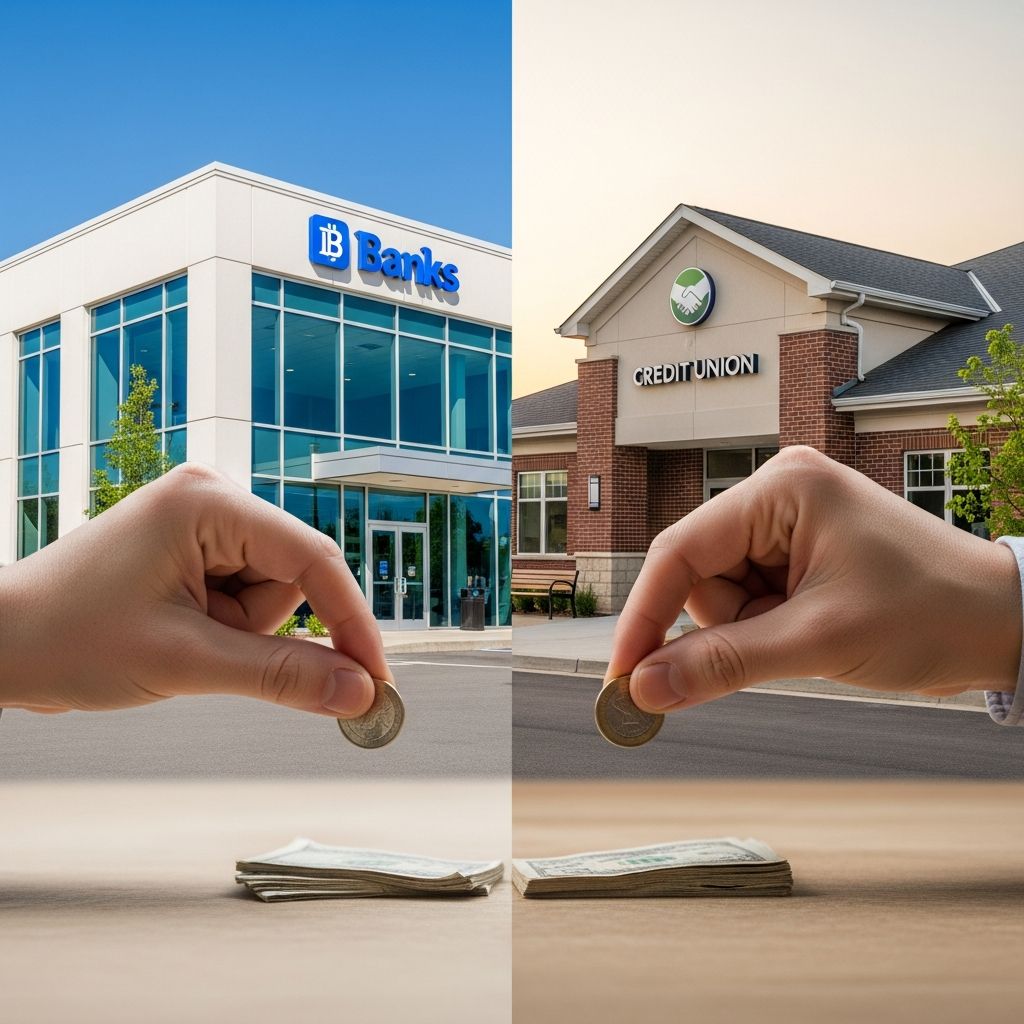
Credit Unions vs. Banks: How to Decide Where to Keep Your Money
When you need a place to store your cash, get a debit card, or borrow for a home or car, you usually end up choosing between a credit union and a bank. Both types of financial institutions offer checking, savings, and loans, but they operate very differently. Understanding those differences can help you get better rates, pay fewer fees, and enjoy service that fits your needs.
This guide explains how credit unions and banks compare on ownership and purpose, safety of deposits, interest rates, fees, access and convenience, and customer service, as well as which option may be better for different kinds of customers.
What Are Credit Unions and Banks?
Banks and credit unions provide similar core services: checking and savings accounts, debit cards, ATMs, and loans for cars, homes, and other needs. They differ mainly in who owns them and what they are trying to achieve.
What Is a Bank?
A bank is typically a for-profit corporation owned by shareholders. Profits are paid out to those shareholders, not directly to customers.
- Goal: Maximize profits for shareholders.
- Ownership: Public or private investors, not customers.
- Scope: Can be local, regional, national, or global.
- Taxes: Pay federal and state corporate income taxes.
What Is a Credit Union?
A credit union is a not-for-profit, member-owned cooperative. When you open an account, you usually buy a small ownership share and become a member.
- Goal: Benefit the membership, not outside investors.
- Ownership: Members collectively own the institution.
- Profits: Returned to members as lower loan rates, higher savings yields, and lower fees.
- Taxes: Generally exempt from federal income tax because of their not-for-profit status.
Because of this structure, research shows that credit union members collectively save money each year through better pricing than banks on similar products.
Similarities Between Credit Unions and Banks
Despite their different structures, banks and credit unions overlap in many ways.
- Offer core accounts: checking, savings, money market accounts, and certificates of deposit (or share certificates at credit unions).
- Provide consumer loans: auto loans, personal loans, credit cards, and mortgages.
- Offer both in-branch and digital services: online banking, mobile apps, electronic statements, and electronic transfers.
- Serve individuals and, often, small businesses as well.
- Are regulated and supervised to protect consumers.
For everyday banking tasks—using a debit card, making a mobile deposit, or paying a bill online—the experience at a modern credit union can look very similar to that at a bank.
Key Differences: Credit Unions vs. Banks
The most important differences show up in who owns the institution, how profits are used, and what that means for pricing and service.
| Feature | Credit Unions | Banks |
|---|---|---|
| Ownership & Structure | Not-for-profit, member-owned cooperative | For-profit, shareholder-owned corporation |
| Primary Goal | Benefit members (better rates/fees) | Maximize profit for shareholders |
| Use of Profits | Returned to members via pricing and services | Paid as dividends to investors |
| Tax Status | Generally exempt from federal income tax | Pays corporate taxes on profits |
| Deposit Insurance | NCUA insurance up to $250,000 per depositor | FDIC insurance up to $250,000 per depositor |
| Interest on Savings | Often higher yields on savings and CDs | Often lower yields, especially at large banks |
| Loan Rates | Usually lower loan and credit card rates | Often higher, especially at big banks |
| Fees | Typically fewer and lower fees | More and higher fees common at many banks |
| Branch & ATM Access | Fewer branches, but large shared ATM networks | More proprietary branches and ATMs, especially large banks |
| Technology | Competitive online and mobile tools at many credit unions | Large banks often lead in cutting-edge tech and integrations |
| Decision-Making | Local, member-focused decisions and flexibility | More standardized, policy-driven decisions |
Safety of Your Money
For most consumers, deposits at both banks and credit unions are equally safe, as long as the institution is federally insured.
Federal Deposit Insurance
- Banks: Insured by the Federal Deposit Insurance Corporation (FDIC) up to $250,000 per depositor, per insured bank, per ownership category.
- Credit Unions: Insured by the National Credit Union Administration (NCUA), through the National Credit Union Share Insurance Fund, with the same $250,000 coverage limit.
FDIC and NCUA are both backed by the full faith and credit of the U.S. government, and no insured depositor has ever lost a penny in a covered account due to an institution failure.
Rates: Savings and Loans
Pricing is one of the main reasons many consumers consider switching to a credit union.
Savings and Deposit Rates
Because credit unions do not have to generate profit for outside shareholders and benefit from tax advantages, they often pay higher yields on savings accounts and certificates.
- Credit unions often offer more competitive annual percentage yields (APYs) on savings, money market accounts, and share certificates.
- Banks, particularly large traditional banks, frequently pay much lower rates on standard savings accounts.
Loan and Credit Card Rates
For borrowers, credit unions typically provide lower rates on loans than many banks, especially on consumer lending products.
- Auto loans, personal loans, and credit cards often carry lower APRs at credit unions.
- Mortgages from credit unions can also be competitively priced, although banks (especially large lenders) may offer more specialized loan types or promotional programs.
Independent surveys consistently find that the average interest rate on loans is lower and the average yield on deposits is higher at credit unions compared with banks.
Fees and Account Costs
Fees can significantly affect the real value you get from an account.
Typical Bank Fees
Many banks charge multiple recurring or usage-based fees, particularly on checking accounts and overdrafts.
- Monthly maintenance fees if you do not meet minimum balance or direct deposit requirements.
- Overdraft and non-sufficient funds (NSF) fees when your account balance goes negative.
- Out-of-network ATM fees, sometimes on top of the ATM owner’s fee.
- Wire transfer and cashier’s check fees.
Typical Credit Union Fees
Because of their member-focused mission, credit unions tend to keep fees lower and less frequent.
- Many credit unions offer free checking with no monthly maintenance fee.
- Overdraft fees are often lower, and some credit unions emphasize more forgiving overdraft policies or alternatives.
- Some credit unions reimburse ATM surcharges or participate in fee-free ATM networks.
Industry data cited by consumer finance outlets indicates that, on average, households can save meaningful amounts annually by using a credit union instead of a fee-heavy bank.
Access, Branches, and Convenience
Convenience can be just as important as pricing. Here banks and credit unions differ mostly in how they provide access.
Branches and ATMs
- Large banks often have extensive branch and ATM networks in major metropolitan areas and across multiple states.
- Credit unions are usually smaller and may have fewer physical branches, but many participate in shared branching and large fee-free ATM networks, giving members access to thousands of locations nationwide.
For many members, the combination of local branches and shared networks provides sufficient in-person access, even if the credit union itself is relatively small.
Online and Mobile Banking
Most consumers now rely heavily on digital tools. Historically, large banks were seen as more advanced in technology, but credit unions have rapidly closed that gap.
- Both banks and credit unions commonly offer mobile apps, online bill pay, e-statements, mobile check deposit, and person-to-person payments.
- Large banks may adopt cutting-edge features sooner or integrate with more third-party financial apps.
- Many credit unions now provide robust digital platforms that cover the needs of most everyday users.
Customer Service and Member Experience
Service culture is another area where many people perceive a noticeable difference.
- Credit unions often emphasize relationship-focused service and financial education, reflecting their member-owned structure and community mission.
- Banks vary widely: some offer excellent service, while others may feel more transactional or sales-driven.
- At credit unions, members can vote in board elections and have a say in governance, which can encourage policies that favor long-term member well-being.
Many credit unions invest heavily in local community initiatives, such as financial literacy programs, sponsorships, and support for local organizations.
Who Is Each Option Best For?
Neither credit unions nor banks are universally “better.” The right choice depends on your habits, location, and priorities.
Credit Unions May Be Better If You:
- Want lower loan rates and higher savings yields whenever possible.
- Prefer lower and simpler fees, especially on checking accounts and overdrafts.
- Value personalized service and a member-focused culture.
- Like supporting a local or community-based institution.
- Are comfortable joining a membership-based organization (often tied to where you live, work, study, or worship).
Banks May Be Better If You:
- Need a very large branch footprint, including nationwide or international access.
- Rely on specialized products, such as certain types of business accounts, international services, or niche lending programs.
- Prioritize cutting-edge technology and integrations with many fintech apps.
- Prefer not to deal with membership eligibility requirements or membership shares.
How to Choose Between a Credit Union and a Bank
For many people, the best solution is to evaluate both local credit unions and banks, and possibly use a combination.
Steps to Compare Options
- List your needs: everyday checking, savings, credit card, car loan, mortgage, business services, etc.
- Compare interest rates on savings, CDs, and the loans you are most likely to use.
- Review fee schedules for monthly maintenance, overdraft, and ATM usage.
- Test-drive digital tools by exploring app ratings and online banking demos.
- Visit a branch (if local) to get a feel for service and staff responsiveness.
Because accounts are relatively easy to open and close, nothing prevents you from keeping a primary checking account at a credit union for favorable fees and service, while maintaining a specialized account or card at a bank for unique features.
Frequently Asked Questions (FAQs)
Q: Are credit unions safer than banks?
A: Credit unions are not inherently safer than banks, but federally insured credit unions and banks offer similar protection. Bank deposits are insured by the FDIC, while credit union deposits are insured by the NCUA, each covering up to $250,000 per depositor, per institution, per ownership category.
Q: Do credit unions really offer better rates than banks?
A: Industry data and consumer finance research show that, on average, credit unions tend to offer higher interest rates on savings and certificates and lower rates on many common loans, thanks to their not-for-profit, member-owned structure. However, individual offers vary, and some online banks can be very competitive.
Q: Can anyone join a credit union?
A: Most credit unions have field of membership rules, which may be based on where you live, work, study, worship, or on membership in certain organizations. Many have broad eligibility criteria, so it is often easier to join than people expect.
Q: Do credit unions have good online and mobile banking?
A: Many credit unions now offer robust digital banking, including mobile check deposit, online bill pay, and person-to-person payments, and participate in large ATM networks. Large national banks may still lead in the newest features and integrations, but for typical everyday use, credit union technology is often more than sufficient.
Q: Will switching to a credit union or bank hurt my credit score?
A: Simply opening or closing a deposit account usually has little to no direct effect on your credit score. Applying for a new credit card, auto loan, or other credit product can generate a hard inquiry and affect your score slightly, regardless of whether you use a bank or a credit union.
References
- Pros and Cons of Credit Unions — Bankrate. 2024-01-08. https://www.bankrate.com/banking/credit-union-pros-and-cons/
- Credit Union vs a Bank: Features or Values? — Credit Human. 2023-10-02. https://www.credithuman.com/building-slack/credit-union-vs-a-bank-features-or-values
- Credit Unions vs. Banks: The Key Differences You Need to Know — Scott Credit Union. 2023-09-12. https://www.scu.org/credit-unions-vs-banks-the-key-differences-you-need-to-know-blog/
- How Do Credit Unions Compare to Banks? — Oklahoma Central Credit Union. 2022-08-15. https://www.oklahomacentral.creditunion/blog/how-do-credit-unions-compare-to-banks
- Credit Union Savings Accounts: Are They Safer and Smarter than Big Bank Options? — Industrial Federal Credit Union. 2023-06-20. https://www.ifcu.com/about/who-we-are/the-ifcu-blog/detail.html?title=credit-union-savings-accounts-are-they-safer-and-smarter-than-big-bank-options
- Using Data to Demonstrate the Credit Union Difference — America’s Credit Unions. 2023-11-14. https://www.americascreditunions.org/blogs/americas-credit-unions/using-data-demonstrate-credit-union-difference
Similar Articles








Read full bio of medha deb