Understanding Credit Score Declines of 20 Points
Discover the hidden reasons behind sudden credit score drops and how to recover.

A sudden decline in your credit score can be frustrating and concerning, especially when the drop is significant. When your credit score falls by approximately 20 points, it signals that something meaningful has changed in your credit profile. While minor fluctuations of a few points are entirely normal as credit bureaus update information regularly, a 20-point decrease warrants investigation. Understanding what triggers such declines is the first step toward protecting and improving your creditworthiness.
The Architecture of Credit Scoring Systems
Before diving into why scores decrease, it helps to understand how credit scoring models work. The most widely used model in the United States is FICO, which calculates scores based on five primary components. These components are weighted differently, with some factors carrying significantly more influence than others.
Payment history represents the largest component, accounting for 35% of your FICO score. This metric reflects your track record of making timely payments on all credit obligations. The amounts owed, which represents your total debt and credit utilization, comprises 30% of your score. The length of your credit history—how long you’ve had credit accounts—makes up 15%. Credit mix, referring to the variety of credit types you maintain, accounts for 10%. Finally, new credit inquiries and recently opened accounts constitute 10% of your score.
An alternative scoring model, VantageScore, uses a different weighting system. This model emphasizes payment history at 40%, places credit utilization at 20%, and considers age and credit type at 21%. Understanding these frameworks helps explain why certain actions affect your score more dramatically than others.
Payment Delays: The Primary Score Culprit
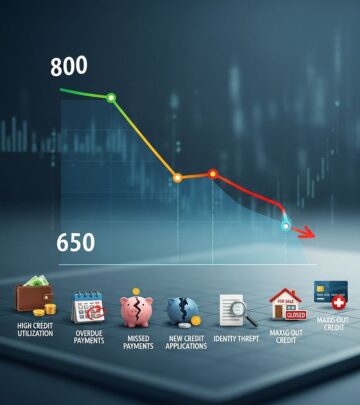
Among all the reasons your credit score might decline, missed or late payments represent one of the most impactful. Because payment history is the largest component of credit scores, even a single late payment can trigger a noticeable decrease in your score. This is particularly true if the late payment is recent, as scoring models weight recent payment behavior more heavily than older delinquencies.
A late payment occurs when you fail to make your minimum payment by the due date. The severity of the impact depends on how late the payment is. A payment that is 30 days overdue will typically have less impact than one that is 60, 90, or more days late. Additionally, if a creditor reports your late payment to the credit bureaus, the negative mark will remain on your credit report for seven years, though its impact diminishes over time.
It’s worth noting that many people don’t realize a payment is late until they receive a notification from their creditor. Setting up automatic payments or calendar reminders can help prevent these costly mistakes.
Rising Credit Card Balances and Utilization Ratios
Your credit utilization ratio—the percentage of available credit you’re currently using—is another powerful driver of credit score changes. This metric is particularly sensitive, meaning even modest increases in your balances can produce noticeable score reductions.
To calculate your credit utilization ratio, divide your total credit card balances by your total credit limits. For example, if you have a credit card with a $10,000 limit and currently carry a $4,500 balance, your utilization on that card is 45%. Credit scoring models typically view utilization ratios above 30% unfavorably, with higher ratios suggesting greater credit risk.
What makes this factor particularly important is that it can change month-to-month without you opening or closing any accounts. A single large purchase or an unexpected expense that temporarily increases your balance can push your utilization higher. Even if you pay off the balance the following month, the damage is done for that billing cycle. This is why maintaining lower balances throughout the month, rather than paying down balances only at the end of the billing cycle, can help protect your score.
Account Closures and Their Unexpected Consequences
Many people believe that closing unused credit accounts will improve their credit scores, but this assumption is incorrect. Closing an account actually can harm your credit in multiple ways. First, closing an account reduces the total amount of credit available to you, which increases your overall credit utilization ratio even if your balances remain unchanged. Second, closing an account decreases the average age of your accounts, and longer credit history is viewed favorably by lenders.
If the account you closed was one of your oldest, the negative impact may be more pronounced. Lenders appreciate seeing a long track record of responsible credit management, and removing an old account eliminates evidence of your historical payment reliability.
The Paradox of Paying Off Installment Loans
While it seems counterintuitive, paying off an installment loan—such as a mortgage, car loan, or student loan—can temporarily reduce your credit score. This occurs because paying off these loans removes an account from your credit profile, thereby reducing the diversity of your credit mix.
Credit scoring models reward having both revolving credit (credit cards) and installment loans active on your account simultaneously. When you pay off an installment loan, you lose that diversity, which can result in a temporary score decrease. However, this decline is typically modest and temporary. Within a few months, as other positive credit behaviors accumulate, your score should recover and likely improve beyond where it was before the payoff.
The silver line is that paying off debt is still the right financial decision. The temporary score dip shouldn’t discourage you from eliminating loans, especially if you’re paying interest. The long-term benefits of being debt-free far outweigh a brief, modest credit score reduction.
New Credit Applications and Hard Inquiries
Whenever you apply for a new credit card, auto loan, mortgage, or other financing, lenders typically perform a hard inquiry into your credit report. Each hard inquiry can lower your score by a few points. While a single inquiry usually has minimal impact, applying for multiple credit products within a short timeframe can produce a more noticeable decline.
Additionally, when you’re approved for new credit and open a new account, your score may decrease further. This happens because new accounts lower the average age of your credit history and add to your overall credit utilization if they carry balances. However, these effects are temporary, and your score should begin recovering within several months as the account seasons and the inquiry ages.
Credit Report Errors and Fraudulent Activity
Sometimes credit score declines result from factors completely outside your control. Errors on your credit report—whether from identity theft, creditor mistakes, or data entry errors—can significantly damage your score. Common errors include incorrect account information, accounts listed multiple times, misreported payment statuses, and balances attributed to you in error.
If you suspect fraudulent activity or errors on your report, federal law grants you the right to dispute inaccurate information with the credit bureaus and creditors at no cost. The bureaus and creditors are required to investigate disputes and correct confirmed inaccuracies immediately. Checking your credit reports from all three bureaus (Equifax, Experian, and TransUnion) annually is a prudent step toward catching and correcting such errors early.
Co-Signing Obligations and Their Impact
If you’ve co-signed a loan or credit card for someone else, their credit behavior directly affects your credit score. Should the person you co-signed for miss a payment or accumulate a large balance, both of your credit scores can suffer. This happens because creditors view co-signers as equally responsible for the debt. Before agreeing to co-sign, carefully consider the financial reliability of the borrower and your willingness to assume their debt obligations.
Timeline for Credit Score Recovery
After experiencing a 20-point or larger drop, you may wonder how quickly your score will rebound. The recovery timeline depends on the cause of the decline. For factors like hard inquiries, the impact diminishes after about 12 months. For late payments, the negative effect lessens over time but remains on your report for seven years.
If your score dropped due to a large payment you made or a balance you paid down, wait 30 to 45 days before checking your score again. This timeframe allows the payment to be reported by your card issuer and your credit profile to update. In many cases, your score will begin improving during this period.
Actionable Steps to Address Score Declines
Once you’ve identified the reason for your score decline, take steps to reverse the damage. Prioritize making all payments on time, as this is the most important factor. Set up automatic payments if you struggle to remember due dates. Work to lower your credit utilization by paying down balances, particularly on high-balance cards. Avoid opening new accounts unless absolutely necessary, and refrain from closing old accounts, especially those with positive payment histories. Finally, regularly monitor your credit reports and dispute any errors you find.
FAQ
How quickly does a credit score drop after a missed payment?
A missed payment can negatively impact your score within one or two billing cycles, depending on when the creditor reports it to the bureaus. The impact is typically immediate once the report is filed.
Can I improve my score within 30 days?
While modest improvements may occur within 30 days, meaningful recovery typically takes several months. Consistent positive behavior over time produces the best results.
Does checking my own credit report hurt my score?
No. Checking your own credit report is a soft inquiry and does not affect your score. Only hard inquiries from creditors impact your score.
What should I do if I find an error on my credit report?
Dispute the error with the credit bureau and the creditor reporting the information. By law, they must investigate your dispute free of charge and correct confirmed inaccuracies.
How long does a 20-point drop stay on my credit report?
The duration depends on the cause. Hard inquiries age off after 12 months, while late payments remain for seven years but impact your score less as they age. Accurate positive information remains indefinitely.
References
- 7 Reasons Your Credit Score Suddenly Dropped — Arizona Central Credit Union. 2024. https://www.azcentralcu.org/blog/sudden-credit-score-drop/
- Why Did My Credit Score Drop by 20 Points? — Experian. 2024. https://www.experian.com/blogs/ask-experian/why-did-my-credit-score-decrease-by-20-points/
- Why Did My Credit Score Drop 20 Points for No Reason? — SoFi. 2024. https://www.sofi.com/learn/content/why-did-my-credit-score-drop-20-points-for-no-reason/
- Why Did My Credit Score Drop? — Intuit Credit Karma. 2024. https://www.creditkarma.com/credit/i/credit-score-drop
- Why Did My Credit Score Drop for No Reason? — NerdWallet. 2024. https://www.nerdwallet.com/finance/learn/why-did-my-credit-score-drop
Similar Articles








Read full bio of medha deb