Credit Inquiries and Loan Applications: Impact on Scores
Understand how loan inquiries affect your credit and smart strategies to minimize damage.
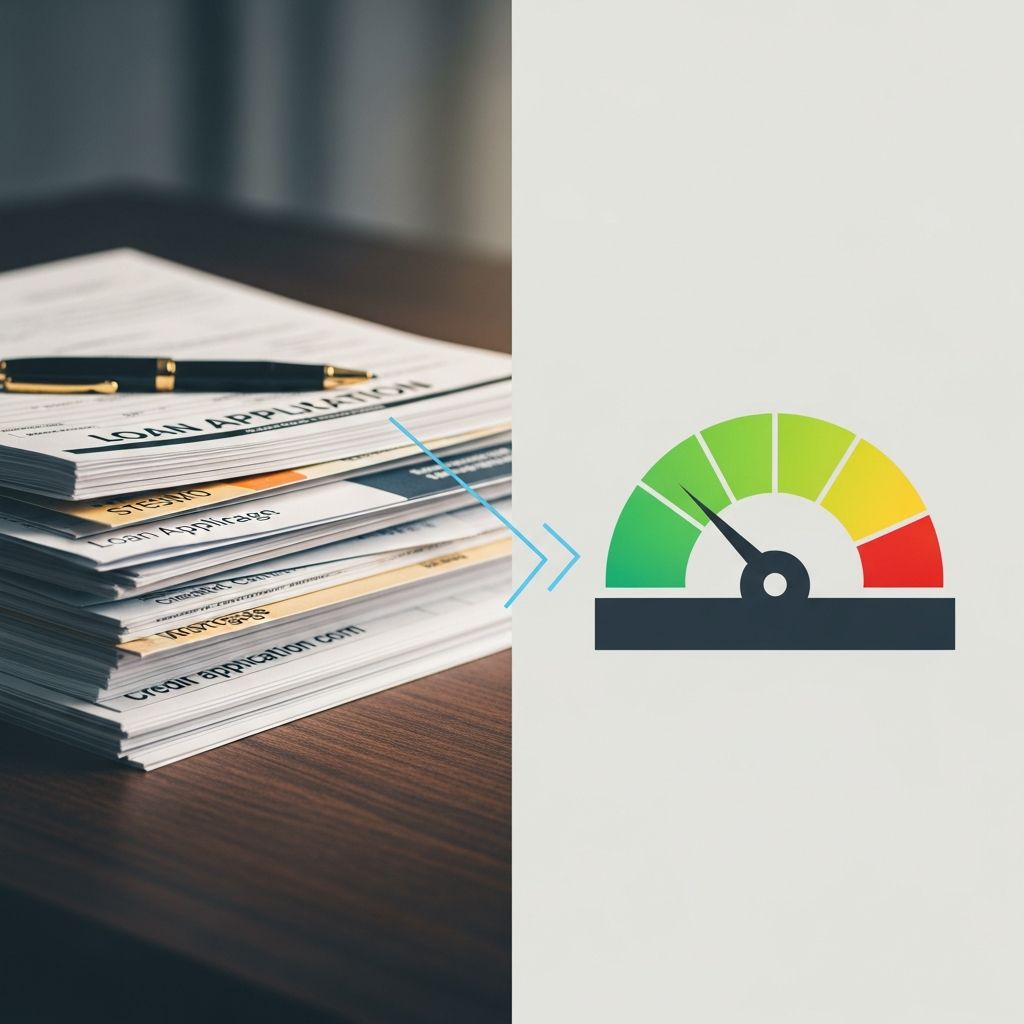
When you apply for a loan, lenders request your credit report to evaluate your creditworthiness. This request, known as a credit inquiry, leaves a mark on your credit profile that can influence your credit score. Understanding the mechanics of how these inquiries work—and crucially, how multiple inquiries might compound their effects—is essential for anyone planning to borrow money. The relationship between loan applications and credit scores is more nuanced than many people realize, with different rules applying depending on the type of loan and the credit scoring model used to calculate your score.
Understanding Credit Inquiries and Their Mechanics
A credit inquiry represents a documented instance when a credit bureau generated and transmitted your credit report to a third party. Not all inquiries function identically; the credit industry distinguishes between two fundamental categories based on their origin and purpose. Each type carries different weight in the credit-scoring equation, and understanding this distinction is crucial for managing your creditworthiness effectively.
When you actively request credit—whether for a mortgage, auto loan, personal loan, or credit card—the lender typically performs what’s called a hard inquiry. These inquiries appear on your credit report and are visible to other potential creditors. Research has demonstrated that individuals applying for multiple new accounts simultaneously may represent a higher risk for missed payments, which is why credit scoring models penalize multiple hard inquiries. A single hard inquiry typically reduces your FICO Score by fewer than five points, though VantageScore models may see reductions of five to ten points. However, these negative effects generally diminish within a few months.
Conversely, soft inquiries occur when you check your own credit, employers conduct background checks, or companies prequalify you for offers without your explicit application. These inquiries never appear on the version of your credit report that lenders see and have zero impact on your credit scores.
The Cumulative Effect of Multiple Hard Inquiries
While a single hard inquiry causes minimal damage to your credit profile, the situation changes dramatically when you apply for multiple loans in rapid succession. Each application can trigger its own hard inquiry, and without intelligent timing, these inquiries accumulate quickly. The cumulative impact becomes progressively more significant; whereas one inquiry might reduce your score by a few points, multiple inquiries occurring over a condensed timeframe could depress your score by ten or more points with each additional inquiry.
Statistics reveal the severity of excessive inquiries: individuals with six or more recent hard inquiries are eight times more likely to file for bankruptcy than those with none. This correlation isn’t merely coincidental—it reflects the reality that people desperately applying for credit across multiple sources often face genuine financial distress. This is precisely why credit scoring algorithms treat accumulating inquiries as warning signals.
The timing of your applications directly influences the total damage to your score. Submitting applications for different loan types on different dates compounds the problem because each inquiry gets counted separately in many scenarios. Strategic timing, by contrast, can minimize this damage significantly.
Rate Shopping Windows: Your Strategic Advantage
Credit scoring companies recognize that rational consumers shop around for the best interest rates before making major purchases. Applying for a mortgage or auto loan with multiple lenders is sensible financial behavior, not reckless borrowing. To accommodate this legitimate shopping pattern, FICO and VantageScore have incorporated special rules that group multiple inquiries into single entries under specific conditions.
The FICO Approach: FICO’s deduplication system functions differently depending on the loan category. For auto loans, mortgages, and student loans specifically, multiple inquiries within a 45-day window typically count as a single inquiry for scoring purposes. Additionally, FICO ignores all inquiries for these three loan categories that occurred within the previous 30 days when calculating your score. This 30-day buffer provides substantial protection for active shoppers. However, this favorable treatment only applies to these three loan types; credit card applications and personal loans receive no such grouping benefit and each generates its own separate inquiry.
Older FICO models still used by some mortgage lenders employ a 15-day window instead of 45 days, so precise timing becomes even more critical in those scenarios. Furthermore, the grouping only applies within each category—if you apply for three auto loans and two mortgages, FICO counts that as two inquiries, not five.
The VantageScore Approach: VantageScore operates under a simpler, more generous framework. Any hard inquiries occurring within a 14-day rolling period are deduplicated and counted as a single inquiry, regardless of loan type. This means you could apply for auto loans, mortgages, student loans, and credit cards all within two weeks and potentially have them all count as one inquiry. VantageScore offers no 30-day buffer period, however, so inquiries outside that 14-day window count individually.
Strategic Timing for Different Loan Types
Optimal application strategy varies depending on which types of loans you’re pursuing:
- Same Loan Type Shopping: If you’re applying for auto loans exclusively, cluster your applications within 14 days (to maximize VantageScore benefits) or 45 days (for FICO advantages). This approach ensures maximum grouping benefits regardless of which scoring model lenders use.
- Multiple Loan Types: If you need both an auto loan and a mortgage, apply for both within 14 days to benefit from VantageScore’s broader deduplication, then space any other applications beyond the 45-day window to avoid triggering additional inquiries on FICO models.
- Personal Loans and Credit Cards: These applications don’t receive deduplication benefits, so space them out beyond the 45-day window whenever possible to minimize their impact on your overall score.
What Happens When Applications Are Denied?
A common misconception suggests that denied applications spare you from inquiry damage. This is incorrect. Whether a lender approves or denies your application, they’ve already conducted the hard inquiry, which appears on your credit report and negatively impacts your score. The denial itself doesn’t appear on your credit report, but the inquiry remains permanent. This distinction is crucial: the hard inquiry happens at the moment the lender accesses your credit, not contingent on approval status. Consequently, applying repeatedly for loans you likely won’t qualify for compounds your credit damage without generating any corresponding credit benefit.
Who Should Worry About Inquiry Accumulation?
Not every borrower faces significant consequences from multiple inquiries. Financial experts identify specific scenarios where inquiry impact becomes genuinely concerning:
- Individuals spending several months shopping for mortgage or auto financing across numerous lenders
- Consumers simultaneously shopping for multiple unrelated credit products (such as both a personal loan and several credit cards in the same year)
- Applicants who know their credit profile barely qualifies for their desired borrowing amount, where even minor score reductions might trigger denial
For most borrowers with established credit histories and reasonable scores, the inquiry impact proves manageable. Those with weak credit profiles or scores hovering near qualification thresholds must exercise greater caution.
Practical Steps to Minimize Inquiry Damage
Strategic planning allows you to access credit competitively while protecting your score:
- Consolidate Your Shopping: Complete all rate shopping for a specific loan type within a single 14-day period, maximizing the VantageScore deduplication benefit while ensuring favorable FICO treatment.
- Check Your Credit First: Obtain your free credit reports from all three bureaus at AnnualCreditReport.com before applying anywhere. Soft inquiries don’t harm your score but provide valuable information about your profile that lenders will see.
- Get Prequalified: Many lenders offer prequalification services using soft inquiries, allowing you to assess your likely approval status and interest rates before committing to hard inquiries.
- Understand Your Current Score: Use free credit score tools to establish your baseline, then carefully plan applications. If your score sits dangerously close to qualification thresholds, minimize unnecessary inquiries.
- Space Out Different Loan Types: If you’re not rate shopping but instead applying for different credit products, separate these applications by 45+ days when possible to avoid triggering multiple inquiries.
Long-Term Inquiry Visibility
Hard inquiries remain visible on your credit report for approximately two years, though their scoring impact diminishes substantially after the first few months. VantageScore models may extend inquiry impact up to 24 months, particularly for consumers with limited credit history. This extended timeline means inquiries from six months ago still appear on your report but influence your score minimally compared to recent inquiries.
The Broader Context: Inquiries as One Factor Among Many
While hard inquiries matter, they represent just one component of your overall credit score. Your payment history (35%), amounts owed (30%), length of credit history (15%), and credit mix (10%) collectively outweigh the impact of new inquiries (10%) in determining your FICO Score. This composition means that even several hard inquiries matter far less than maintaining perfect payment records or keeping credit card balances low. Focus your primary energy on these more influential factors; inquiry management matters, but it’s secondary to credit fundamentals.
Frequently Asked Questions
Can I apply for multiple loans without damaging my credit?
Yes, if you apply strategically. Rate shopping within 14-45 days for the same loan type typically results in all inquiries counting as one, minimizing score impact. Different loan types receive different treatment, so timing varies.
How long do hard inquiries stay on my credit report?
Hard inquiries remain visible for approximately two years, though their scoring impact diminishes significantly after the first few months. The inquiry doesn’t disappear but becomes progressively less influential.
Will applying for pre-approval hurt my score?
If the pre-approval uses a soft inquiry, your score won’t be affected at all. Many lenders offer soft-inquiry prequalification. Always ask specifically whether they’re using a hard or soft inquiry before providing authorization.
Is there a maximum number of loan applications I should make?
While technically you can apply for as many loans as you wish, having six or more hard inquiries significantly increases lender concern about your financial stability. Focus on strategic rate shopping within appropriate time windows rather than applying broadly.
References
- Do Multiple Loan Inquiries Affect Your Credit Score? — Experian. Accessed March 31, 2026. https://www.experian.com/blogs/ask-experian/do-multiple-loan-inquiries-affect-your-credit-score/
- Does Applying for Multiple Loans Hurt Your Credit Score? — American Express. Accessed March 31, 2026. https://www.americanexpress.com/en-us/credit-cards/credit-intel/does-applying-for-multiple-loans-affect-your-credit-score/
- Understanding Hard Inquiries on Your Credit Report — Equifax. Accessed March 31, 2026. https://www.equifax.com/personal/education/credit/report/articles/-/learn/understanding-hard-inquiries-on-your-credit-report/
- Will Multiple Credit Inquiries Hurt My Score? — InCharge Debt Solutions. Accessed March 31, 2026. https://www.incharge.org/debt-relief/credit-counseling/credit-score-and-credit-report/will-multiple-credit-inquiries-hurt-my-score/
- How Many Points Does a Hard Inquiry Affect My Credit Score? — Nav. Accessed March 31, 2026. https://www.nav.com/blog/how-many-points-does-a-hard-inquiry-affect-credit-my-credit-score-188062/
- How Many Hard Credit Inquiries Are Too Many? — Chase Bank. Accessed March 31, 2026. https://www.chase.com/personal/credit-cards/education/credit-score/how-many-hard-credit-inquires-are-too-many
- What kind of credit inquiry has no effect on my credit score? — Consumer Finance Protection Bureau. Accessed March 31, 2026. https://www.consumerfinance.gov/ask-cfpb/what-kind-of-credit-inquiry-has-no-effect-on-my-credit-score-en-321/
Similar Articles








Read full bio of medha deb