Credit Default Swap: Definition, How It Works, and Risks
Understand credit default swaps: Insurance-like contracts protecting against borrower default and credit risk.
What Is a Credit Default Swap?
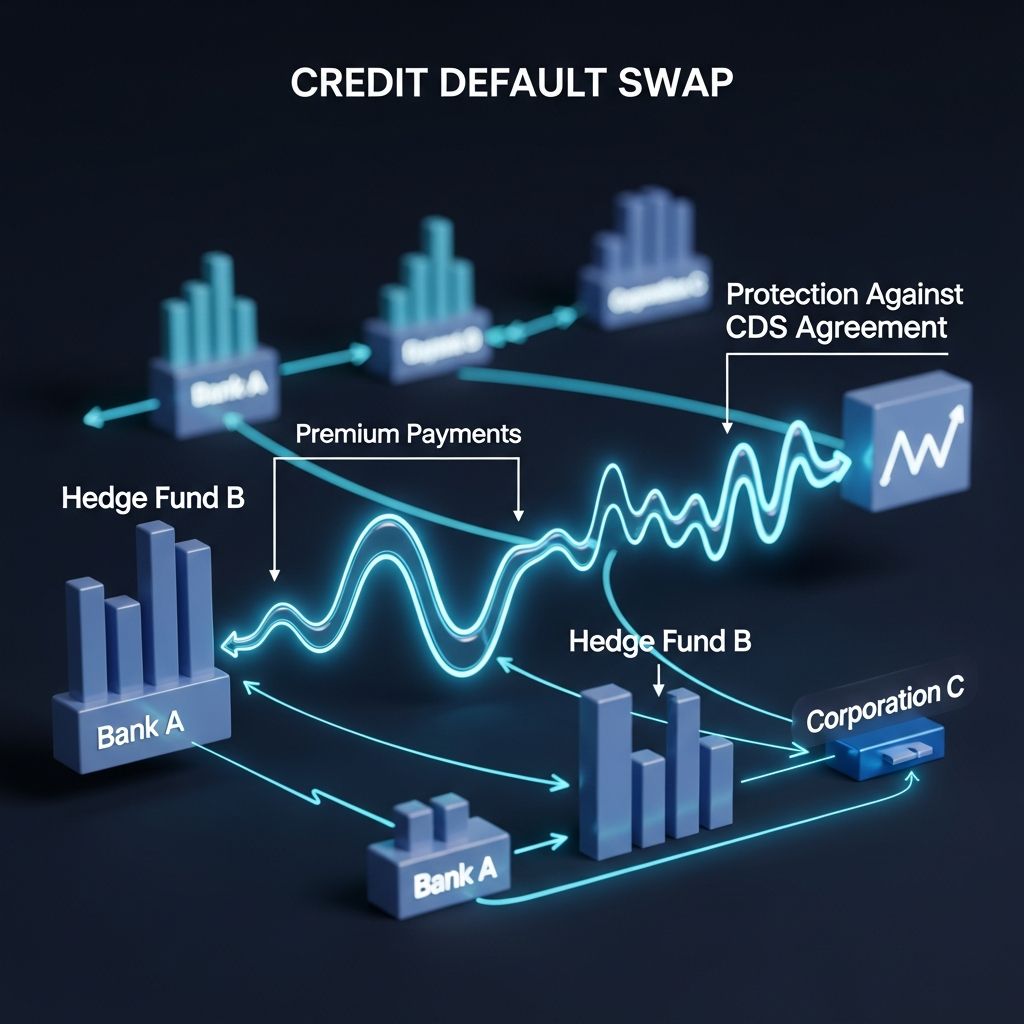
A credit default swap (CDS) is a type of credit derivative that provides the buyer with protection against default and other credit-related risks associated with a borrower. Essentially, it functions as insurance against non-payment, allowing investors to transfer credit risk from one party to another. The buyer of a CDS makes periodic payments to the seller until the credit maturity date, and in return, the seller commits to compensate the buyer if the debt issuer defaults. If a default occurs, the seller will pay the buyer all premiums and interest that would have been paid up to the date of maturity.
The CDS market has become one of the most significant components of the global financial system, with trillions of dollars in notional value. These instruments allow financial institutions and investors to manage credit exposure and take positions on the creditworthiness of borrowers without directly owning the underlying debt.
How Credit Default Swaps Work
Understanding the mechanics of a CDS requires knowing the key parties involved and the payment structure. The buyer of the CDS, known as the protection buyer, makes regular payments to the seller, known as the protection seller. These payments are typically expressed as a percentage of the notional value of the underlying debt and are commonly quoted in basis points.
Key Components of a CDS
- Reference Entity: The borrower whose credit is being protected
- Reference Obligation: The specific debt instrument being covered, typically a senior unsecured bond
- Notional Amount: The principal amount of debt covered by the CDS
- Maturity Date: The end date of the CDS contract
- Credit Events: Specific occurrences such as bankruptcy, failure to pay, or restructuring that trigger the CDS payment
When a credit event occurs, the CDS pays off either through cash settlement or physical delivery. In cash settlement, the protection seller pays the protection buyer an amount determined by an auction of the reference entity’s debt. In physical settlement, the protection buyer delivers the reference obligation to the seller in exchange for the full notional value of the CDS.
The Pricing and Valuation of Credit Default Swaps
CDS pricing is determined by several factors, including the creditworthiness of the reference entity, market conditions, and the probability of default. The fixed payments made from CDS buyer to CDS seller are customarily set at a fixed annual rate of approximately 1% for investment-grade debt or 5% for high-yield debt.
The valuation of a CDS involves calculating the present value of two components: the payment leg and the protection leg. The payment leg represents the series of payments made from the protection buyer to the protection seller over the life of the contract. The protection leg represents the expected payment from the seller to the buyer in the event of default.
Credit Spreads and Pricing
CDS prices are often quoted in terms of credit spreads, which represent the implied number of basis points that the credit protection seller receives to justify providing the protection. These spreads reflect the market’s assessment of the likelihood of default and the potential recovery rate. A wider CDS spread indicates a higher perceived risk of default, while a narrower spread indicates lower perceived risk. Credit spreads are often expressed in terms of a credit curve, which shows the relationship between credit spreads on bonds of different maturities for the same borrower.
Uses of Credit Default Swaps
Hedging Credit Risk
One of the primary uses of CDS is hedging, an investment strategy aimed at reducing the risk of adverse price movements. Banks may hedge against the risk that a borrower may default by entering into a CDS contract as the buyer of protection. If the borrower defaults, the proceeds from the contract offset the defaulted debt. This approach allows banks to manage default risk while maintaining the loan as part of their portfolio, which is preferable to selling the loan to another institution.
Additionally, banks use CDS to manage concentration risk, which occurs when a single borrower represents a significant percentage of the bank’s total borrowers. If that borrower defaults, it could result in substantial losses. A CDS contract allows the bank to mitigate this risk exposure.
Speculation and Trading
Beyond hedging, investors use CDS for speculation and arbitrage opportunities. An investor can buy a CDS on an entity believing that the CDS spread is underpriced or overpriced, attempting to profit from the position. Investors may also buy CDS protection to speculate that a company is likely to default, as an increase in CDS spread reflects a decline in creditworthiness.
Another speculative strategy involves selling CDS protection if an investor believes that the seller’s creditworthiness might improve. This creates opportunities to profit from improvements in credit conditions. Arbitrage opportunities can emerge when investors exploit the slowness of the market to capture pricing disparities between different credit instruments.
Assessing Creditworthiness
Most investors argue that CDS helps in determining the creditworthiness of an entity. When a company experiences an adverse event and its share price drops, investors would typically expect an increase in the CDS spread relative to the share price drop. The CDS market often provides real-time information about perceived credit risk, making it a valuable tool for credit analysis.
Risks Associated with Credit Default Swaps
Counterparty Risk
One significant risk of a CDS is that the buyer may default on the contract, thereby denying the seller the expected revenue. The seller might transfer the CDS to another party as a form of protection against this risk, but this can lead to additional default scenarios. If the original buyer drops out of the agreement, the seller may be forced to sell a new CDS to a third party to recoup the initial investment. However, the new CDS may sell at a lower price than the original CDS, leading to a loss.
Jump-to-Default Risk
The seller of a CDS also faces jump-to-default risk. The seller may be collecting monthly premiums from the protection buyer with the expectation that the original buyer will continue to pay as agreed. However, a default by the buyer creates an immediate obligation on the seller to pay millions or billions owed to protection buyers. This concentration of risk can be substantial, particularly when dealing with large notional amounts.
Systemic Risk
The unregulated nature of the CDS market prior to the 2008 financial crisis created systemic risks. The explosive growth in the CDS market, combined with the use of these instruments to insure complex financial products, created interconnections among major financial institutions that posed risks to the entire financial system.
Credit Default Swaps and the 2008 Financial Crisis
Before the financial crisis of 2008, there was more money invested in credit default swaps than in other asset pools. The value of credit default swaps stood at $45 trillion compared to $22 trillion invested in the stock market, $7.1 trillion in mortgages, and $4.4 trillion in U.S. Treasuries. By mid-2010, the value of outstanding CDS had declined to $26.3 trillion, reflecting the market contraction that followed the crisis.
Many investment banks were heavily involved in CDS trading, but the biggest casualty was Lehman Brothers investment bank, which owed $600 billion in debt, out of which $400 billion was covered by CDS. The bank’s insurer, American Insurance Group (AIG), lacked sufficient funds to clear the debt. The Federal Reserve of the United States was forced to intervene and provide a massive bailout to prevent complete financial collapse. This event highlighted the systemic risks posed by interconnected CDS exposures among major financial institutions.
Companies that traded in swaps were severely impacted during the financial crisis. Since the market was largely unregulated, banks had used swaps to insure complex financial products whose true value and risk characteristics were not well understood by many investors. When the crisis hit, investors lost confidence in these instruments, and the market seized up. Banks began holding more capital and became increasingly risk-averse in granting loans, contributing to the credit crunch that deepened the recession.
Regulatory Changes and Market Reform
In response to the 2008 financial crisis, regulatory authorities implemented significant reforms to the CDS market. The Dodd-Frank Wall Street Reform and Consumer Protection Act of 2010 was introduced to regulate the credit default swap market and prevent future crises. Key provisions of the act include:
- Phasing out the riskiest swaps to reduce systemic risk
- Prohibiting banks from using customer deposits to invest in swaps and other derivatives
- Requiring the establishment of clearinghouses to trade and price swaps, increasing transparency and reducing counterparty risk
- Mandating standardization of CDS contracts to facilitate more efficient trading
These regulatory measures aimed to make the CDS market more transparent, safer, and less prone to systemic failure. The establishment of central clearing counterparties has significantly reduced counterparty risk by acting as an intermediary between buyers and sellers.
Current Applications of Credit Default Swaps
Today, credit default swaps remain important tools for credit risk management and speculation. Financial institutions use CDS to manage their credit exposures, banks use them to hedge loan portfolios, and investors use them to express views on credit market developments. CDS indices, which track the credit spreads of multiple entities, have become popular instruments for gaining broad credit market exposure or for expressing macroeconomic views.
Bespoke CDS and baskets of CDS tailored to specific client needs are also common in the market. These customized instruments allow investors to take precise positions on the credit quality of specific entities or portfolios of entities. The development of the CDS market has also created opportunities for credit market arbitrage, where traders exploit pricing discrepancies between different credit instruments tied to the same reference entity, such as bonds, loans, equities, and equity-linked instruments.
Frequently Asked Questions
Q: What is the difference between a CDS and insurance?
A: While CDS functions similarly to insurance by providing protection against default, there are important differences. CDS is a financial derivative traded in the secondary market, whereas insurance is typically not tradable. Additionally, you do not need to own the underlying debt to purchase CDS protection, whereas traditional insurance requires an insurable interest.
Q: How do CDS spreads change over time?
A: CDS spreads change in response to changes in the credit quality of the reference entity. When a company’s credit quality improves, CDS spreads typically narrow. Conversely, when credit quality deteriorates, spreads widen. CDS spreads approach zero as the contract approaches maturity and the risk of default diminishes.
Q: Can CDS be used for speculation on company failure?
A: Yes, CDS can be used speculatively to bet on the deterioration of a company’s creditworthiness or potential default. An investor who believes a company’s credit quality will decline can buy CDS protection to profit if the CDS spread widens, reflecting increased default risk.
Q: What happens when a CDS contract is settled?
A: CDS settlement occurs either through cash payment or physical delivery. In cash settlement, the protection seller pays the protection buyer an amount determined by an auction of the reference entity’s debt. In physical settlement, the protection buyer delivers the reference obligation to the seller in exchange for the full notional value.
Q: How have regulations changed the CDS market?
A: Post-2008 reforms, including the Dodd-Frank Act, have increased transparency and reduced counterparty risk through central clearing, restricted bank activities in the derivatives market, and phased out the riskiest CDS products. These changes have made the market safer and more regulated.
References
- Credit Default Swap (CDS) — Corporate Finance Institute. 2024. https://corporatefinanceinstitute.com/resources/derivatives/credit-default-swap-cds/
- Credit Default Swaps — CFA Institute, 2025 CFA Program Level II Fixed Income. 2025. https://www.cfainstitute.org/insights/professional-learning/refresher-readings/2025/credit-default-swaps
- Dodd-Frank Wall Street Reform and Consumer Protection Act — United States Congress. 2010. https://www.congress.gov/111/plaws/publ203/PLAW-111publ203.pdf
- Basel III: International Regulatory Framework for Banks — Bank for International Settlements. 2023. https://www.bis.org/bcbs/basel3.htm
Similar Articles








Read full bio of Sneha Tete