Credit Cycle: Definition, Phases, and Investment Impact
Understanding credit cycles: Definition, phases, and strategic investment implications.
What Is a Credit Cycle?
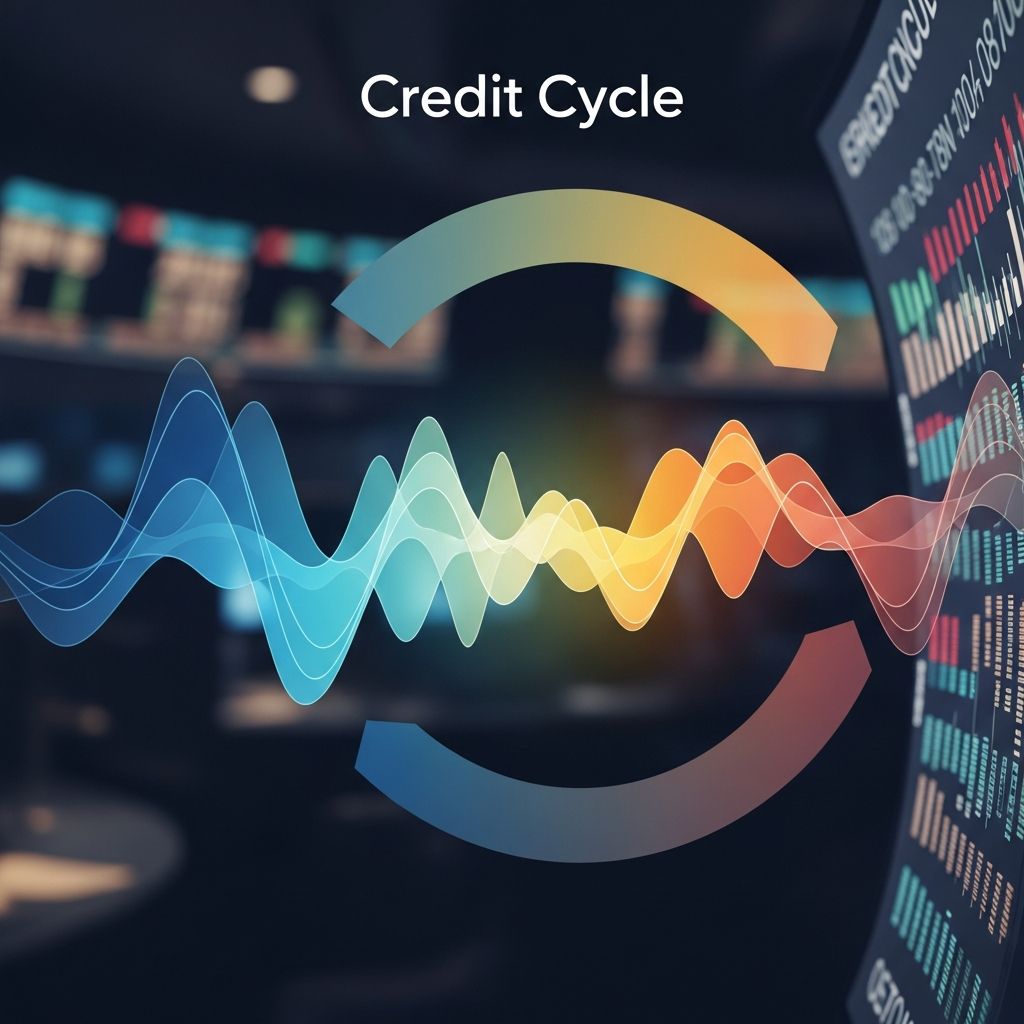
A credit cycle is a disciplined top-down framework used to analyze changing credit conditions over time. The credit cycle describes the cyclical availability and pricing of credit in the economy, particularly tracking which economies are borrowing and spending, while others are saving and deleveraging. Credit cycles are intrinsically tied to the real economy, as they measure the growth in private sector credit and its usage of loans across different regions and markets.
Unlike business cycles, which focus on general economic expansion and contraction, credit cycles specifically examine the flow of capital and the terms under which it becomes available. When the economy is strong, lenders are eager to offer credit with favorable terms and competitive rates. Conversely, in a weak economy, lenders become reluctant to provide credit, making terms unfavorable and increasing borrowing costs. This fundamental relationship between credit availability and economic conditions creates predictable patterns that investors and policymakers closely monitor.
The Four Phases of the Credit Cycle
The credit cycle operates through four distinct phases, each with characteristic economic conditions, policy responses, and investment implications. Understanding these phases is essential for portfolio management and strategic decision-making.
1. Expansion
During the expansion phase, the economy experiences robust growth with increasing production and rising prices. Key characteristics include:
- Low interest rates established by central banks to stimulate economic activity
- Strong private sector credit growth as businesses and consumers borrow readily
- Increasing corporate profits exceeding debt growth rates
- High levels of liquidity and robust risk appetite among investors
- Diminishing economic slack as unemployment falls and capacity utilization increases
During this phase, asset prices typically appreciate, and investors tend to favor riskier assets. Credit spreads narrow as default risk is perceived to be minimal.
2. Late Cycle
As expansion continues, the economy transitions into the late cycle phase, characterized by signs of potential stress:
- Debt growth beginning to exceed profit growth
- Monetary policy shifting toward tightness as central banks attempt to prevent overheating
- Limited economic slack with tight labor markets and high capacity utilization
- Fading risk appetite as investors become more cautious
- Liquidity beginning to tighten across markets
This phase represents a critical inflection point where the seeds of eventual contraction are sown. Credit defaults typically begin to rise during this phase.
3. Downturn
The downturn phase represents a sharp contraction in economic activity and credit availability:
- Profit contraction as companies face declining revenues and margins
- Central banks cutting interest rates aggressively to stimulate the economy
- Recession characterized by falling production and employment
- Collapsing liquidity and severely diminished risk appetite
- Rising defaults as companies struggle to service debt
- Credit spreads widening dramatically as risk aversion dominates
Credit risk premiums peak during the downturn phase, and asset prices across the credit spectrum typically decline sharply. This phase is most challenging for investors holding lower-quality credits.
4. Credit Repair and Recovery
Following the downturn, the economy enters a recovery phase focused on stabilization and gradual improvement:
- Easy monetary policy with low interest rates supporting borrowing
- Economic growth beginning to rebound from recessionary levels
- High levels of liquidity injected into the financial system
- Gradually improving risk appetite as confidence returns
- Debt contraction as companies and consumers deleverage
- Profit growth beginning to exceed debt growth again
During this phase, fundamentally sound credits purchased at discounted prices during the downturn may experience significant price appreciation as the cycle progresses. This creates attractive opportunities for value-oriented investors.
Credit Cycles Versus Business Cycles
While credit cycles and business cycles are related, they possess distinct characteristics that make them valuable to study separately. Credit cycles tend to be longer, deeper, and sharper than business cycles. This means credit disruptions have more severe and prolonged impacts on the economy compared to typical business fluctuations.
Business cycles can be amplified significantly because of changes in access to external financing. When recessions are accompanied by financial disruption and credit contraction, they tend to be longer and deeper than typical downturns. Conversely, recoveries combined with rapid credit growth tend to be stronger and more robust. This relationship demonstrates why monitoring the credit cycle separately provides valuable insights beyond traditional business cycle analysis.
Why Investors Monitor Credit Cycles
Sophisticated investors pay close attention to the stage in the credit cycle for several strategic reasons:
Anticipating Policy Actions
Understanding where the economy stands in the credit cycle helps investors better anticipate the actions policymakers will take. Central banks and governments respond differently depending on the credit cycle phase, and these policy responses drive asset price movements. For example, aggressive rate cuts during a downturn may support equity and credit markets, while monetary tightening in late-cycle phases may pressure risk assets.
Assessing Business Cycle Dynamics
Credit cycle analysis helps investors understand the extent and intensity of business cycle expansions and contractions. By examining credit availability and pricing, investors gain deeper insights into economic momentum beyond traditional GDP data. This allows for more nuanced portfolio positioning and risk management.
Understanding Housing and Construction Markets
Housing and construction sectors are particularly sensitive to credit conditions, as they depend heavily on available financing. Credit cycle analysis helps investors understand developments in these economically sensitive sectors, which often lead broader economic cycles.
Identifying Banking Crisis Risk
Studies have shown that sharp increases in credit cycles are closely linked to future banking crises. By monitoring credit cycle dynamics, investors can identify building systemic risks and adjust portfolio positioning accordingly. This is particularly important for macroprudential stabilization policies aimed at targeting financial booms before they become destabilizing.
Credit Cycles and Financial Crises
The relationship between credit cycles and financial crises is well-documented. Loose private sector credit has been identified as a contributing factor to numerous financial crises, including the 2008-2009 global financial crisis. When credit becomes excessively loose relative to economic fundamentals, speculative bubbles form. The subsequent bursting of these bubbles triggers severe downturns that can cascade through the financial system.
The Financial Instability Hypothesis, proposed by Post-Keynesian economist Hyman Minsky, explains how credit cycles generate instability. During expansion, low interest rates encourage companies to borrow heavily from banks for investment. As economic activity expands, firms generate increasing cash flows, making banks confident in granting additional loans. However, this process eventually leads to excessive indebtedness, causing firms to stop investing and the economy to slip into recession. Understanding this dynamic helps investors recognize when credit conditions are becoming dangerously extended.
Multi-Asset Credit Investing Through the Cycle
Multi-asset credit (MAC) strategies are specifically designed to capitalize on credit cycle dynamics by allocating across different credit asset classes based on cycle phases. Different credit sectors exhibit fairly dependable behavioral patterns throughout each credit cycle phase.
Investment-Grade Bonds
Investment-grade bonds tend to perform well during expansion and recovery phases when credit quality is intact and refinancing risk is minimal. During late-cycle and downturn phases, investors typically increase allocation to investment-grade credits to reduce portfolio risk and focus on capital preservation.
Leveraged Loans
Leveraged loans exhibit varying performance across cycle phases. They may provide attractive risk-adjusted returns during credit repair and recovery phases when credit conditions are improving. During late-cycle and downturn phases, allocation is typically minimized as the leveraged nature of these instruments increases default risk.
High-Yield Bonds
High-yield bonds are most attractive during expansion and recovery phases when economic growth supports corporate earnings. However, an associated rise in interest rates during late-cycle phases can offset price appreciation gains despite improving fundamentals. MAC managers actively manage duration exposure to address these scenarios.
Securitized Assets
Securitized credit assets, including mortgage-backed and asset-backed securities, perform best when credit conditions are accommodative and housing markets are healthy. These assets become challenging during downturns when defaults rise sharply.
Emerging Market Credit
Emerging market credit typically performs strongly during expansion and recovery phases when risk appetite is high. During downturns, emerging market spreads widen dramatically as investors flee to safety.
Duration Management and Currency Considerations
Effective credit cycle investing requires active management of duration exposure, which represents interest rate sensitivity of bond holdings. By managing duration strategically based on credit cycle phases, MAC investors can optimize return potential and enhance risk management. During late-cycle and downturn phases, extending duration provides capital preservation benefits. During expansion phases, shorter duration positioning may enhance returns if rates are expected to rise despite credit fundamentals improving.
Additionally, managing currency exposure separately allows managers to optimize overall portfolio positioning without being constrained by geographic credit opportunity limitations. This flexibility provides MAC strategies with significant advantages over single-asset credit strategies.
Identifying Credit Opportunities Through the Cycle
MAC strategies combine credit cycle framework analysis with deep understanding of valuations and technical factors to promote strong fundamental risk management. Valuations reflect the degree to which securities are over or undervalued relative to historical levels and peer comparisons. Technical factors include capital trends and seasonalities affecting supply and demand dynamics.
Fundamentally sound credits purchased at discounted prices during downturn and early recovery phases may experience significant price appreciation as credit conditions improve and the economy recovers. This price appreciation, combined with coupon income, can generate attractive total returns for patient, disciplined investors who maintain conviction in cycle analysis during periods of maximum fear and uncertainty.
Conclusion
The credit cycle represents a critical framework for understanding economic dynamics and managing investment portfolios effectively. By recognizing the four distinct phases—expansion, late cycle, downturn, and recovery—investors can position portfolios to capture credit risk premiums while managing downside risks appropriately. Credit cycles tend to be longer, deeper, and sharper than business cycles, making their separate analysis essential for comprehensive portfolio management.
Active investing across global geographies and multiple credit sectors requires sophisticated analysis of credit cycle dynamics. MAC strategies designed to navigate full market cycles by capturing global credit risk premiums while minimizing costs associated with downgrades and defaults represent a comprehensive approach to credit investing. By combining credit cycle analysis with valuation discipline and technical insight, investors can enhance return potential and reduce portfolio risk across full economic cycles.
Frequently Asked Questions
What is the primary purpose of analyzing credit cycles?
The primary purpose is to understand changing credit conditions over time and identify how credit availability and pricing vary across economic cycles. This analysis helps investors anticipate policy actions, assess business cycle dynamics, understand housing market developments, and identify potential banking crises before they fully materialize.
How do credit cycles differ from business cycles?
Credit cycles tend to be longer, deeper, and sharper than business cycles. While business cycles measure general economic expansion and contraction, credit cycles specifically examine credit availability, pricing, and growth in the private sector. Recessions accompanied by credit disruption tend to be more severe and prolonged than typical downturns.
What are the four phases of the credit cycle?
The four phases are: (1) Expansion—featuring low rates, strong credit growth, and rising profits; (2) Late Cycle—showing debt exceeding profit growth and tightening monetary policy; (3) Downturn—characterized by profit contraction, rate cuts, and rising defaults; and (4) Recovery—featuring easy monetary policy, rebounding growth, and improving risk appetite.
Why do investors need to understand credit cycles?
Understanding credit cycles helps investors anticipate policy actions, assess the extent of economic cycles, understand housing and construction market developments, and identify emerging banking crisis risks. Credit cycles provide a framework for optimizing portfolio positioning across different economic environments.
What is the relationship between credit cycles and financial crises?
Loose private sector credit has contributed to numerous financial crises, including the 2008-2009 global financial crisis. When credit becomes excessively loose, speculative bubbles form. The bursting of these bubbles triggers severe downturns that cascade through the financial system, making credit cycle monitoring essential for risk management.
How can multi-asset credit strategies navigate the credit cycle?
MAC strategies allocate across investment-grade bonds, leveraged loans, high-yield bonds, securitized assets, and emerging market credit based on credit cycle phases. During expansion and recovery, they increase risk exposure; during late-cycle and downturns, they focus on quality and capital preservation. Active duration and currency management enhance returns and reduce risk.
References
- Multi-Asset Credit Investing — Loomis Sayles. 2018-02-01. https://www.loomissayles.com/internet/internetdata.nsf/0/70ADCF81C7F4933585257F180073B6FD/$FILE/Multi-Asset-Credit-Investing-US.pdf
- Credit Cycles and Economic Performance — AnalystPrep CFA Level 1 Economics. 2024. https://analystprep.com/cfa-level-1-exam/economics/credit-cycles-2/
- Business Cycles — Wikipedia. 2025. https://en.wikipedia.org/wiki/Business_cycle
Similar Articles








Read full bio of medha deb