Credit Card Late Fees: Rules and Realities
Explore the evolving regulations on credit card late fees, from proposed caps to court rulings, and learn how to manage payments effectively.
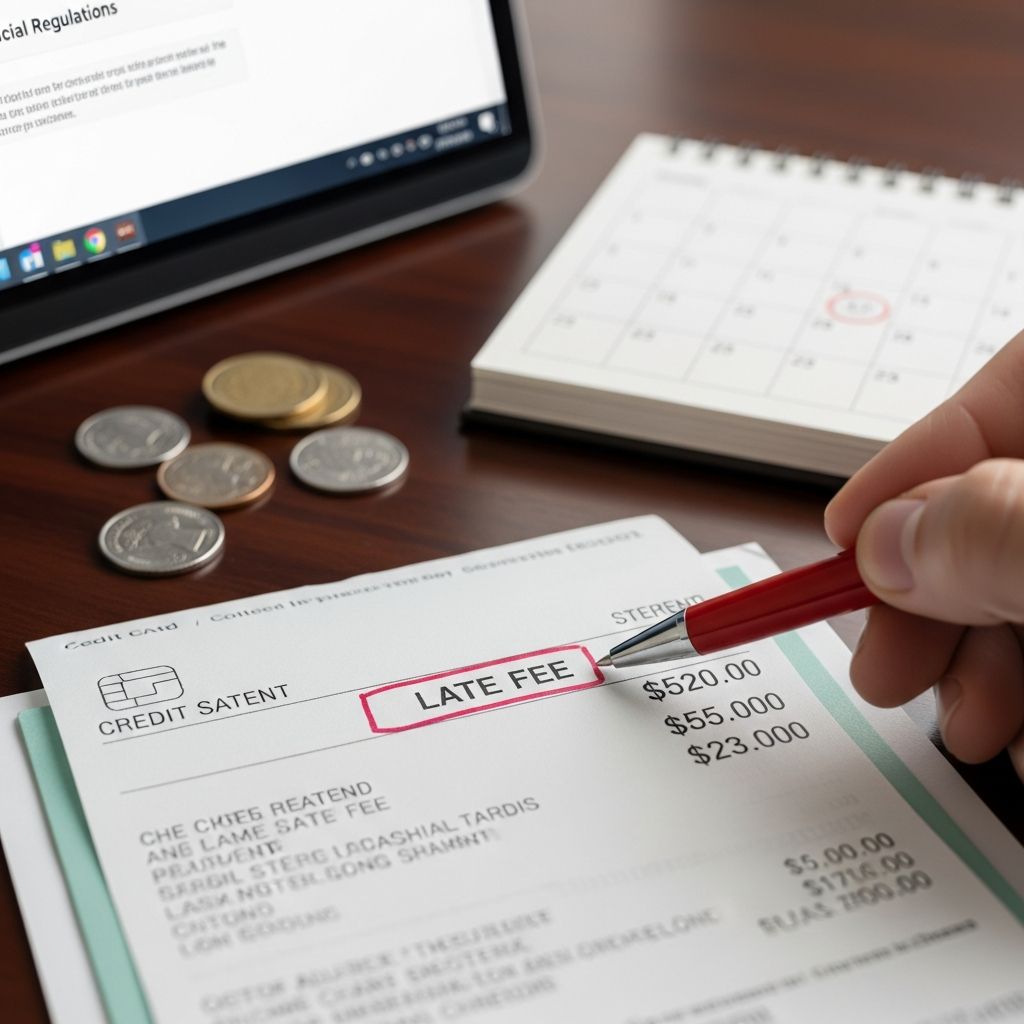
Credit card late fees are charges imposed by issuers when payments miss due dates, typically ranging from $25 to $40 depending on account history and issuer policies. These penalties serve to encourage timely payments but have faced scrutiny for their size relative to actual costs.
The Foundation of Late Fee Regulations
The Credit Card Accountability Responsibility and Disclosure Act of 2009 (CARD Act) established key protections against excessive penalty fees, requiring them to be reasonable and proportional to the violation. Regulation Z under the Truth in Lending Act sets safe harbor limits, allowing issuers to charge up to specified amounts without proving costs, provided they stay within bounds.
Prior to recent developments, larger issuers could apply a safe harbor of $30 for the first late payment and $41 for subsequent ones within six billing cycles, adjusted annually for inflation. Smaller issuers faced different thresholds, often lower.
CFPB’s Ambitious Push for Lower Fees
In March 2024, the Consumer Financial Protection Bureau (CFPB) finalized a rule targeting larger card issuers—those with over one million open accounts—capping the late fee safe harbor at $8, with no inflation adjustment. The agency argued this covered collection costs while curbing profits from penalties, projecting billions in consumer savings.
The rule distinguished between first-time and repeat late payments, eliminating higher tiers for subsequent violations. It also addressed other penalties like returned payments, maintaining higher safe harbors there (up to $32-$41).
Legal Challenges and the Rule’s Demise
Industry groups, including the U.S. Chamber of Commerce and bank associations, challenged the rule in court, claiming it violated the CARD Act by not accounting for deterrence costs and exceeding CFPB authority. On April 15, 2025, the U.S. District Court for the Northern District of Texas vacated the rule following a settlement where CFPB conceded it failed statutory requirements.
The court ruled the $8 cap prevented reasonable penalty fees, breaching the Administrative Procedure Act. CFPB agreed to abandon it entirely, reverting to pre-2024 safe harbors.
Current Late Fee Landscape Post-Ruling
As of 2026, late fees revert to CARD Act safe harbors: $30 (inflation-adjusted) for initial lates and $41 for repeats within six cycles for larger issuers. Issuers cannot charge if payments postmark by the due date or arrive within grace periods, typically 23 days after statement closing.
| Fee Type | First Violation Safe Harbor | Subsequent (within 6 cycles) | Notes |
|---|---|---|---|
| Late Payment | $30 (adj.) | $41 (adj.) | Larger issuers; no inflation on failed $8 rule |
| Returned Payment | $32 (adj.) | $41 (adj.) | Applies to bounced checks |
| Over Limit | $32 (adj.) | $41 (adj.) | Declined transactions |
Grace Periods and Payment Timing
Most cards offer a grace period—time between statement date and due date—where no interest accrues if full balance pays. Late fees trigger only if minimum payment misses post-grace. Electronic payments often credit same day; mailed ones by postmark.
- Pay at least minimum by due date to avoid fees.
- Monitor statements for exact dates.
- Use autopay for minimums to prevent oversights.
Impact of Late Payments Beyond Fees
A late payment dings credit scores via payment history (35% of FICO), reported after 30 days. Multiple lates compound damage, raising APRs and insurance rates. Fees add immediate costs, but score hits linger 7 years.
Strategies to Dodge Late Fees
Proactive management minimizes risks:
- Set calendar alerts for due dates.
- Enroll in autopay, but verify minimum covers fees.
- Contact issuer for one-time waivers, especially first offenses.
- Make partial payments early if full amount uncertain.
- Switch to digital billing for instant notifications.
Some issuers waive fees for good history or disputes.
Alternatives if Fees Hit
If charged, review statements for errors. Dispute via issuer, then CFPB if unresolved. Balance transfers to 0% APR cards or debt consolidation loans can pause cycles, but watch fees.
Industry Perspectives on Fee Caps
Critics argue low caps shift costs to on-time payers via higher APRs or reduced rewards. Banks claim fees fund fraud detection and collections. Proponents highlight relief for 45 million annual late payers.[10]
State-Level Variations
Federal rules set floors, but states like California cap at $35 or actual costs. Check local laws for extras.
Future Outlook for Penalty Fees
Post-vacation, CFPB may pursue overdraft or smaller issuer rules. Monitor Federal Register for updates. Consumers benefit from awareness amid shifting regs.
Frequently Asked Questions
When does a payment count as late?
Typically after due date; grace periods vary, but postmark rule applies for mail.
Can issuers charge multiple fees per cycle?
No, one late fee per billing cycle max.
Does autopay prevent all fees?
It covers minimum if funds available; insufficient funds trigger returned payment fees.
How does a late fee affect APR?
Penalty APRs can apply, hiking rates until good standing.
Are late fees tax-deductible?
No, personal credit card fees aren’t.
References
- Understanding New Credit Card Late Fee Limits — Debthelper. 2024. https://debthelper.com/new-limits-placed-on-credit-card-late-fees-and-other-penalties/
- Consumer Financial Protection Bureau Releases Final Rule on Credit Card Late Fees — Sidley. 2024-03-11. https://www.sidley.com/en/insights/newsupdates/2024/03/consumer-financial-protection-bureau-releases-final-rule-on-credit-card-late-fees
- What to Know About the CFPB’s Cap on Credit Card Late Fees — Experian. 2024. https://www.experian.com/blogs/ask-experian/cfpb-new-cap-on-credit-card-late-fees/
- § 1026.52 Limitations on fees — Consumer Financial Protection Bureau. N/A. https://www.consumerfinance.gov/rules-policy/regulations/1026/52
- Credit Card Penalty Fees Final Rule — Consumer Financial Protection Bureau. 2024. https://www.consumerfinance.gov/rules-policy/final-rules/credit-card-penalty-fees-final-rule/
- CFPB Agrees To Eliminate $8 Cap on Credit Card Late Fees — Consumer Finance Insights. 2025-05-02. https://www.consumerfinanceinsights.com/2025/05/02/cfpb-agrees-to-eliminate-8-cap-on-credit-card-late-fees/
- CFPB Abandons Credit Card Late Fee Rule — Consumer Financial Services Law Monitor. 2025-04. https://www.consumerfinancialserviceslawmonitor.com/2025/04/cfpb-abandons-credit-card-late-fee-rule/
Similar Articles








Read full bio of medha deb