Credit Card Convenience Checks: Safe to Use?
Discover the hidden risks and benefits of those credit card checks arriving in your mailbox and decide if they're worth cashing.
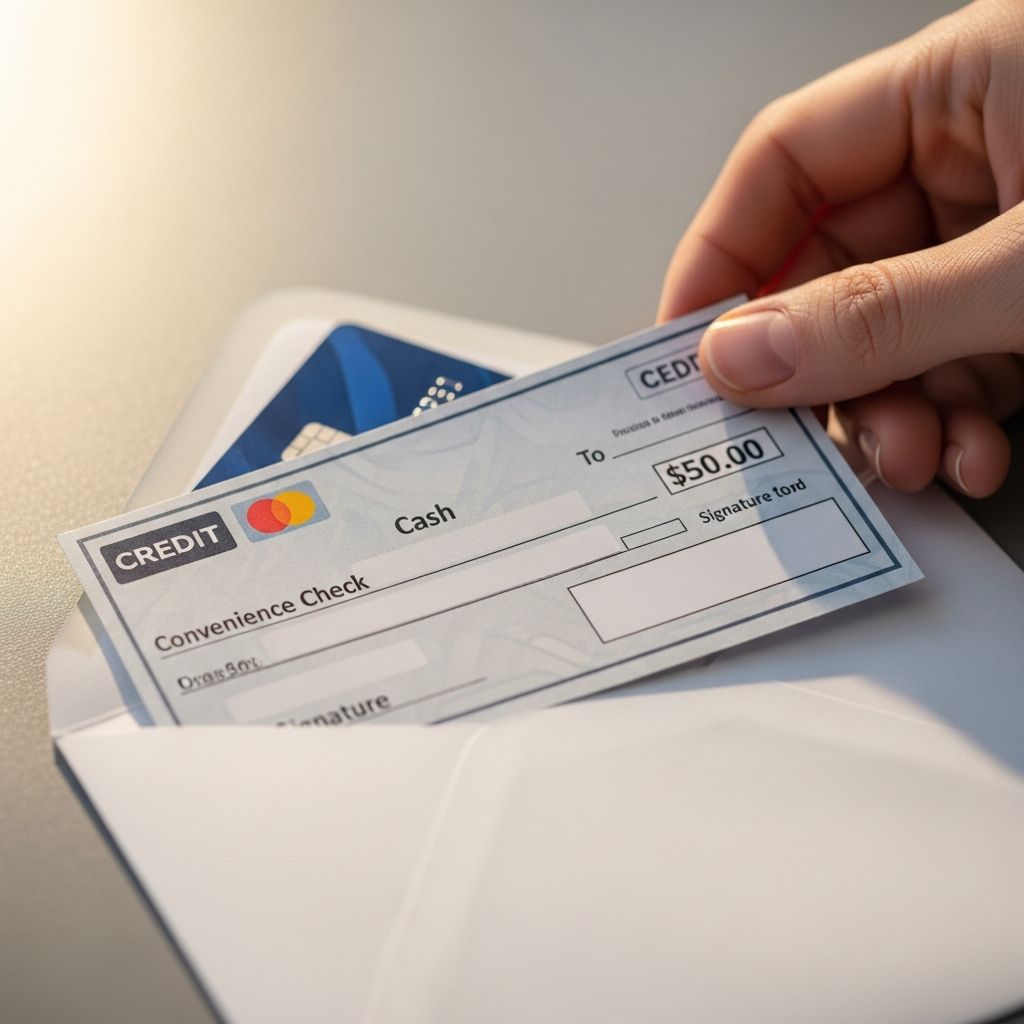
Credit card issuers frequently mail blank checks known as convenience checks to cardholders, offering an easy way to access credit for payments, debt consolidation, or purchases. These checks draw directly from your credit limit but often come with promotional financing offers that can save on interest if managed properly.
What Exactly Are Convenience Checks?
Convenience checks, also called access checks, are pre-printed checks provided by your credit card company. When you write and deposit one, it functions like borrowing money against your available credit line, similar to a purchase or cash advance. Issuers send them periodically, especially to customers with good payment histories, as a marketing tool to encourage usage.
Unlike standard personal checks from your bank, these pull funds from your credit card account. You might receive a booklet of 5-10 checks with terms like ‘0% APR for 12 months on balance transfers.’ They can be used to pay bills, transfer balances from other cards, or even deposit into your bank account for cash needs.
- Typically mailed unsolicited to eligible cardholders.
- Draw from your credit limit, reducing available credit immediately.
- Often tied to special introductory rates to attract usage.
How Do They Function in Practice?
When you endorse and deposit a convenience check, the amount is charged to your credit card account, usually posting within 1-3 business days. Your statement will reflect it as a purchase, balance transfer, or cash advance, depending on the terms. Minimum payments apply right away, even during promotional periods.
For example, writing a $1,000 check to pay off another credit card creates a balance transfer. If eligible for a promo rate, interest might be waived temporarily. However, confirm the categorization by reviewing the offer letter or calling your issuer, as misclassification can lead to higher costs.
| Transaction Type | Typical Treatment | Promo Eligibility |
|---|---|---|
| Balance Transfer | New card debt payoff | Often 0% APR for 6-21 months |
| Purchase | Goods or services | Possible low intro APR |
| Cash Advance/Deposit | Bank deposit or cash | Rarely promo; high fees/APR |
Promotional Rates: A Double-Edged Sword
Many convenience checks promote low or 0% introductory APRs, mandated by law to last at least six months but often extending to 12-21 months. During this window, qualifying balances accrue little to no interest, aiding debt payoff or large buys. Post-promo, standard APRs—averaging 20-30%—apply to remaining balances.
Key distinction: true 0% APR promotions charge no interest during the period, even if unpaid at end. Only future interest accrues on leftovers. In contrast, deferred interest (e.g., ‘no interest if paid in full’) accrues from day one; failing to clear the balance triggers retroactive charges at high rates.
- 0% APR: Interest-free period; pay off partially, owe only on remainder going forward.
- Deferred: Hidden interest piles up; full payoff required or face backdated fees.
Avoid deferred offers unless confident in full repayment, as they can inflate costs unexpectedly.
Hidden Costs and Fees to Watch For
While promo rates sound appealing, fees can erode savings. Cash advance fees (3-5% of amount) apply if the check is treated as such, plus immediate high APRs without grace periods. Balance transfers might incur 3-5% fees too.
Late payments forfeit promos, triggering penalty APRs (up to 29.99%) on all balances. Exceeding credit limits or multiple checks can max out your line, hurting spending flexibility.
| Potential Fee | Typical Amount | Trigger |
|---|---|---|
| Cash Advance Fee | 3-5% | Deposited to bank or cash use |
| Balance Transfer Fee | 3-5% | Paying other debts |
| Penalty APR | Up to 29.99% | Late payment |
Effects on Your Credit Score
Using convenience checks impacts credit utilization (30% of FICO score). High usage—say, 80% of limit—signals risk to lenders, dropping scores temporarily. Multiple checks increase debt-to-credit ratio quickly.
Positive side: On-time payments during promo build payment history (35% of score). Balance transfers consolidating high-interest debt can improve overall profile if managed well. Monitor via free weekly reports from AnnualCreditReport.com.
- Utilization over 30%: Potential score dip.
- Consistent payments: Score boost over time.
- New hard inquiries: Rare, but check for promo activation.
When Might They Make Financial Sense?
Ideal scenarios include short-term bridging for emergencies or transferring high-APR debt (e.g., 25% store card) to 0% promo. Calculate breakeven: If transfer fee is 4% ($40 on $1,000) but saves $200 in interest over 12 months, it’s worthwhile.
Best for disciplined users with payoff plans. Pair with budgeting apps to track promo end dates and automate payments exceeding minimums.
Risks and Common Mistakes to Avoid
Traps abound: Treating checks as ‘free money’ leads to overspending. Promo expiration surprises with ballooning interest. Cash equivalents often skip grace periods, accruing interest daily from posting.
Mistake: Ignoring fine print. Always verify promo applicability—some exclude convenience checks. Multiple issuers sending checks? Track per-account terms to avoid mix-ups.
Smarter Alternatives for Borrowing
Before cashing a check, compare options:
- Personal loans: Fixed rates (6-36%), no promo cliffs.
- 0% APR cards: Apply for dedicated balance transfer cards.
- Home equity lines: Lower rates for large sums, secured.
- High-yield savings overdraft: If you have reserves.
Shop rates via prequalification tools without hard pulls. For promo shopping, standard 0% purchase cards outperform convenience checks.
Steps to Take Before Using One
- Read the offer letter thoroughly for APR, duration, fees, exclusions.
- Call issuer to confirm terms and transaction coding.
- Calculate total cost vs. alternatives.
- Ensure payoff plan covers principal plus fees before promo ends.
- Void unused checks to prevent fraud; shred if possible.
Frequently Asked Questions (FAQs)
Are convenience checks free money?
No. They create credit card debt subject to terms, fees, and eventual repayment.
Do they count as cash advances?
Often yes if deposited or used for cash, incurring fees and high APRs.
Can I get more if I use them?
Issuers may send more, but usage raises utilization, risking credit health.
What if I lose a check?
Report immediately like a lost card; liability limited if notified promptly.
Do they help build credit?
Yes, via on-time payments, but high balances can harm utilization.
Final Thoughts on Smart Usage
Convenience checks offer convenient access to promo financing but demand caution. Review terms meticulously, align with repayment ability, and weigh against rivals. When used strategically, they facilitate cost savings; otherwise, they compound debt burdens. Stay informed on your statements and credit profile for optimal financial outcomes.
References
- How credit card promotional interest rates work — Capital One. 2023-01-15. https://www.capitalone.com/learn-grow/money-management/how-credit-card-promotional-interest-rates-work/
- What Is a Promotional Balance on a Credit Card? — CareCredit. 2024-05-20. https://www.carecredit.com/well-u/financial-health/what-is-promotional-balance/
- How to understand special promotional financing offers on credit cards — Consumer Financial Protection Bureau. 2023-10-10. https://www.consumerfinance.gov/about-us/blog/how-understand-special-promotional-financing-offers-credit-cards/
- What Is a Convenience Check, and Should I Use One? — NerdWallet. 2024-08-05. https://www.nerdwallet.com/credit-cards/learn/credit-card-convenience-checks-when-to-use
- Credit Card Checks and Cash Advances — FDIC. 2023-01-01. https://www.fdic.gov/consumer-resource-center/2023-01/credit-card-checks-and-cash-advances
Similar Articles








Read full bio of Sneha Tete