Credit Card Cash Advances: Costs, Risks, And Safer Alternatives
Discover how credit card cash advances function, their hidden costs, access methods, and smarter financial alternatives for urgent cash needs.
Credit card cash advances provide a quick way to access funds by borrowing against your available credit limit, but they come with steep fees and immediate interest charges that can quickly escalate costs.
Understanding the Fundamentals of Cash Advances
A cash advance allows cardholders to withdraw cash using their credit card, treating it as a loan drawn from the card’s credit line rather than a standard purchase. Unlike everyday purchases, this transaction adds directly to your balance and starts accruing interest without any grace period, making it more akin to high-interest borrowing than convenient spending.
The available amount for cash advances is often capped below your total credit limit, typically ranging from 20% to 50% depending on the issuer’s policies and your account status. This limit ensures you can’t exhaust your entire credit line on cash needs alone. Always verify your specific cash advance limit through your online account, statement, or by contacting customer service to avoid surprises.
Step-by-Step Process of Taking a Cash Advance
Once initiated, the cash advance amount appears on your statement almost immediately, with fees applied upfront and interest compounding daily from the transaction date. Repayment follows your regular credit card billing cycle, but minimum payments may prioritize lower-interest balances first, prolonging the high-rate debt payoff.
- Funds are dispensed in cash or transferred to a linked account.
- No additional credit checks are needed since approval is based on your existing card agreement.
- Certain transactions, like buying money orders or cryptocurrency, may be classified as cash advances even if they feel like purchases.
Primary Methods to Access Cash Advances
Card issuers offer several channels for obtaining cash advances, each with its own conveniences and potential extra costs.
ATM Withdrawals: Fast but Fee-Heavy
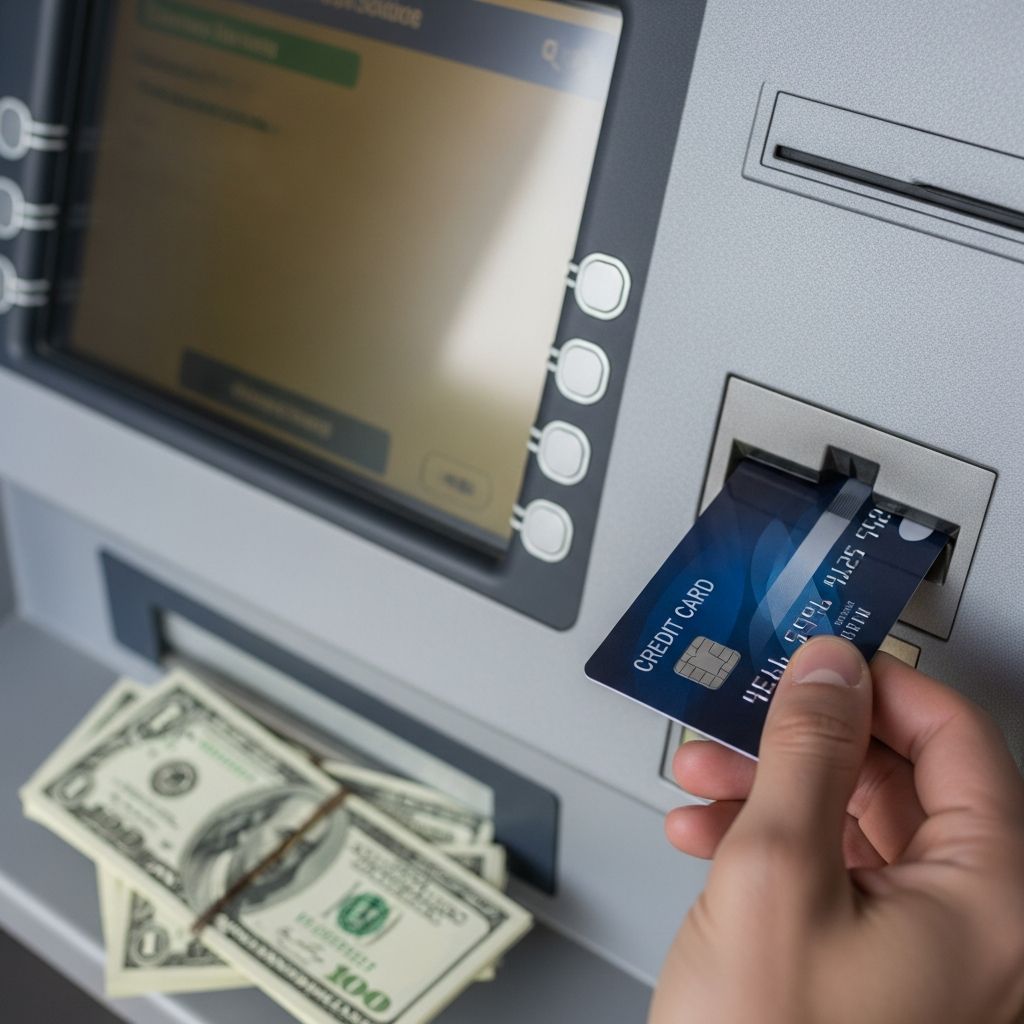
The most common method involves using an ATM with your credit card and PIN. Insert the card, enter your PIN (request one from your issuer if needed), and select the cash advance option. Limits apply, often mirroring daily ATM withdrawal caps, and out-of-network ATMs add their own surcharges.
| Method | Requirements | Potential Extra Costs |
|---|---|---|
| ATM | Card + PIN | ATM fee ($2-5), issuer fee (3-5%) |
| Convenience Check | Checkbook from issuer | Fee (3-5%), possible interest |
| In-Person | ID + Card | Branch fee, travel time |
Convenience Checks: Flexible Payment Option
Many issuers mail blank checks tied to your account, usable like personal checks for deposits or payments. Write the amount to yourself or a payee, deposit it, and it processes as a cash advance. These are handy for larger sums without visiting an ATM but still trigger the same fees and rates.
Bank Branch Visits: Traditional Approach
Visit a participating bank branch with your card and photo ID to request cash directly from a teller. Funds can be handed over in cash or wired to your account. This method suits those preferring face-to-face service but may involve wait times and branch-specific fees.
Digital Transfers: Modern Convenience
Some apps and online banking portals let you transfer cash advances to a checking account instantly. Select your credit card as the source and follow prompts—ideal for avoiding physical trips but check for digital processing fees.
Breaking Down the True Costs Involved
Cash advances are notoriously expensive, designed as a last-resort feature rather than a cheap borrowing tool.
Transaction Fees: Upfront Hit
Expect a fee of 3% to 5% of the advance amount, often with a $10 minimum. For a $200 advance at 5%, that’s $10 gone immediately, deducted from the cash received or added to your balance.
Elevated Interest Rates: No Mercy Period
Cash advance APRs average 25% to 30% or higher, exceeding purchase rates by 5-10 points. Interest accrues from day one, calculated daily on the outstanding balance including fees.
Example: Borrowing $500 at 28% APR with a 5% fee costs $25 upfront. Daily interest might add $0.38, snowballing if unpaid.
Other Hidden Charges
- ATM operator fees for non-network machines.
- No rewards earning—cash advances rarely qualify for points or cashback.
- Impact on credit utilization if nearing limits.
Risks and Long-Term Impacts
Beyond immediate costs, cash advances can trap users in debt cycles. High rates mean balances grow fast, and issuers apply payments to lower-rate debts first. Credit scores may dip from increased utilization, and repeated use signals risk to lenders.
Regulators like the Consumer Financial Protection Bureau warn against relying on these for routine needs, as they mimic payday loans in expense.
Wiser Alternatives for Emergency Funds
Before turning to a cash advance, consider these lower-cost options:
- Personal Loans: Fixed rates often under 15% APR from banks or credit unions.
- Balance Transfers: Move debt to a 0% intro APR card.
- Peer-to-Peer Lending: Platforms like LendingClub offer competitive rates.
- Overdraft Protection: Cheaper than cash advance APRs on linked checking.
- Emergency Savings: Build a fund covering 3-6 months’ expenses.
Strategic Tips for Using Cash Advances
If unavoidable:
- Pay off immediately to minimize interest.
- Compare issuer fees and limits.
- Use in-network ATMs.
- Track via app to avoid exceeding limits.
Frequently Asked Questions
Do cash advances build credit?
They can if paid responsibly, as they’re reported like purchases, but high utilization hurts scores short-term.
Is there a grace period?
No—interest starts immediately, unlike purchases.
Can all cards offer cash advances?
Not all; check your terms. Some charge-enabled cards exclude them.
How much can I withdraw?
Up to your cash advance limit, often $100 minimum to 30-50% of total limit.
Do they earn rewards?
Typically no—excluded from bonuses and points.
References
- Credit Card Cash Advance: What It Is & How It Works — Chase Bank. 2023-10-01. https://www.chase.com/personal/credit-cards/education/basics/how-do-credit-card-cash-advances-work
- What is a Cash Advance on a Credit Card? — TD Bank. 2024-05-15. https://www.td.com/us/en/personal-banking/learning/what-is-cash-advance-on-a-credit-card
- What Is a Cash Advance and How Does It Work? — Experian. 2024-08-20. https://www.experian.com/blogs/ask-experian/what-is-a-cash-advance/
- What Is a Cash Advance on a Credit Card? — PNC Bank. 2024-03-12. https://www.pnc.com/insights/personal-finance/spend/what-is-a-cash-advance-on-a-credit-card.html
- What Is a Cash Advance? — Citizens Bank. 2023-11-05. https://www.citizensbank.com/learning/what-is-a-cash-advance.aspx
- What Is a Cash Advance on a Credit Card? — Capital One. 2024-07-18. https://www.capitalone.com/learn-grow/money-management/cash-advance/
Similar Articles








Read full bio of medha deb