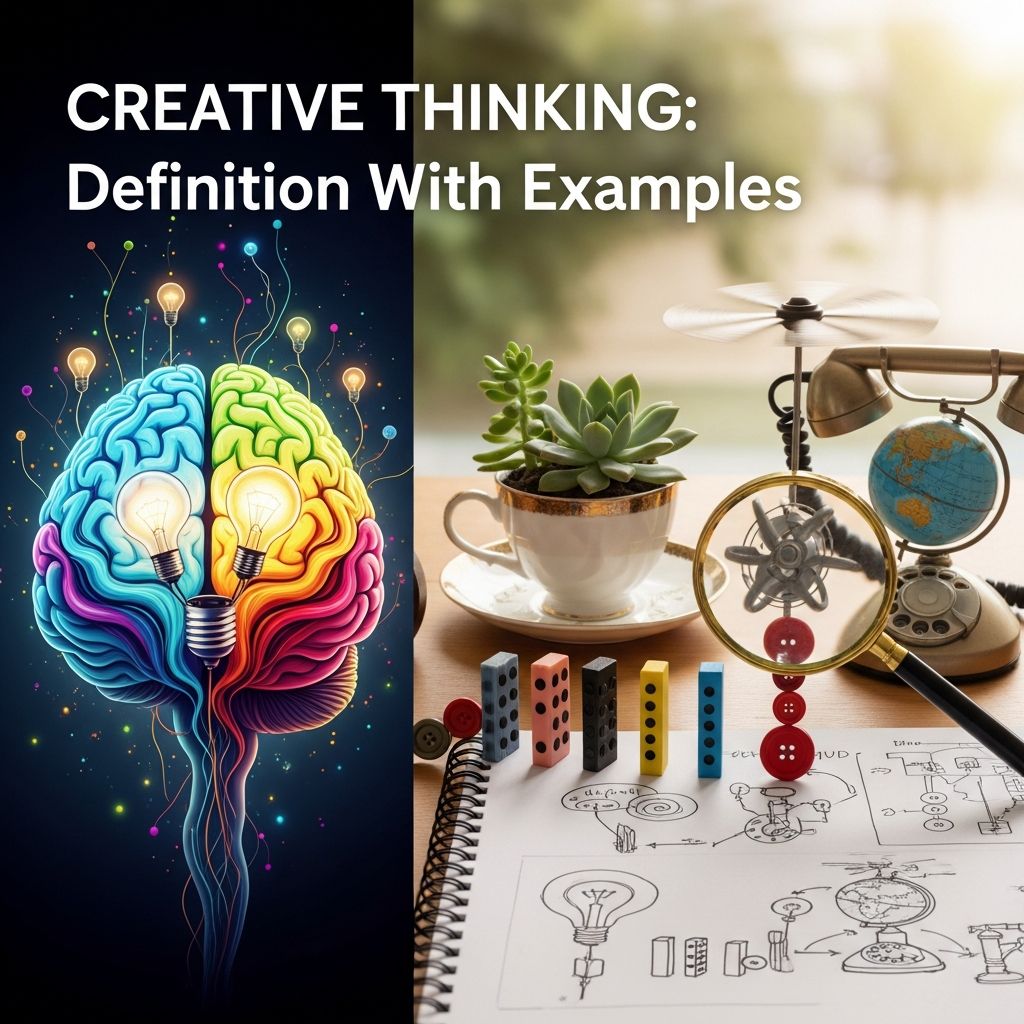
Creative Thinking: Definition With Examples
Master creative thinking skills to solve problems innovatively and drive success in your career and business.
In today’s fast-paced business environment, the ability to think creatively has become one of the most sought-after skills across industries. Creative thinking enables professionals to tackle complex challenges, innovate solutions, and drive organizational growth. Whether you’re an entrepreneur launching a startup, a manager leading a team, or an employee seeking to advance your career, understanding and developing creative thinking skills can significantly enhance your professional capabilities and open doors to new opportunities.
What Is Creative Thinking?
Creative thinking is the ability to look at problems or situations from a fresh perspective and come up with unique, effective solutions. At its core, creative thinking is intentionally gaining new insights and different ideas through existing information. It involves thinking outside the box and examining information from different viewpoints to see new patterns and possibilities.
Unlike conventional problem-solving approaches that follow established procedures, creative thinking requires you to break free from traditional boundaries and explore unconventional pathways. Creative thinking is a way of thinking that involves thinking out of the box to generate or, literally, create new and innovative ideas. This form of thinking encompasses methods and techniques that diverge from conventional thought patterns, often used synonymously with divergent thinking.
Creative thinking is not limited to artistic fields such as graphic design or advertising. This skill is essential in every profession, from business and science to technology and education. In the workplace, creative thinking manifests when employees brainstorm ideas, experiment with new approaches, examine solutions from multiple perspectives, and aren’t afraid to take risks implementing original ideas.
Key Characteristics of Creative Thinkers
Creative thinkers share certain defining characteristics that set them apart in the workplace:
- Open-mindedness: They embrace new ideas and perspectives without immediate judgment
- Risk-taking: They’re willing to experiment and aren’t deterred by potential failure
- Curiosity: They ask questions and explore multiple angles of a problem
- Flexibility: They adapt their thinking when initial approaches don’t work
- Persistence: They continue exploring possibilities until finding viable solutions
- Collaboration: They value input from others and build on collective ideas
Types of Creative Thinking
Creative thinking manifests in several distinct forms, each valuable in different contexts and situations:
Artistic Creativity
This is the ability to create something new and beautiful, whether it’s a painting, song, book, or well-designed website. Artistic creativity is crucial in fields like graphic design, advertising, and entertainment, where visual and auditory appeal play significant roles. It allows professionals to express complex ideas through aesthetic mediums and create emotional connections with audiences.
Innovation and Invention
Innovation involves creating new ideas, products, or methods, while invention brings those ideas to life. This type of creative thinking thrives in environments that encourage experimentation and risk-taking. An engineer designing a groundbreaking app or a scientist developing a new process exemplifies this creative approach. Innovation and invention drive competitive advantage and market differentiation.
Problem-Solving
Problem-solving represents a key aspect of creative thinking—the ability to define a problem, create original solutions, and implement the best one. A project manager overcoming significant challenges through unique approaches showcases creative problem-solving. This involves identifying root causes, generating multiple solutions, and selecting the most effective approach.
Lateral Thinking
Lateral thinking involves letting ideas flow in a step-by-step format, allowing you to approach problems from unconventional angles. Rather than following a direct logical path, lateral thinkers explore indirect routes and make unusual connections between disparate concepts.
Inspirational Thinking
Inspirational thinking focuses on imagining the best-case scenarios to find a new way to solve a problem. This approach encourages optimistic exploration of possibilities and aspirational goal-setting before determining practical implementation strategies.
Creative Thinking in the Workplace
Creative thinking manifests in numerous practical ways within professional environments. Employees and managers demonstrating creative thinking might:
- Hold interactive brainstorms to gather initial thoughts on projects
- Evaluate current processes and offer suggestions for improvement
- Research alternative marketing strategies and lead experiments on new channels
- Develop innovative outreach methods for prospective clients
- Identify unique opportunities to promote company brands
- Discover new metrics to measure initiative success and iterate accordingly
- Find patterns in revenue growth and use data trends for strategic planning
In the workplace, creative thinking is highly valuable because employers look to hire innovative employees who can help them solve the company’s problems. Organizations increasingly recognize that creative thinkers provide competitive advantages through innovation, improved efficiency, and breakthrough solutions.
Essential Creative Thinking Skills
Creative thinking encompasses several interconnected skills that work together to produce innovative solutions:
Analytical Skills
Analytical skills are problem-solving skills that help you sort through facts, data, and information to develop rational solutions. These skills aid in the initial phase of creative thinking as you brainstorm and generate ideas. Key analytical skills include:
- Data analysis
- Research
- Forecasting
- Reporting
- Interpreting
- Communication
Collaboration
Collaboration involves working with others to build upon collective ideas, leverage diverse perspectives, and refine solutions through group input. Creative breakthroughs often emerge from cross-functional teams bringing different expertise and viewpoints to problem-solving sessions.
Innovation
Creative thinking includes the process of innovative problem-solving — from analyzing the facts to brainstorming to working with others. Innovation as a skill involves recognizing opportunities, conceptualizing solutions, and implementing changes that create value.
Open-Mindedness
This skill enables you to consider diverse perspectives, embrace unconventional ideas, and suspend judgment during ideation phases. Open-minded professionals can evaluate suggestions objectively and combine the best elements from multiple proposals.
Active Listening
Active listening ensures you fully understand problems, capture nuances in team discussions, and build upon others’ ideas effectively. This skill strengthens collaborative creative processes and prevents valuable insights from being overlooked.
Common Creative Thinking Techniques
Several proven techniques can stimulate and enhance creative thinking:
Brainstorming
Brainstorming is a technique for stimulating creative thoughts that involves idea generation in a group setting. This method encourages team members to express thoughts freely, building upon each other’s ideas. One idea can spark another, creating chains of insights and expanding the solution space. Traditional brainstorming suspends evaluation during the generation phase, typically allowing 30 minutes to an hour for idea collection.
Analogical Thinking
Analogical thinking is the process of identifying a common similarity between two or more distinct objects or situations and using it to solve a problem at hand. For example, a company studying how schools organize information might apply similar principles to internal knowledge management systems. This method unlocks solutions by drawing parallels to unrelated domains.
Three Ifs Technique
The Three Ifs technique is about stimulating creativity through hypothetical ‘If’ scenarios. You imagine what could happen if certain variables changed. For instance: “If we had double our budget, what would we do?” or “If our competitors disappeared tomorrow, how would we operate?” This technique fosters innovation and flexibility by breaking free from current limitations.
Blue Skies Thinking
Blue Skies Thinking is the act of thinking without any preconceived limits and boundaries. It’s akin to daydreaming where no answers are wrong. With all constraints temporarily removed, truly transformative ideas can surface. After generating possibilities, you then evaluate feasibility and implementation.
Cross-Pollination
Cross-Pollination involves combining elements or ideas from different fields, disciplines or sources, leading to innovation and fresh perspectives. Think of it as creating fusion cuisine by mixing ingredients from diverse culinary cultures. Technology companies often cross-pollinate ideas from biology, art, and social sciences to create novel products.
The Creative Problem-Solving Process
Effective creative thinking follows a structured yet flexible process:
Identify the Problem
Clearly define the issue at hand, ensuring thorough understanding of its complexities. Many failed solutions stem from misdiagnosing root causes rather than symptoms. Ask clarifying questions and gather background information.
Generate Ideas
Brainstorm a wide range of potential solutions, encouraging creativity and open-mindedness. Quantity matters during this phase—aim to generate numerous possibilities before evaluating quality. Defer judgment and allow wild ideas to emerge.
Evaluate Options
Assess the feasibility and effectiveness of each idea, considering factors such as resources, time, and impact. Create evaluation matrices or scoring systems to objectively compare options against predetermined criteria.
Refine and Develop
Select the most promising ideas and refine them further, adding detail and specificity. This stage often involves prototyping, testing assumptions, and incorporating feedback to strengthen your solution.
Implement and Iterate
Put the chosen solution into action, continuously evaluating and adjusting as necessary. Monitor outcomes, collect feedback, and be prepared to pivot if results don’t meet expectations. Many successful innovations emerge through iterative refinement.
Real-World Examples of Creative Thinking
Creative thinking delivers tangible benefits across industries. Organizations create branding materials like logos and webpage layouts using creative approaches. Educational institutions develop innovative lesson plans for training programs. Professionals start journals, blogs, or social media accounts to share expertise. Teams design quizzes or tests that engage users differently. Individuals brainstorm ideas for home décor and renovation projects. Companies enhance product or service quality through creative redesign.
Everyday creative thinking examples include finding alternative solutions to common problems, discovering innovative ways to organize and streamline tasks, and thinking creatively in social interactions. Creative thinking can benefit businesses by fostering innovation, driving problem-solving, enhancing productivity, and enabling companies to stay competitive in a rapidly changing market.
How to Develop Your Creative Thinking Skills
Many people believe creative thinking strikes at random, but in reality, there are many ways to use creative problem-solving every day, even if you don’t think you have innate creativity. Building creative skills requires intentional practice and environmental support.
Start by embracing curiosity—question assumptions and explore why things work as they do. Read widely across diverse subjects to accumulate knowledge you can recombine creatively. Seek diverse perspectives by engaging with people from different backgrounds and disciplines. Practice brainstorming regularly, starting with low-stakes problems before tackling critical challenges. Take calculated risks and view failures as learning opportunities rather than setbacks. Keep a notebook for capturing ideas throughout your day. Finally, give yourself permission to play and experiment without immediate pressure for results.
Frequently Asked Questions
Q: Is creative thinking something you’re born with or can it be developed?
A: While some people may have natural inclinations toward creativity, anyone can foster a creative mind with some practice. Creative thinking is a skill that can be strengthened through deliberate practice, exposure to diverse ideas, and regular application of creative techniques.
Q: How does creative thinking differ from critical thinking?
A: Creative thinking generates new ideas and possibilities, often diverging from established patterns. Critical thinking evaluates and analyzes ideas for validity and effectiveness. Both are essential—creative thinking for innovation and critical thinking for implementation. The most effective problem-solving combines both approaches.
Q: Can creative thinking be taught in formal education?
A: Yes, creative thinking can be developed through formal education. Schools can incorporate brainstorming exercises, project-based learning, collaborative problem-solving, and exposure to creative techniques. However, organizational culture and supportive environments significantly influence creative thinking development.
Q: What industries benefit most from creative thinking?
A: While advertising, design, and entertainment obviously benefit from creative thinking, this skill is essential in every profession, from business and science to technology and education. Marketing, product development, management, engineering, healthcare, finance, and countless other fields require creative problem-solving.
Q: How can organizations foster a culture of creative thinking?
A: Organizations can foster creativity by encouraging experimentation, tolerating calculated risks, rewarding innovation, providing time for creative work, encouraging cross-functional collaboration, and removing unnecessary constraints. Leadership that models creative thinking and values diverse perspectives also contributes significantly.
References
- What Is Creative Thinking? Definition and Examples — The Forage. 2024. https://www.theforage.com/blog/skills/creative-thinking
- 25 Creative Thinking Examples — Helpful Professor. 2025. https://helpfulprofessor.com/creative-thinking-examples/
- What Is Creative Thinking? Definition, Examples, and Advice — The Muse. https://www.themuse.com/advice/creative-thinking-definition
- Inspiring Examples of Creative Thinking — James Taylor. https://www.jamestaylor.me/inspiring-examples-of-creative-thinking/
- What Is Creative Thinking? Examples and 13 Ways to Improve Your Creative Thinking — BetterUp. https://www.betterup.com/blog/creative-thinking
Similar Articles








Read full bio of Sneha Tete