Coupon Rate: Definition, Calculation, and Bond Investing
Master coupon rates: Learn how bond interest payments work and impact your investment returns.
What Is a Coupon Rate?
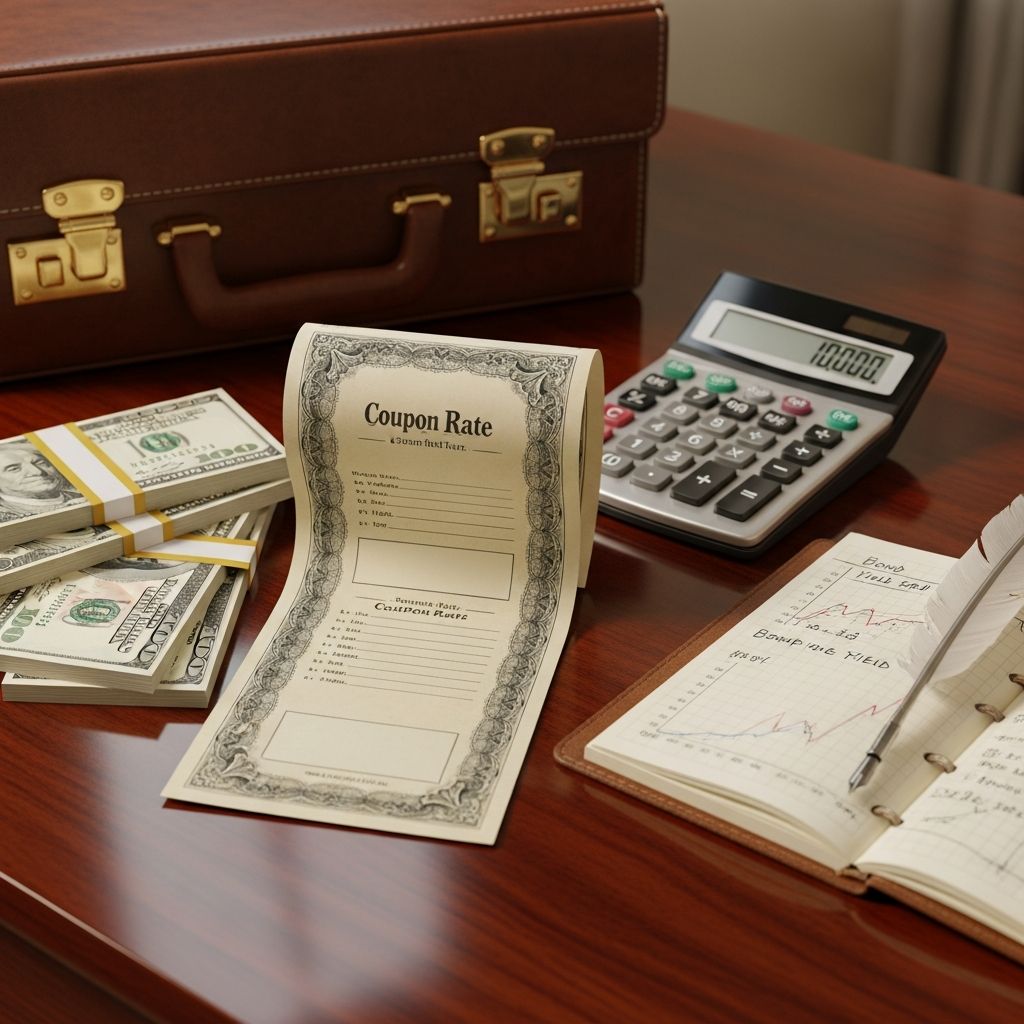
A coupon rate is the annual interest payment made by a bond issuer to bondholders, expressed as a percentage of the bond’s face value. When you purchase a bond, you are essentially lending money to the issuer, who promises to repay the principal at maturity while making regular interest payments along the way. The coupon rate determines the size of these periodic payments.
For example, if you own a bond with a face value of $1,000 and a coupon rate of 5%, the issuer will pay you $50 annually in interest, typically divided into semi-annual payments of $25 each. This coupon payment remains fixed throughout the bond’s life, regardless of changes in market interest rates or the bond’s market price.
The term “coupon” has historical roots dating back to the era of bearer bonds, when physical certificates were issued with attached coupons. Bondholders would literally clip these coupons and present them for payment on their due dates—a practice that gave rise to the phrase “clipping the coupon.”
Understanding the Coupon Rate Definition
The coupon rate is a contractual obligation established when the bond is issued. It represents the promised return to the bondholder and is fixed at the time of purchase. This is distinct from the current yield or yield-to-maturity, which can fluctuate based on market conditions and the bond’s trading price.
Bond issuers include corporations, government agencies, and municipalities. They set coupon rates based on prevailing interest rate conditions at the time of issuance. A bond issued during a high-interest-rate environment will typically offer a higher coupon rate than one issued when rates are low.
The coupon rate is calculated as:
Coupon Rate = (Annual Coupon Payment ÷ Bond Face Value) × 100
This calculation is straightforward and remains constant throughout the bond’s life, making it easy for investors to understand their expected annual income from the investment.
How to Calculate Coupon Rate
Calculating the coupon rate is a simple mathematical exercise. Let’s walk through several examples to illustrate the concept:
Basic Calculation Example
Suppose you purchase a corporate bond with the following characteristics:
- Face value: $1,000
- Annual coupon payment: $60
The coupon rate would be calculated as: ($60 ÷ $1,000) × 100 = 6%
Multiple Coupon Payments
Many bonds make semi-annual coupon payments. If a bond pays $30 every six months ($60 annually) on a $1,000 face value, the coupon rate is still 6% annually, with investors receiving $30 twice per year.
Different Face Values
Consider a municipal bond with:
- Face value: $5,000
- Annual coupon payment: $200
Coupon rate = ($200 ÷ $5,000) × 100 = 4%
The key takeaway is that the coupon rate depends entirely on the relationship between the annual payment amount and the bond’s face value. Bonds with the same coupon rate but different face values will pay different dollar amounts in interest.
Coupon Rate vs. Yield: Key Differences
While the terms are sometimes used interchangeably, coupon rate and yield are distinct concepts that often confuse new bond investors.
| Feature | Coupon Rate | Yield |
|---|---|---|
| Definition | Fixed interest payment as percentage of face value | Return earned based on current market price |
| Variation | Remains constant throughout bond life | Changes as bond price fluctuates in market |
| Determination | Set at bond issuance | Calculated from current trading price |
| Impact of Price Changes | Not affected by market price changes | Increases when price falls, decreases when price rises |
| Example | 5% on $1,000 bond = $50 annually | If same bond trades at $950, yield ≈ 5.26% |
The distinction is important because a bond’s yield reflects the actual return you’ll receive if you purchase the bond at its current market price, while the coupon rate represents only the promised interest payment as a percentage of face value.
When interest rates in the market rise after a bond is issued, newly issued bonds come with higher coupon rates. This makes existing bonds with lower coupon rates less attractive, causing their prices to fall. Conversely, when market interest rates decline, existing bonds with higher coupon rates become more valuable, and their prices increase.
Zero-Coupon Bonds
Not all bonds make regular coupon payments. Zero-coupon bonds are issued without any periodic interest payments and have a coupon rate of 0%. Instead, they are sold at a deep discount to their face value, and the investor receives a single payment equal to the face value at maturity.
For example, a zero-coupon bond with a $1,000 face value might be purchased for $500. The investor pays $500 today and receives $1,000 at maturity, with the $500 difference representing the return on the investment. The time value of money compensates the bondholder for waiting to receive their payment.
Zero-coupon bonds are attractive to investors with specific future financial needs, such as funding education or retirement, because they provide a known amount at a known future date. They are also useful for investors in lower tax brackets or tax-advantaged accounts, since the interest is not paid periodically but accrues and is taxed at maturity.
These bonds are issued by corporations, government agencies, and financial institutions. U.S. Treasury STRIPS (Separate Trading of Registered Interest and Principal Securities) are popular examples of government-issued zero-coupon bonds.
Factors Affecting Coupon Rates
Bond issuers determine coupon rates based on several important factors:
Prevailing Market Interest Rates
The most significant factor influencing coupon rates is the current interest rate environment. When the Federal Reserve raises benchmark interest rates, new bonds must offer higher coupons to attract investors. When rates fall, new bonds can be issued with lower coupon rates.
Creditworthiness of the Issuer
Bonds from issuers with higher credit ratings typically have lower coupon rates because the risk of default is minimal. Conversely, bonds from issuers with lower credit ratings or higher default risk must offer higher coupon rates to compensate investors for taking on additional risk.
Time to Maturity
Longer-term bonds generally offer higher coupon rates than shorter-term bonds because investors require greater compensation for locking up their money for extended periods. This relationship is often reflected in the yield curve.
Bond Type and Features
Callable bonds—which can be redeemed by the issuer before maturity—typically offer higher coupons than non-callable bonds. Convertible bonds, which can be converted into stock, may have lower coupons than straight bonds from the same issuer.
The Importance of Coupon Rates for Investors
Understanding coupon rates is essential for several reasons:
Income Planning
The coupon rate determines the predictable income stream you’ll receive from your bond investment. This is particularly important for retirees or conservative investors relying on fixed income.
Comparing Bond Investments
The coupon rate allows investors to quickly compare the income potential of different bonds. However, it should be considered alongside yield, price, credit quality, and maturity to make informed investment decisions.
Understanding Price Movements
Changes in interest rates affect bond prices inversely to how they affect coupon rates. A higher coupon rate provides more cushion against price declines if rates rise, while lower coupon rate bonds are more sensitive to interest rate movements.
Tax Considerations
Coupon payments are generally subject to income tax. Tax-exempt municipal bonds offer coupon payments free from federal income tax, making their effective after-tax return potentially higher than taxable bonds with similar coupon rates.
Bond Valuation and Coupon Rates
A bond’s market price between its issue date and maturity date depends on several interconnected factors:
- Face Value: The principal amount to be repaid at maturity
- Coupon Rate and Payment Frequency: The periodic interest payments relative to face value
- Time to Maturity: The remaining years until the bond matures
- Creditworthiness of Issuer: The probability that the issuer will make all promised payments
- Prevailing Market Interest Rates: Current yields on comparable bonds
When market interest rates rise above a bond’s coupon rate, the bond trades at a discount to face value. When market rates fall below the coupon rate, the bond trades at a premium. This inverse relationship is fundamental to bond investing and explains why bond prices move opposite to interest rate changes.
Types of Coupon Structures
While fixed-rate coupons are most common, some bonds feature alternative coupon structures:
Fixed-Rate Coupons
The most traditional structure, where the coupon rate remains constant throughout the bond’s life.
Floating-Rate Coupons
Bonds where the coupon rate adjusts periodically based on a reference rate, such as LIBOR or the prime rate. These bonds protect investors if interest rates rise.
Step-Up Coupons
Bonds with increasing coupon rates over time. For example, a bond might pay 3% for the first five years and 4% for the remaining years until maturity.
Decreasing Coupons
Less common, but some bonds have declining coupon rates over time.
Frequently Asked Questions
Q: Is coupon rate the same as interest rate?
A: No. The coupon rate is the fixed interest payment on a bond as a percentage of face value. Interest rates refer to the broader market rates that change constantly. When market interest rates rise, existing bonds with lower coupon rates become less attractive.
Q: Can coupon rates change during a bond’s life?
A: For fixed-rate bonds, the coupon rate remains constant. However, floating-rate bonds have coupons that adjust periodically based on market conditions and reference rates.
Q: How does a higher coupon rate affect bond price?
A: A higher coupon rate doesn’t directly determine the bond’s price, but it makes the bond more attractive if market interest rates have fallen. If rates rise after a bond is issued, a lower coupon rate will result in a lower bond price.
Q: What is a coupon payment?
A: A coupon payment is the actual dollar amount of interest paid to bondholders. It’s calculated by multiplying the coupon rate by the bond’s face value. For a $1,000 bond with a 5% coupon rate, the annual coupon payment is $50.
Q: Why do zero-coupon bonds not pay coupons?
A: Zero-coupon bonds are sold at a discount and provide all returns through the difference between the purchase price and face value received at maturity. This structure is useful for specific financial planning goals and offers tax advantages in certain situations.
Q: How do I calculate yield from a coupon rate?
A: Yield requires more complex calculations than coupon rate and depends on the bond’s current market price, time to maturity, and coupon payment frequency. If a bond trades at a discount, its yield will be higher than its coupon rate. If it trades at a premium, the yield will be lower.
References
- Coupon (Finance) — Wikipedia. https://en.wikipedia.org/wiki/Coupon_(finance)
- Bond Basics: What Are Bonds? — U.S. Securities and Exchange Commission (SEC). https://www.sec.gov/investor/pubs/bonds.pdf
- Understanding Bond Returns — The Federal Reserve. https://www.federalreserve.gov/monetary/bonds.htm
- Fixed Income Securities: Definition and Examples — FINRA (Financial Industry Regulatory Authority). https://www.finra.org/investors/learn-to-invest/types-investments/bonds
Similar Articles








Read full bio of medha deb