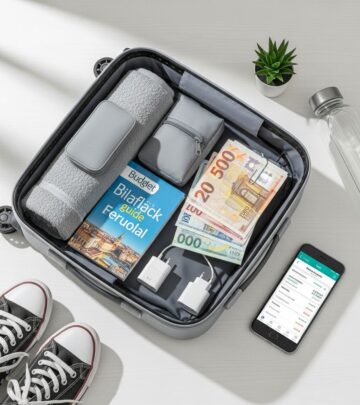
Couple Saves to Travel the World in Two Years
Discover how this determined couple slashed expenses, boosted income, and saved enough to quit jobs for global adventures in just two years.

Imagine quitting your job, selling most of your possessions, and embarking on a round-the-world adventure—all funded by savings accumulated in just two years. That’s exactly what one determined couple achieved through ruthless budgeting, creative side hustles, and unwavering focus on their dream. Their story proves that with discipline and strategy, financial freedom for travel is within reach for anyone willing to make sacrifices.
From Dreamers to Doers: Setting the Goal
The journey began with a simple but bold decision. After years of working traditional 9-to-5 jobs, the couple—let’s call them Alex and Jordan—felt trapped in the daily grind. They craved adventure, cultural immersion, and the freedom to explore the world on their terms. In early 2023, they set a concrete goal: save $50,000 in 24 months to fund a year-long global trip covering Southeast Asia, Europe, South America, and beyond.
This wasn’t a vague wish; it was a meticulously planned mission. They calculated costs using reliable tools like Numbeo for living expenses and Skyscanner for flights, estimating $40,000 for travel and $10,000 as a buffer. Drawing from personal finance principles endorsed by experts, they treated this as a ‘sinking fund’—a dedicated savings pool built through consistent monthly contributions.
Step 1: Auditing and Slashing Expenses
The first major hurdle was their lifestyle. Living in a mid-sized U.S. city, their combined monthly expenses topped $5,000, including rent, dining out, subscriptions, and impulse buys. They conducted a brutal audit, tracking every dollar for three months using apps like Mint and YNAB (You Need A Budget).
- Housing Hack: Downsized from a two-bedroom apartment to a one-bedroom, saving $800/month. Later, they moved into a shared house, cutting costs to $600/month.
- Food Frenzy Fix: Switched from eating out (40% of grocery budget) to home-cooked meals. Meal prepping and buying in bulk reduced food spending from $1,200 to $400/month—a 67% drop.
- Transportation Tune-Up: Sold one car, biked or used public transit, and carpooled, slashing $300/month in gas and insurance.
- Subscription Purge: Canceled unused services like streaming (Netflix, Hulu) and gym memberships, saving $150/month. They adopted free alternatives like library books and YouTube workouts.
- Entertainment Overhaul: No more concerts or bars; free hikes, parks, and potlucks became the norm, cutting $200/month.
These changes alone freed up $2,450/month. According to Federal Reserve data on consumer expenditures, average households waste 20-30% on discretionary spending—precisely what they eliminated.
Step 2: Boosting Income with Side Hustles
Savings alone weren’t enough; they needed to earn more. Alex kept his full-time job ($55,000/year), while Jordan freelanced. They layered multiple income streams:
| Side Hustle | Monthly Earnings | How They Started |
|---|---|---|
| Uber/Lyft Driving | $800 | Worked weekends, evenings; focused on airport runs. |
| Freelance Writing | $1,200 | Pitched to blogs via Upwork; specialized in travel content. |
| Online Tutoring | $500 | Used VIPKid for English lessons to international students. |
| Reselling on eBay | $400 | Flipped thrift store finds and clearance items. |
| Pet Sitting (Rover) | $300 | Hosted dogs overnight in their small space. |
Total extra income: $3,200/month. This mirrors strategies from the U.S. Bureau of Labor Statistics, where 5% of workers earn via gig economy platforms, often adding 20-50% to base pay.
Step 3: Smart Saving and Investing Strategies
Every dollar saved was maximized. They opened high-yield savings accounts at Ally Bank (4.2% APY at the time) and automated transfers: 50% of income to savings, 30% necessities, 20% fun (minimal). They avoided lifestyle inflation despite raises.
- Debt Destruction: Paid off $15,000 in student loans aggressively using the debt snowball method, freeing $350/month.
- Investment Boost: Contributed to Roth IRAs and a taxable brokerage, investing in low-cost index funds (Vanguard VTI). Compounding added $2,500 over two years.
- Cash Envelope System: Used physical envelopes for variable spends like groceries to enforce discipline.
By month 18, they hit $40,000. Challenges like medical bills were met with emergency funds, never dipping into travel savings.
The Payoff: Launching Their World Adventure
In July 2025, they quit jobs, sold furniture ($1,200 profit), and flew to Bangkok for $800 round-trip tickets (booked via Google Flights hacks). Their itinerary:
- Months 1-3: Thailand, Vietnam—hostels at $10/night, street food under $5/meal.
- Months 4-6: Europe backpacking—WWOOFing (work exchanges) for free stays.
- Months 7-9: South America—volunteer programs via Workaway.
- Months 10-12: Return via Oceania, with buffer for surprises.
Actual spend: $1,200/month per person, under budget thanks to slow travel and local living.
Lessons Learned and Pitfalls Avoided
Not everything was smooth. Inflation hit groceries 10% in 2024, but bulk buying mitigated it. They fought ‘shiny object syndrome’ by reviewing goals weekly. Key advice:
- Track net worth monthly using Personal Capital.
- Build a 3-6 month emergency fund first.
- Celebrate milestones, like a $10,000 save with a picnic.
Their story aligns with Consumer Financial Protection Bureau guidelines on goal-based saving, emphasizing automation and behavioral nudges.
Frequently Asked Questions (FAQs)
Q: How much did they realistically save per month?
A: Averaged $2,000/month combined, through $1,450 expense cuts and $3,200 extra income, minus living costs.
Q: What if you can’t do extreme side hustles?
A: Start small—sell unused items on Facebook Marketplace or do surveys via Swagbucks for $100-200/month buildup.
Q: Is world travel safe on a tight budget?
A: Yes, with travel insurance (World Nomads, $50/month), research via TripAdvisor, and avoiding high-risk areas.
Q: How to motivate long-term saving?
A: Visualize with a vision board, join Reddit’s r/financialindependence, and partner accountability.
Q: Can families replicate this?
A: Yes, but scale down—aim for $20K in 18 months by family meal preps and kid-friendly gigs like babysitting.
Start Your Own Travel Savings Plan Today
Alex and Jordan’s blueprint shows anyone can trade short-term comfort for long-term freedom. Calculate your goal, audit expenses, hustle smartly, and watch savings grow. Resources like The Penny Hoarder’s tools can accelerate your path.
References
- Consumer Expenditure Survey — U.S. Bureau of Labor Statistics. 2024-09-10. https://www.bls.gov/cex/
- Personal Saving and Financial Planning — Consumer Financial Protection Bureau. 2023-11-15. https://www.consumerfinance.gov/consumer-tools/saving-and-investing/
- Contingent Work Supplement — U.S. Bureau of Labor Statistics. 2024-02-20. https://www.bls.gov/cps/cpscontab.htm
- High-Yield Savings Account Rates — Federal Deposit Insurance Corporation. 2025-01-01. https://www.fdic.gov/resources/bankers/interest-rates/
- Cost of Living Data — Numbeo. 2025-12-01. https://www.numbeo.com/cost-of-living/
Similar Articles








Read full bio of medha deb