Cost Of Electric Cars: 2026 Buyer’S Guide To True Costs
Uncover the true costs of owning an electric car, from upfront prices and incentives to ongoing fees, charging, and long-term savings.

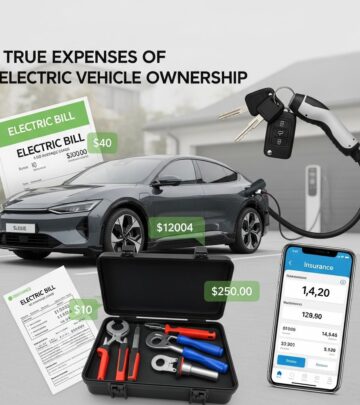
Electric vehicles (EVs) promise lower operating costs and environmental benefits, but their total cost of ownership involves more than just the sticker price. This article breaks down upfront costs, incentives, ongoing fees, charging expenses, insurance, maintenance, and real-world factors to help you decide if an EV is worth it.
Upfront Purchase Price of Electric Cars
The initial cost of electric cars remains a primary barrier for many buyers. In 2026, popular models range widely based on size, range, and features. Entry-level EVs like the Nissan Leaf start around $28,000, while premium options like the Tesla Model S exceed $90,000. Midsize crossovers, such as the Hyundai Ioniq 5 or Kia EV6, typically fall between $40,000 and $55,000, offering family-friendly space and 250-300 miles of range.
Compared to gas-powered equivalents, EVs often carry a 20-30% premium. For instance, a comparable gas SUV might cost $35,000, while its EV counterpart hits $45,000. However, rapid advancements in battery technology and manufacturing scale are driving prices down, with average new EV prices dropping 15% year-over-year.
| Model | Starting Price (2026) | Range (miles) |
|---|---|---|
| Nissan Leaf | $28,000 | 212 |
| Hyundai Ioniq 5 | $42,000 | 303 |
| Tesla Model 3 | $40,000 | 341 |
| Ford F-150 Lightning | $50,000 | 320 |
| Tesla Model Y | $45,000 | 330 |
This table highlights affordable yet capable options. Prices exclude incentives, which can significantly reduce the effective cost.
Federal and State Incentives for EVs
Government incentives make EVs more accessible. The federal clean vehicle tax credit, previously up to $7,500 for new EVs and $4,000 for used ones, has evolved by 2026. Eligible buyers can still claim credits for North American-assembled vehicles meeting battery sourcing rules, though some changes occurred post-2025. Check IRS guidelines for current eligibility based on income and vehicle qualifications.
State incentives vary: California offers rebates up to $7,500 via the Clean Vehicle Rebate Project, while Colorado provides $5,000. These can stack with federal credits, potentially slashing $10,000-$15,000 off the price. Utility companies often add rebates for home charger installation, up to $1,000.
- Federal tax credit: Up to $7,500 (new), $4,000 (used)
- State rebates: $2,000-$7,500 depending on location
- Utility incentives: $500-$1,500 for chargers
- HOV lane access and exemptions from emissions testing in many states
Registration Fees and Road Taxes for EVs
One hidden cost: Many states impose extra registration fees on EVs to offset lost gas tax revenue. As EV adoption rises—1.2 million sold in 2024 alone—gas taxes, which fund roads, decline. By 2026, 39 states charge EV fees from $50-$400 annually.
In Ohio, it’s $200 extra; Michigan spiked to $267 for light-duty EVs; Texas hits $400 for new registrations and $200 yearly. These fees support road maintenance and charger infrastructure.
| State | EV Registration Fee |
|---|---|
| Texas | $400 (new), $200 annual |
| Michigan | $267 annual |
| Ohio | $200 annual |
| Florida | $225+ (increasing) |
| California | $100-$175 + road usage pilot |
Some states like Hawaii and Oregon pilot per-mile road usage charges ($0.08/mile up to $50/year) as fairer alternatives.
Insurance Costs for Electric Vehicles
EV insurance averages 20-30% higher than gas cars due to repair costs—batteries and tech components are pricey. A Tesla Model 3 might cost $2,200 annually vs. $1,700 for a Toyota Camry. Factors include vehicle value, driver profile, and location. Shopping multiple insurers and bundling policies can save 10-15%.
However, safe driving discounts and EV-specific programs from insurers like Progressive offset some increases. Always get quotes pre-purchase.
Home Charging Setup Costs
Convenient home charging is essential, but installation isn’t cheap. Level 2 chargers cost $200-$700 (e.g., Emporia 48-amp at $399). Electrician fees add $1,000-$2,000, including panel upgrades or load management to avoid overloads.
Total: $1,500-$3,000. Renters may use portable Level 1 chargers ($200) with standard outlets, adding 3-5 miles/hour. Incentives from utilities reduce this.
- Level 1 (120V): Free outlet, slow charge
- Level 2 (240V): $500-$2,500 installed, 20-60 miles/hour
- DC Fast (public): $0.30-$0.60/kWh, 100+ miles in 30 min
Electricity vs. Gas: Operating Costs
EVs shine here: Charging costs $0.04-$0.15/mile vs. $0.12-$0.20 for gas. A 300-mile EV trip costs $12-$45 electricity vs. $36-$60 gas. Annual savings: $800-$1,300 for 12,000 miles.
Home rates average $0.16/kWh; public chargers $0.30+. Time-of-use plans lower off-peak costs. Cold weather reduces efficiency 20-40%, as heat draws power.
Maintenance and Repair Costs
Fewer moving parts mean lower maintenance: No oil changes, simpler brakes (regenerative braking). Annual costs: $0.02-$0.05/mile vs. $0.08-$0.10 for gas cars. Tires wear faster on heavy EVs, though.
Battery replacement (rare before 150,000 miles) costs $5,000-$20,000, but warranties cover 8 years/100,000 miles. Overall, 10-year savings exceed $5,000.
Total Cost of Ownership Breakdown
Over 5 years/60,000 miles:
| Category | EV | Gas Car | Savings |
|---|---|---|---|
| Purchase (after incentives) | $35,000 | $30,000 | -$5,000 |
| Fuel/Charging | $1,200 | $6,000 | +$4,800 |
| Maintenance | $949 | $4,628 | +$3,679 |
| Insurance | $10,000 | $8,500 | -$1,500 |
| Registration/Fees | $2,500 | $1,500 | -$1,000 |
| Total | $49,649 | $50,628 | +$979 |
EVs break even in 2-4 years, with greater savings long-term.
Real-World EV Ownership Costs
Owners report surprises: Public chargers unreliable (e.g., gym spots taken), range drops in cold (260 miles to 220 with heat on Hyundai Ioniq 5). Still, satisfaction is high for those with home charging.
Florida sees gas tax losses from 254,900 EVs; high-adoption states like California predict 64% revenue drop by 2040 without alternatives.
Frequently Asked Questions (FAQs)
How much does it cost to charge an EV at home?
Average $0.04-$0.15 per mile, or $12-$45 for 300 miles, depending on rates.
Are EV registration fees higher?
Yes, 39 states add $50-$400 annually to replace gas taxes.
What’s the cheapest EV in 2026?
Nissan Leaf at ~$28,000 base.
Do EVs save on maintenance?
Yes, ~50% less over 10 years due to fewer parts.
Is home charger installation required?
Not required, but recommended; costs $1,500-$3,000.
References
- 4 Things I Wish I Knew Before Buying an Electric Car — The Penny Hoarder. 2024. https://www.thepennyhoarder.com/save-money/know-before-buying-an-ev/
- GM hit with $6 billion in charges as EV incentives cut — CT Post. 2026-01-12. https://www.ctpost.com/business/article/gm-hit-with-6-billion-in-charges-as-ev-21285585.php
- Michigan EV fees spike under road funding deal — Michigan Thumb. 2026. https://www.michigansthumb.com/news/article/michigan-ev-fees-spike-under-road-funding-deal-21284512.php
- More electric vehicles means less gas tax revenue — ClickOrlando. 2026-01-12. https://www.clickorlando.com/insider/2026/01/12/more-electric-vehicles-means-less-gas-tax-revenue-how-this-impacts-floridas-budget/
- Is the Cost of Electric Cars Really Worth It? — The Penny Hoarder. 2024. https://www.thepennyhoarder.com/save-money/cost-of-electric-cars/
Similar Articles








Read full bio of Sneha Tete