Cost of Capital: Definition, Calculation & Importance
Master cost of capital calculations to make smarter investment and financing decisions.

What Is Cost of Capital?
Cost of capital represents the minimum rate of return or profit that a company must earn before generating genuine value for its stakeholders. It serves as a critical financial metric that helps business leaders, accounting departments, and investors determine whether proposed investments justify their upfront costs and risks. Essentially, cost of capital establishes the threshold that any new project, investment, or business initiative must exceed to create shareholder value and contribute positively to the company’s overall financial performance.
Companies use cost of capital as a fundamental decision-making tool. When evaluating new ventures or expansion opportunities, business leaders must understand how much return these initiatives need to generate to offset their initial investment and achieve profitability. Additionally, cost of capital helps organizations assess the potential risk associated with future business decisions, allowing them to make more informed strategic choices about capital allocation and resource deployment.
For investors and creditors, understanding a company’s cost of capital provides insight into the financial risk profile of the organization. A higher cost of capital suggests greater risk, while a lower cost of capital may indicate a more stable, established business with stronger credit profiles and market positioning.
Why Cost of Capital Matters
Cost of capital serves multiple crucial functions in corporate finance and investment analysis. First, it establishes a benchmark for evaluating investment opportunities and determining which projects deserve funding. By comparing potential returns against the cost of capital, companies can prioritize investments that will create the most shareholder value. Second, it influences a company’s capital structure decisions, affecting how much debt and equity financing the organization uses. Third, it impacts corporate valuation, as the cost of capital serves as the discount rate when calculating the present value of future cash flows. Finally, understanding cost of capital helps companies communicate with investors about risk and return expectations.
Components of Cost of Capital
Cost of capital comprises several interconnected components that work together to provide a comprehensive picture of a company’s financing costs. The three primary components include cost of debt, cost of equity, and weighted average cost of capital (WACC). Understanding each component and how they interact is essential for accurate financial analysis and strategic planning.
Cost of Debt
Cost of debt represents the effective rate of interest a company pays on its borrowed funds, including bonds, loans, and other debt instruments. This metric reflects the average rate of return that debt holders (creditors and bondholders) require for providing capital to the company. One straightforward method for calculating cost of debt involves adding all interest expenses for each debt source throughout the year and dividing by the total amount of debt outstanding.
A more comprehensive formula for calculating cost of debt considers the risk profile and tax implications:
Cost of Debt = (Risk-Free Rate of Return + Credit Spread) × (1 – Tax Rate)
This formula incorporates three key components:
- Risk-Free Rate of Return: Typically determined from the yield on U.S. government securities, representing the baseline return without credit risk
- Credit Spread: The additional yield that investors demand over Treasury bonds, reflecting the company’s credit quality and default risk
- Tax Rate: The corporate tax percentage, important because interest payments on debt are tax-deductible, creating a tax shield that reduces the effective cost
The tax adjustment is particularly significant because it acknowledges that interest expenses reduce taxable income, effectively lowering the true cost of debt for the company. Companies with higher tax rates benefit more substantially from this deduction.
Cost of Equity
Cost of equity represents the return that shareholders demand for investing their capital in the company. Unlike debt holders who receive fixed interest payments, equity investors expect returns through stock price appreciation and dividends. Calculating cost of equity is inherently more challenging than calculating cost of debt because it depends on stakeholder expectations, company estimates, historical performance data, and comparisons to similar firms.
The most widely used method for calculating cost of equity is the Capital Asset Pricing Model (CAPM), which explicitly factors in the relationship between an investment’s risk and its expected return:
Cost of Equity = Risk-Free Rate of Return + Beta × (Market Rate of Return – Risk-Free Rate of Return)
The components of this formula include:
- Risk-Free Rate of Return: The yield on U.S. government securities, serving as the baseline return
- Market Rate of Return: The average historical return of broader stock market indices, such as the S&P 500 or Dow Jones Industrial Average
- Beta: A measure of the stock’s volatility relative to the overall market, indicating how much more or less risky the investment is compared to the market average
For companies that distribute dividends to shareholders, an alternative approach called the Dividend Capitalization Model offers another way to estimate cost of equity:
Cost of Equity = (Dividends per Share / Current Market Value of Stocks) + (Dividend Growth Rate)
This model uses:
- Dividends per Share: The annual cash dividend paid to shareholders on a per-share basis
- Current Market Value of Stocks: The present market price of the company’s shares
- Dividend Growth Rate: The annual percentage rate at which dividends are expected to grow over time
Early-stage companies often lack substantial debt capacity and instead rely on equity financing, which involves raising capital by selling company shares. This approach helps newer firms raise necessary funds despite limited operating histories and asset bases.
Weighted Average Cost of Capital (WACC)
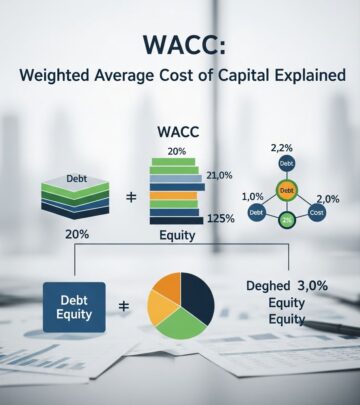
The weighted average cost of capital (WACC) represents the most comprehensive and commonly used method for calculating overall cost of capital. WACC calculates the average rate of return required by all investors—both debt and equity holders—weighted according to their proportional contribution to the company’s total capital structure.
WACC is calculated using the following formula:
WACC = (E/V × Re) + ((D/V × Rd) × (1 – T))
Where:
- E: Market value of the firm’s equity
- D: Market value of the firm’s debt
- V: Total value of capital (equity plus debt combined)
- E/V: Percentage of total capital financed through equity
- D/V: Percentage of total capital financed through debt
- Re: Cost of equity (required rate of return for equity investors)
- Rd: Cost of debt (yield on company’s debt)
- T: Corporate tax rate
WACC serves multiple important functions in corporate finance. It establishes the minimum rate of return that new projects and investments must generate to create shareholder value. It helps investors and analysts gauge the risk profile associated with a company’s cash flows and assess the attractiveness of company shares and potential acquisitions. Additionally, WACC provides the appropriate discount rate for calculating the present value of future cash flows in valuation models.
A high WACC calculation suggests that a company’s stock is volatile or its debt carries elevated risk, indicating that investors will demand greater returns to compensate for this additional risk. Conversely, a lower WACC suggests a more stable company with lower financial risk.
Applications and Strategic Importance
Understanding and calculating cost of capital has profound implications for business strategy and financial decision-making. Capital structure optimization represents one key application where companies regularly review their mix of debt and equity to improve efficiency and reduce expenses. For example, a retail organization might decide to decrease its dependence on high-interest debt to lower overall financing costs. By recalculating cost of capital using different capital structures, the company can identify the most cost-efficient balance between debt and equity financing.
Improving capital structure can potentially increase shareholder value by reducing the hurdle rate—the lowest rate of return that an initiative must achieve before it’s considered acceptable—for future investments. This creates more opportunities for value-accretive projects to meet the company’s investment threshold.
Frequently Asked Questions
Q: What is the difference between cost of capital and cost of equity?
A: Cost of equity specifically represents the return demanded by shareholders for their investment, while cost of capital is a broader metric that encompasses both the cost of debt and cost of equity weighted by their proportions in the capital structure.
Q: Why is WACC considered the most important cost of capital metric?
A: WACC is considered most important because it provides a comprehensive measure of the overall cost of financing for a company, incorporating both debt and equity sources at their actual proportions. This makes it the most appropriate discount rate for valuation and investment decisions.
Q: How does tax rate affect cost of capital calculations?
A: Tax rate primarily affects cost of debt calculations because interest payments are tax-deductible. A higher tax rate increases the tax shield benefit, effectively lowering the after-tax cost of debt and potentially making debt financing more attractive relative to equity financing.
Q: Can cost of capital change over time?
A: Yes, cost of capital can fluctuate based on changes in market conditions, interest rates, company risk profile, credit ratings, and economic factors. Companies should periodically recalculate their cost of capital to ensure accuracy in their financial analyses and investment decisions.
Q: How do companies use cost of capital in practice?
A: Companies use cost of capital to evaluate investment opportunities, establish capital budgets, determine appropriate discount rates for valuation models, assess financial risk, and make strategic decisions about capital structure optimization and financing arrangements.
References
- Cost of Capital: What It Is & How to Calculate It — Harvard Business School Online. 2024. https://online.hbs.edu/blog/post/cost-of-capital
- Weighted Average Cost of Capital (WACC) — Corporate Finance Institute. 2024. https://corporatefinanceinstitute.com/resources/valuation/wacc-weighted-average-cost-of-capital/
- Capital Asset Pricing Model — U.S. Securities and Exchange Commission. 2024. https://www.sec.gov/
Similar Articles








Read full bio of Sneha Tete