Cost Accounting: Definition, Methods, and Applications
Master cost accounting: Essential strategies for tracking production costs and optimizing profitability.
Understanding Cost Accounting
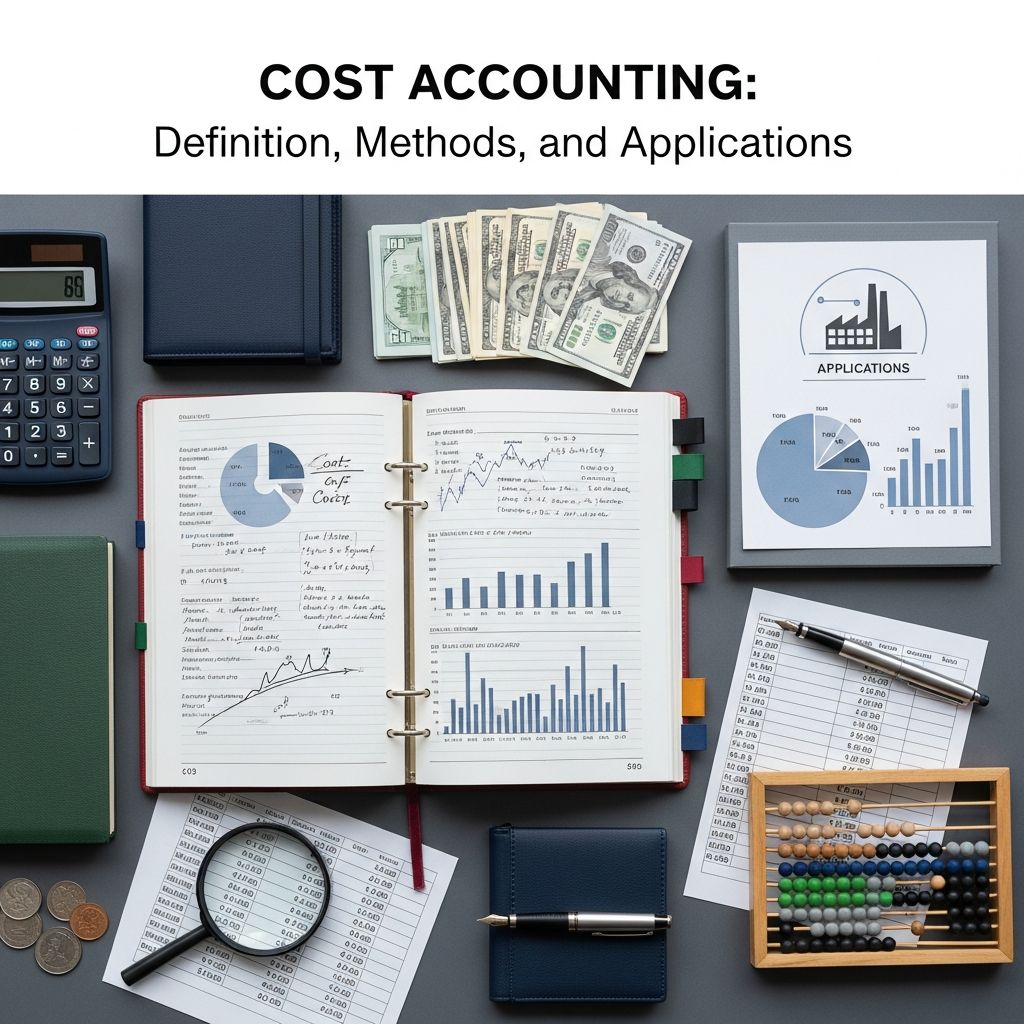
Cost accounting is a systematic method that allows companies to capture and analyze the total costs associated with their production processes. Unlike financial accounting, which focuses on reporting to external stakeholders, cost accounting serves as an internal management tool designed to help business leaders make informed decisions about resource allocation, pricing strategies, and operational efficiency.
The primary objective of cost accounting is to measure, record, and assign input costs and fixed costs to specific products, services, or departments. By breaking down production expenses into detailed categories, organizations gain clear visibility into where their money is being spent and can identify opportunities to reduce waste and improve profitability.
Cost Accounting vs. Financial Accounting
While both cost accounting and financial accounting deal with a company’s financial information, they serve fundamentally different purposes and audiences.
Key Differences
Purpose: Financial accounting presents a company’s overall financial performance to external parties such as investors, creditors, and regulatory bodies. Cost accounting, conversely, is exclusively for internal use by management to support decision-making processes.
Classification Approach: In financial accounting, costs are classified based on the type of transaction that occurred. Cost accounting, however, classifies costs according to the specific information needs of management. This flexibility allows different departments or companies to adapt their cost accounting systems to their unique operational requirements.
Regulatory Standards: Financial accounting must comply with Generally Accepted Accounting Principles (GAAP) and other regulatory frameworks. Cost accounting, being an internal tool, does not need to adhere to any specific standard, allowing it to vary significantly from company to company or even from department to department within the same organization.
Reporting Audience: Financial accounting results are presented in standardized formats such as balance sheets, income statements, and cash flow statements for external stakeholders. Cost accounting reports are customized for internal management use and may include detailed breakdowns of departmental costs, product profitability analyses, and budget comparisons.
Historical Development of Cost Accounting
The practice of tracking and managing business costs has evolved significantly over nearly two centuries. During the early 19th century, as economists like David Ricardo and T.R. Malthus were developing economic theory, pioneers such as Charles Babbage were writing the first practical guides to help businesses manage their internal cost accounting systems. These early works laid the foundation for modern cost management practices.
By the beginning of the 20th century, cost accounting had become a widely discussed and implemented topic in business management literature. As manufacturing became more complex and companies grew larger, the need for systematic cost tracking and analysis became increasingly apparent. Today, cost accounting remains a cornerstone of effective business management.
Applications of Cost Accounting in Business
Cost accounting serves multiple critical functions within an organization:
Budgeting and Planning
One of the most valuable applications of cost accounting is in developing accurate budgets and strategic plans. By understanding historical cost patterns and current operational efficiency, management can project future resource needs and establish realistic financial targets.
Cost Control Programs
Cost accounting enables organizations to implement effective cost control programs that monitor actual spending against planned budgets. When variances occur, management can investigate root causes and take corrective action to improve net margins and operational efficiency.
Product and Service Pricing
Accurate cost accounting provides the foundation for setting competitive yet profitable prices. By understanding the true cost of producing each product or service, companies can ensure they cover expenses and generate desired profit margins.
Performance Evaluation
Cost accounting helps organizations evaluate the efficiency of different departments, production processes, and individual products. This information enables management to identify high-performing areas to expand and underperforming areas requiring improvement or restructuring.
Standard Cost Accounting
Standard cost accounting is a traditional approach that uses predetermined cost standards to evaluate actual performance. This method relies on ratios and benchmarks that compare the efficient use of labor and materials to produce goods or services under standard conditions.
How Standard Costing Works
In standard cost accounting, management establishes predetermined standards for the costs of materials, labor, and overhead required to produce a unit of output. These standards are based on historical data, industry benchmarks, and expected efficiency levels.
Variance Analysis
Once actual production occurs, accountants compare actual costs to the predetermined standards. The differences between actual and standard costs are called variances. Assessing these variances is known as variance analysis, and it helps management identify where production deviated from expectations and why.
Limitations of Traditional Costing
Traditional cost accounting allocates overhead costs using a single measure, typically direct labor hours or machine hours. However, in modern manufacturing environments, overhead costs have risen proportionately to labor costs since the genesis of standard cost accounting. As a result, allocating all overhead costs as a single lump sum has sometimes produced misleading insights into true product profitability and resource usage.
Additionally, standard cost accounting emphasizes labor efficiency despite the fact that direct labor often represents a comparatively small percentage of total production costs in contemporary manufacturing. This focus may lead management to optimize the wrong metrics and miss opportunities for more meaningful cost reductions.
Activity-Based Costing
Activity-based costing (ABC) represents a more sophisticated and accurate approach to cost allocation that addresses many limitations of traditional costing methods.
Core Principles of Activity-Based Costing
Activity-based costing accumulates overhead costs from each department and assigns them to specific cost objects such as individual services, customer accounts, or products. Rather than using a single allocation measure, ABC recognizes that different activities drive different types of overhead costs.
Cost Drivers and Activity Analysis
The first step in implementing activity-based costing is conducting an activity analysis to identify the key factors that drive costs in each department. These cost drivers represent the activities that consume resources and generate overhead expenses. For example, machine setup time, quality inspections, or customer service calls might serve as cost drivers depending on the business.
Once cost drivers are identified, accountants assign overhead costs to cost objects based on their actual consumption of each activity. This approach tends to be much more accurate and helpful when assisting managers in understanding the true cost and profitability of their company’s specific services or products.
Implementation Process
Implementing activity-based costing typically involves surveying employees to understand how they allocate their time across different tasks and activities. Employees account for the percentage of time they spend on various functions throughout the production process. This detailed time tracking gives management a clearer picture of where their time and money is actually being spent, providing insights that simple labor hour allocations cannot reveal.
Advantages of Activity-Based Costing
Activity-based costing offers several significant advantages over traditional costing methods. It provides more accurate product cost information, helps identify inefficient processes, improves pricing decisions, and enables better product mix decisions. Organizations using ABC often discover that certain products thought to be highly profitable are actually barely profitable when true costs are assigned.
Choosing the Right Cost Accounting Method
The selection of an appropriate cost accounting method depends on several factors:
Industry Characteristics
Manufacturing companies with straightforward, labor-intensive processes may find traditional standard costing adequate. However, companies with diverse products, complex overhead structures, or service-oriented operations typically benefit from activity-based costing.
Organizational Complexity
As companies grow and their operations become more complex, the limitations of simple costing methods become more apparent. Larger organizations often migrate toward more sophisticated costing approaches to maintain decision-making accuracy.
Management Information Needs
Different organizations have different information requirements. Some need detailed product profitability analysis, while others prioritize departmental cost tracking. The cost accounting method should align with these specific information needs.
Cost-Benefit Considerations
While more sophisticated costing methods provide better information, they also require greater investment in systems, training, and ongoing data collection. Management must weigh the benefits of improved accuracy against implementation costs.
Challenges in Cost Accounting
Organizations face several challenges when implementing and maintaining effective cost accounting systems:
Data Collection and Accuracy
Accurate cost accounting requires reliable data collection across all operations. Incomplete, inaccurate, or untimely data can compromise the quality of cost information and lead to poor decisions.
Overhead Allocation Complexity
Allocating overhead costs fairly and accurately remains a significant challenge. Different allocation methods can produce substantially different product cost conclusions.
Changing Cost Structures
As operations evolve, cost structures change. Cost accounting systems must be regularly reviewed and updated to reflect new realities, or they risk becoming obsolete and misleading.
Balancing Accuracy with Simplicity
While greater detail improves accuracy, overly complex systems become difficult to maintain and understand. Organizations must balance the desire for accuracy with the need for practicality and clarity.
Best Practices in Cost Accounting
Organizations implementing effective cost accounting systems typically follow these best practices:
First, establish clear cost accounting objectives aligned with overall business strategy. Understand what decisions the cost accounting system must support and design it accordingly. Second, implement robust data collection systems that capture costs accurately and timely. Third, regularly review and validate cost calculations to ensure accuracy. Fourth, communicate cost accounting findings clearly to management to support decision-making. Fifth, periodically reassess the cost accounting method to ensure it remains appropriate for current operations. Sixth, integrate cost accounting with other business intelligence systems to provide comprehensive decision support.
The Future of Cost Accounting
Cost accounting continues to evolve as technology advances and business environments become more complex. Automation and artificial intelligence are increasingly used to collect, process, and analyze cost data. Real-time cost accounting systems are becoming more feasible, allowing managers to access current profitability information immediately rather than waiting for monthly or quarterly reports. Additionally, as sustainability becomes more important, many organizations are incorporating environmental and social costs into their cost accounting frameworks.
Frequently Asked Questions
Q: What is the primary purpose of cost accounting?
A: The primary purpose of cost accounting is to capture, measure, and analyze a company’s production costs to support management decision-making regarding budgeting, pricing, cost control, and operational efficiency.
Q: How does cost accounting differ from financial accounting?
A: Cost accounting is an internal management tool that classifies costs according to management information needs and is not bound by GAAP standards. Financial accounting, by contrast, reports to external stakeholders following standardized regulatory requirements.
Q: What are the main methods of cost accounting?
A: The two primary methods are standard cost accounting, which uses predetermined cost standards and variance analysis, and activity-based costing, which allocates costs based on the activities that drive them.
Q: What are cost drivers in activity-based costing?
A: Cost drivers are the factors or activities that cause costs to be incurred. Examples include machine setup time, labor hours, quality inspections, or customer service calls. Activity-based costing assigns overhead costs to products or services based on their consumption of these cost drivers.
Q: When should a company use activity-based costing instead of standard costing?
A: Companies with diverse product lines, complex overhead structures, multiple departments, or service-oriented operations typically benefit from activity-based costing because it provides more accurate cost information than traditional methods.
Q: How can cost accounting improve profitability?
A: By providing accurate information about product costs, departmental efficiency, and resource utilization, cost accounting enables management to identify cost reduction opportunities, set appropriate prices, optimize product mix, and improve overall operational efficiency.
References
- Definition and Explanation of Cost Accounting — Investopedia. Accessed November 2025. https://www.investopedia.com/terms/c/cost-accounting.asp
- Generally Accepted Accounting Principles (GAAP) — Financial Accounting Standards Board (FASB). Accessed November 2025. https://www.fasb.org
- Activity-Based Costing: Best Practices for Implementation — Institute of Management Accountants (IMA). 2024. https://www.imanet.org
- Cost Accounting Methods and Variance Analysis — American Accounting Association. 2023. https://aaahq.org
- Management Accounting: Theory and Practice — Chartered Institute of Management Accountants (CIMA). 2024. https://www.cimaglobal.com
Similar Articles








Read full bio of medha deb