Conditional Value at Risk (CVaR): Definition and Calculation
Understand CVaR, a critical risk metric for measuring extreme portfolio losses.
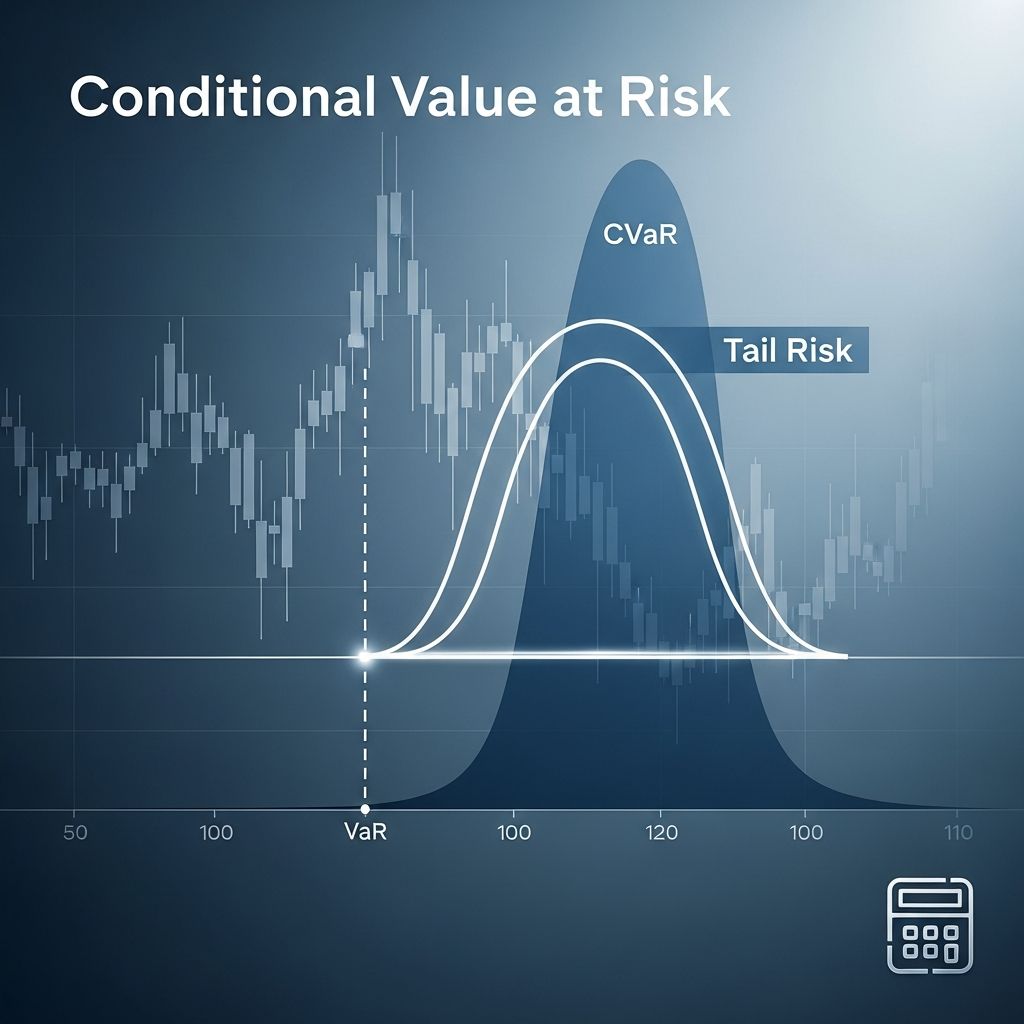
What Is Conditional Value at Risk (CVaR)?
Conditional Value at Risk, commonly abbreviated as CVaR, is an advanced risk assessment metric used by financial professionals and investors to quantify the expected loss of an investment or portfolio during extreme market conditions. Also known as Expected Shortfall (ES), Tail Value at Risk (TVaR), Average Value at Risk (AVaR), or Expected Tail Loss (ETL), CVaR provides a more comprehensive understanding of portfolio risk beyond traditional Value at Risk (VaR) measurements. Unlike VaR, which estimates the maximum loss at a specific confidence level, CVaR calculates the average of losses that exceed the VaR threshold, offering insight into what happens in the worst-case scenarios.
CVaR is particularly valuable for assessing the risk of investments with non-normal return distributions, including those characterized by fat tails or significant skewness. Financial institutions and sophisticated investors use CVaR as a cornerstone tool for stress testing, scenario analysis, risk budgeting, and capital allocation decisions. By focusing on tail risk—the probability of extreme losses—CVaR enables better understanding of potential catastrophic outcomes that traditional metrics might underestimate.
Understanding CVaR vs. Value at Risk (VaR)
While CVaR and VaR are both essential risk management tools, they serve different purposes and provide different levels of insight into portfolio risk. Value at Risk measures the potential loss of an investment or portfolio at a specific confidence level, typically expressed as a percentage such as 95% or 99%. VaR provides a single point estimate—a threshold beyond which losses are unlikely to occur with a given probability.
Conditional Value at Risk, by contrast, measures the expected loss beyond that VaR threshold. If a portfolio has a 95% confidence level VaR of $100,000, it means there is a 5% chance the portfolio could lose more than $100,000 in a given period. CVaR would then calculate the average loss in that worst 5% of scenarios, providing a more complete picture of downside risk.
The key distinction is that CVaR is a more conservative and robust measure because it focuses on the severity of losses in extreme scenarios rather than just identifying a threshold. This property makes CVaR a coherent risk measure, suitable for portfolio optimization and comprehensive risk management strategies. For assets with non-normal distributions or fat-tail characteristics—where extreme events occur more frequently than normal distributions suggest—CVaR provides significantly more valuable insights than VaR alone.
Key Concepts in CVaR Analysis
To fully understand Conditional Value at Risk, investors and risk managers must grasp several fundamental concepts that underpin CVaR calculations and interpretations.
Confidence Level
The confidence level represents the degree of certainty used in CVaR calculations to define the worst possible outcomes. Expressed as a percentage—commonly 95%, 99%, or 99.9%—the confidence level determines the threshold beyond which CVaR measures expected losses. A 95% confidence level means CVaR focuses on the average loss in the worst 5% of scenarios. A 99% confidence level concentrates on the worst 1% of outcomes, providing a more severe stress test.
Probability Distribution of Losses
CVaR relies on understanding the probability distribution of potential losses associated with an investment or portfolio. This distribution represents the likelihood of different loss magnitudes occurring under various market conditions. Real-world distributions often deviate from the normal distribution, exhibiting fat tails where extreme losses occur more frequently than traditional models predict.
Tail Risk
Tail risk refers to the probability of extreme losses occurring—the left tail of the return distribution. CVaR explicitly focuses on tail risk, providing estimates of losses during these catastrophic scenarios. This focus distinguishes CVaR from traditional risk measures that may underestimate the impact of tail events, which historically cause significant portfolio damage.
How Is CVaR Calculated?
CVaR calculation methods vary depending on the nature of the underlying distribution and the complexity of the portfolio. Understanding these different approaches helps investors choose the most appropriate methodology for their specific situation.
Discrete Distribution Method
When the probability distribution is discrete with specific, identifiable outcomes, CVaR is calculated as the weighted average of the losses beyond the specified confidence level. For example, if a portfolio has distinct scenarios with assigned probabilities, the analyst identifies all losses exceeding the VaR threshold at the chosen confidence level, weights them by their respective probabilities, and calculates the average. This method is straightforward when outcomes are clearly defined and limited in number.
Continuous Distribution Method
For continuous probability distributions, CVaR calculation employs calculus-based integration. The method integrates the losses multiplied by their corresponding probability densities beyond the specified confidence level. Mathematically, this provides a precise measure of the average loss in the tail of the distribution. However, this approach can be complex for non-standard distributions, requiring sophisticated mathematical techniques.
Monte Carlo Simulation
For complex distributions, large portfolios with hundreds or thousands of positions, or when analytical solutions are impractical, Monte Carlo simulation provides a powerful computational approach. This method involves simulating a large number of potential market scenarios—often thousands or millions—based on historical data and estimated volatilities and correlations. For each simulation, the portfolio’s return is calculated. The analyst then identifies the worst-case scenarios at the chosen confidence level and calculates their average loss. Monte Carlo simulation is particularly valuable for portfolios with derivatives, non-linear payoff structures, or highly correlated assets.
Interpreting CVaR Results
CVaR results can be expressed in multiple formats, each providing different perspectives on portfolio risk. Understanding these representations ensures proper application in risk management decisions.
Dollar Value Expression
CVaR is frequently expressed as a dollar amount representing the expected loss in worst-case scenarios. For instance, a statement like “95% CVaR equals $500,000” means that in the worst 5% of scenarios, the portfolio is expected to lose an average of $500,000 over a specified time period (typically one day or ten days for regulatory purposes).
Percentage Expression
CVaR can also be expressed as a percentage of the portfolio’s total value, facilitating comparisons across portfolios of different sizes. A “95% CVaR of 3%” indicates that in extreme scenarios at the 95% confidence level, the portfolio is expected to lose an average of 3% of its value.
Risk Comparison Between Portfolios
By comparing CVaR values of different assets or portfolios, investors can make more informed decisions about their investment allocations and risk management strategies. A portfolio with lower CVaR at the same confidence level presents less severe tail risk. However, investors must consider the context—a lower CVaR might come with reduced expected returns, requiring careful trade-off analysis.
Advantages of Using CVaR
Conditional Value at Risk offers several compelling advantages over traditional risk measures, explaining its increasing adoption among sophisticated investors and financial institutions.
Comprehensive Tail Risk Assessment
CVaR captures not just the threshold of extreme losses but their average magnitude. This provides a more complete understanding of portfolio behavior during crises than VaR’s single point estimate. Investors gain insight into “how bad” things can get, not just “how likely” extreme losses are.
Coherent Risk Measure Properties
CVaR exhibits mathematical properties that make it a coherent risk measure, supporting sound portfolio optimization. These properties ensure that CVaR behaves logically when combining risks—for example, diversification always reduces CVaR, as theory suggests it should.
Better Handling of Non-Normal Distributions
Many financial assets exhibit returns with fat tails and skewness. CVaR explicitly addresses these characteristics, providing more accurate risk estimates for such investments compared to VaR or standard deviation-based measures that assume normal distributions.
Stress Testing and Scenario Analysis Foundation
CVaR serves as a key input for stress testing and scenario analysis, allowing financial institutions to assess their resilience to extreme market events. By understanding expected losses in severe conditions, institutions can develop contingency plans and ensure adequate capital buffers.
Risk Budgeting and Capital Allocation
CVaR provides a foundation for risk budgeting, helping institutions determine how much risk to take in different asset classes or investment strategies. By establishing CVaR limits across business units, organizations can allocate capital efficiently while maintaining enterprise-wide risk controls.
Limitations and Considerations
While CVaR offers significant advantages, investors should understand its limitations. CVaR relies on historical data and model assumptions that may not predict future events accurately, particularly during unprecedented market conditions. Tail events, by definition, occur rarely, making historical estimation challenging. Additionally, CVaR calculations can be mathematically complex and computationally intensive, particularly for large, complex portfolios. Furthermore, different calculation methodologies can produce varying results, requiring careful method selection and validation.
Practical Applications in Finance
CVaR has become increasingly important across multiple financial domains. Regulatory frameworks, including Basel III banking standards, increasingly reference expected shortfall metrics. Asset managers use CVaR for portfolio construction and rebalancing decisions. Risk officers employ CVaR in enterprise-wide risk frameworks. Insurance companies apply CVaR concepts to assess catastrophic loss scenarios. Hedge funds utilize CVaR in investment decision-making and client reporting.
Frequently Asked Questions
What does Conditional Value at Risk (CVaR) measure?
CVaR measures the expected loss of an investment or portfolio in extreme market conditions. Specifically, it calculates the average of the losses that exceed the Value at Risk threshold at a given confidence level, providing an estimate of what the typical loss might be in the worst-case scenarios.
How does CVaR differ from Value at Risk (VaR)?
VaR measures the potential loss at a specific confidence level, providing a single threshold estimate. CVaR goes further by measuring the average loss beyond that VaR threshold. While VaR asks “what is the maximum loss at 95% confidence?”, CVaR asks “if losses exceed the 95% confidence threshold, what is the average loss?” This makes CVaR a more conservative measure of tail risk.
What confidence levels are typically used for CVaR?
Common confidence levels include 95%, 99%, and 99.9%. A 95% confidence level means CVaR focuses on the average loss in the worst 5% of scenarios. Higher confidence levels like 99% concentrate on more extreme tail events, providing stress tests for truly catastrophic outcomes.
Can CVaR be applied to all types of investments?
CVaR is particularly useful for investments with non-normal return distributions, including those with fat tails or significant skewness. While it can technically be applied to any investment, it provides the most valuable insights for complex portfolios, derivatives, and assets exhibiting extreme event behavior more frequently than traditional models predict.
What are the main limitations of CVaR?
CVaR relies on historical data to estimate future risk, which may not account for unprecedented market conditions. Tail events occur infrequently, making statistical estimation challenging. Different calculation methodologies can produce varying results. Additionally, CVaR calculations can be computationally complex and require sophisticated modeling expertise.
How is CVaR used in risk management?
CVaR serves multiple risk management functions: it provides input for stress testing and scenario analysis, helps determine portfolio resilience to extreme events, supports risk budgeting decisions across business units, facilitates capital allocation decisions, and helps establish risk limits across different asset classes and investment strategies.
References
- Conditional Value at Risk (CVaR): Meaning, Pros, and Cons — Finance Strategists. Retrieved November 2025. https://www.financestrategists.com/wealth-management/risk-profile/conditional-value-at-risk-cvar/
- Extensions of VaR — AnalystPrep CFA Study Notes. Retrieved November 2025. https://analystprep.com/study-notes/cfa-level-2/describe-extensions-of-var/
- Expected Shortfall — Wikimedia Foundation. Retrieved November 2025. https://en.wikipedia.org/wiki/Expected_shortfall
Similar Articles








Read full bio of Sneha Tete