Compounding: The Power of Earning Interest on Interest
Master the concept of compounding and harness its power to grow your wealth exponentially.
Understanding Compounding: The Eighth Wonder of the World
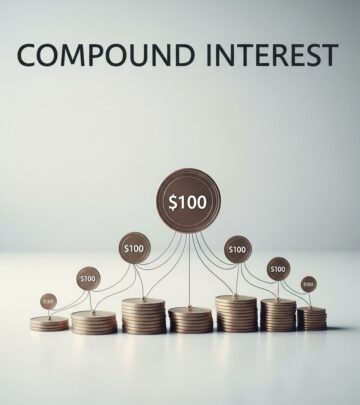
Compounding is often referred to as one of the most powerful concepts in finance, and for good reason. It describes the process of earning returns on your original investment plus all the accumulated interest or earnings over time. In essence, compounding means earning “interest on interest,” which creates exponential growth rather than linear growth. This fundamental principle has enabled countless investors to build substantial wealth over decades, making it a cornerstone of long-term financial success.
Albert Einstein allegedly called compound interest the eighth wonder of the world, and this quote captures the transformative potential of this financial concept. When you understand and harness the power of compounding, you unlock the ability to grow your wealth substantially with relatively modest initial investments, provided you allow enough time for the magic of compounding to work in your favor.
Simple Interest vs. Compound Interest
To fully grasp the power of compounding, it’s essential to understand how it differs from simple interest. Simple interest is calculated only on the original principal amount, regardless of how much time has passed or how much interest has been earned. This is a straightforward, linear calculation.
Let’s examine a practical example. Suppose you deposit $10,000 into a high-interest savings account at a 5% simple interest rate for three years. With simple interest, you would earn 5% of $10,000 annually, which equals $500 per year. Over three years, this totals $1,500 in interest, regardless of how the money accumulates.
Now consider the same $10,000 invested at 5% interest but with annual compounding. In year one, you still earn $500 in interest, bringing your total to $10,500. However, in year two, the calculation changes dramatically. You now earn 5% on $10,500 (your original principal plus the accumulated interest), which equals $525. By year three, you’re earning 5% on $11,025, resulting in an interest payment of $551.25. In total, you earn $1,576.25 in interest over the three-year period with compounding, compared to just $1,500 with simple interest.
While the difference of $76.25 might seem modest in this short-term example, this difference grows exponentially as the time period extends. This is where the true power of compounding becomes evident.
How Compounding Works
The mechanics of compounding are straightforward but profound. Every time your investment earns returns—whether through interest, dividends, or capital appreciation—those returns become part of your principal. In the next compounding period, you earn returns not just on your original investment but on this larger amount. This creates a snowball effect where your wealth accelerates over time.
The compounding effect becomes particularly powerful over longer time periods. While a few years might show modest differences between simple and compound interest, decades of compounding can transform small, regular investments into substantial wealth. This is why starting early with investing, even with small amounts, can lead to dramatic wealth accumulation by retirement.
Several factors influence how effectively compounding works for you:
- Initial Investment: The larger your starting amount, the more your money has to work with and compound upon.
- Interest Rate or Return: Higher rates of return amplify the compounding effect. A 10% annual return will compound much more dramatically than a 2% return.
- Time Period: Time is arguably the most critical factor. The longer your money compounds, the greater the effect. Even modest returns can become substantial over 20, 30, or 40 years.
- Compounding Frequency: How often interest is compounded matters significantly. Daily compounding produces better results than annual compounding, which produces better results than quarterly compounding.
- Regular Contributions: Adding money regularly to your investment amplifies the compounding effect substantially.
The Formula for Compound Interest
The mathematical formula for compound interest is:
A = P(1 + r/n)^(nt)
Where:
- A = the final amount
- P = the principal (initial investment)
- r = the annual interest rate (expressed as a decimal)
- n = the number of times interest is compounded per year
- t = the number of years
Using our previous example of $10,000 at 5% annual interest compounded annually for 3 years: A = $10,000(1 + 0.05/1)^(1×3) = $10,000(1.05)^3 = $11,576.25. This matches our earlier calculation, confirming that you would have $11,576.25 after three years, representing $1,576.25 in earned interest.
Real-World Applications of Compounding
Retirement Savings
One of the most significant applications of compounding is in retirement planning. When you contribute to retirement accounts like 401(k)s or IRAs early in your career, your money has decades to compound. A 25-year-old who invests $6,500 annually in an IRA earning an average of 7% annually will accumulate significantly more by age 65 than someone who starts at age 35, even if the latter person invests larger amounts annually. The extra decade of compounding makes an enormous difference.
Stock Market Investing
Long-term stock market investors benefit tremendously from compounding. When you reinvest dividends rather than spending them, you’re harnessing the power of compounding. Additionally, capital appreciation compounds as the stock price increases. Many of history’s wealthiest individuals have built their fortunes primarily through the compounding effect of stock market investments over several decades.
Debt and Credit Cards
Compounding works against you when you’re carrying debt, particularly with credit cards. Credit card interest compounds daily, meaning that unpaid balances grow exponentially. This is why high-interest debt can quickly become overwhelming if not addressed promptly.
Compounding Frequency and Its Impact
The frequency with which interest compounds significantly affects your returns. Consider the difference between various compounding scenarios on a $10,000 investment at 5% annual interest over 10 years:
| Compounding Frequency | Final Amount | Total Interest Earned |
|---|---|---|
| Annually | $16,288.95 | $6,288.95 |
| Semi-Annually | $16,386.16 | $6,386.16 |
| Quarterly | $16,436.55 | $6,436.55 |
| Monthly | $16,470.09 | $6,470.09 |
| Daily | $16,486.65 | $6,486.65 |
As you can see, more frequent compounding produces better results. However, the differences become marginal after monthly compounding. Banks and financial institutions compete for customers partly by offering daily compounding, which maximizes returns for savers.
The Negative Side of Compounding
While compounding is generally presented as a positive force in finance, it’s essential to recognize that it can work against you when dealing with debt. Credit card debt, personal loans, and other high-interest obligations can compound negatively, causing your debt to spiral if left unmanaged. This is why financial experts emphasize the importance of paying off high-interest debt as quickly as possible—the longer it compounds, the more you ultimately pay.
Additionally, inflation can compound negatively against your purchasing power. If your investments don’t earn returns that exceed the inflation rate, your money’s real value decreases over time, even though the nominal amount might stay the same or grow modestly.
Strategies to Maximize Compounding Benefits
Start Early
The most powerful lever in compounding is time. Starting to invest even small amounts in your twenties will yield dramatically better results by retirement than starting in your forties. Time allows your initial investments and accumulated returns to compound extensively.
Invest Consistently
Regular contributions to your investments amplify the compounding effect. Dollar-cost averaging through regular contributions reduces the impact of market volatility and ensures you’re continuously adding to the base amount that compounds.
Reinvest Earnings
Rather than spending dividends, capital gains, or interest earned from your investments, reinvest them. This allows earnings to compound upon themselves, accelerating wealth accumulation.
Seek Higher Returns Within Your Risk Tolerance
While higher returns come with higher risk, finding investments that align with your risk tolerance and historical return expectations can significantly amplify compounding. A difference of just 2-3% in annual returns, compounded over decades, can result in hundreds of thousands of dollars in additional wealth.
Minimize Fees and Costs
Investment fees and transaction costs reduce the amount available to compound. Choosing low-cost index funds or using fee-only financial advisors can preserve more of your wealth for compounding.
Frequently Asked Questions
Q: How long does it take for compounding to show significant results?
A: The “Rule of 72” provides a quick estimate. Divide 72 by your annual return rate to determine approximately how many years it takes for your money to double. At 8% annual returns, your money approximately doubles every 9 years (72/8 = 9).
Q: Does compounding work the same for all investment types?
A: While the principle is the same, the frequency and mechanism differ. Savings accounts and bonds typically compound interest, stocks compound through dividend reinvestment and capital appreciation, and real estate compounds through property appreciation and rental income reinvestment.
Q: How can I overcome the negative effects of compounding debt?
A: Pay off high-interest debt as aggressively as possible. The longer debt compounds, the more total interest you’ll pay. Prioritize credit cards and personal loans, then focus on lower-interest debt.
Q: Is compound interest better than simple interest?
A: For investors and savers, yes. Compound interest always yields better returns over time. However, borrowers prefer simple interest since they pay less total interest on loans.
Q: What role does inflation play in compounding?
A: Inflation erodes purchasing power over time. It’s important that your investment returns exceed inflation to ensure real wealth growth. A 5% return is less impressive if inflation is 4%, as your real return is only 1%.
References
- What Is Compound Interest? — Investopedia. 2024. https://www.investopedia.com/terms/c/compounding.asp
- Understanding The Time Value Of Money — Investopedia. 2024. https://www.investopedia.com/articles/03/082703.asp
- U.S. Securities and Exchange Commission: Compound Interest — U.S. SEC. 2024. https://www.investor.gov/
- Understanding Compounding and Your Investments — Federal Reserve System. 2024. https://www.federalreserveeducation.org/
Similar Articles








Read full bio of Sneha Tete