Compound Interest: Building Wealth Through Time
Master compound interest: the powerful force multiplying wealth over time through earning returns on returns.

What Is Compound Interest?
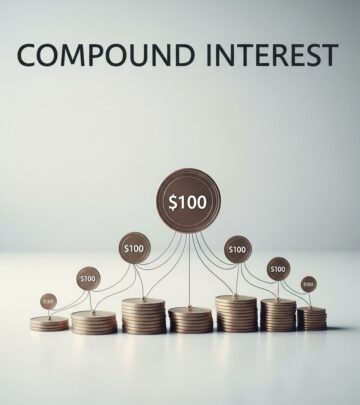
Compound interest represents one of the most powerful concepts in finance and investing. It is the interest earned on an initial investment plus all the accumulated interest from previous periods. Often described as “interest on interest,” compound interest is the mechanism through which your money can grow exponentially over time rather than linearly. This phenomenon occurs when the returns generated by an investment are reinvested, creating a snowball effect where each successive period generates earnings on a larger base.
The fundamental principle behind compound interest is that as your investment grows, the interest calculations apply to an increasingly larger amount. This creates a compounding effect where the growth rate accelerates, particularly over extended time horizons. Whether you are saving for retirement, building an emergency fund, or investing in the stock market, understanding compound interest is essential for making informed financial decisions and maximizing your long-term wealth accumulation.
Compound Interest vs. Simple Interest
To fully appreciate the power of compound interest, it is important to contrast it with simple interest, which represents a more basic approach to calculating returns on investment.
Simple interest is calculated only on the principal amount—the original sum invested or borrowed. With simple interest, you earn the same amount of interest each period, regardless of how much total interest has accumulated. For example, if you deposit $10,000 into a savings account earning 5% simple interest annually, you would earn $500 each year for three years, totaling $1,500 in interest regardless of the time period.
Compound interest, by contrast, calculates interest on both the principal and the accumulated interest from previous periods. Using the same $10,000 initial deposit at 5% interest compounded annually over three years illustrates the difference. In year one, you earn $500 (5% of $10,000). In year two, you earn $525 (5% of $10,500, which includes your year one interest). In year three, you earn $551.25 (5% of $11,025). Over the three-year period, compound interest generates $1,576.25 in total interest compared to only $1,500 with simple interest—a difference of $76.25.
This $76.25 difference may seem modest, but the power of compounding becomes increasingly significant over longer time periods and with higher interest rates or investment returns. This is why Albert Einstein reportedly referred to compound interest as the eighth wonder of the world.
The Compound Interest Formula
Understanding the mathematical formula behind compound interest allows you to calculate potential returns and make more informed investment decisions. The compound interest formula is:
A = P(1 + r/n)^(nt)
Where:
- A = Final amount (principal plus interest)
- P = Principal (initial investment amount)
- r = Annual interest rate (expressed as a decimal)
- n = Number of times interest is compounded per year
- t = Number of years the money is invested
Let’s apply this formula to a practical example. Suppose you invest $5,000 at an annual interest rate of 6%, compounded quarterly, for five years:
- P = $5,000
- r = 0.06
- n = 4 (quarterly compounding)
- t = 5
A = $5,000(1 + 0.06/4)^(4×5) = $5,000(1.015)^20 = $6,734.28
In this scenario, your initial $5,000 investment would grow to $6,734.28, earning $1,734.28 in compound interest over five years.
How Compounding Frequency Affects Growth
The frequency at which interest is compounded significantly impacts the total returns on an investment. Common compounding frequencies include:
- Annual compounding: Interest is calculated and added once per year
- Semi-annual compounding: Interest is calculated twice per year
- Quarterly compounding: Interest is calculated four times per year
- Monthly compounding: Interest is calculated twelve times per year
- Daily compounding: Interest is calculated 365 times per year
- Continuous compounding: Interest is calculated infinitely, using the mathematical constant e
As the compounding frequency increases, the total amount of interest earned also increases. For example, $1,000 invested at 5% annual interest for one year would yield:
- Annual compounding: $1,050.00
- Quarterly compounding: $1,050.95
- Monthly compounding: $1,051.14
- Daily compounding: $1,051.27
While the differences may appear small over short periods, they become substantial over decades of investing, making compounding frequency an important consideration when selecting savings accounts, bonds, or other fixed-income investments.
The Time Value of Money and Compound Interest
Compound interest is intrinsically linked to the concept of the time value of money, which holds that a dollar received today is worth more than a dollar received in the future. This principle exists because money available now can be invested to generate additional returns. By understanding compound interest, you gain insight into why starting to invest early is one of the most effective strategies for building long-term wealth.
Time is your greatest ally in leveraging compound interest. An investor who begins contributing to a retirement account at age 25 will accumulate significantly more wealth by age 65 than someone who starts at age 35, even if the latter contributes larger amounts annually. The additional ten years of compounding growth can more than compensate for lower annual contributions made earlier.
Real-World Applications of Compound Interest
Savings Accounts and Certificates of Deposit (CDs): Banks use compound interest to calculate returns on savings accounts and certificates of deposit. Higher compounding frequencies and interest rates both contribute to faster wealth accumulation for savers.
Bonds and Fixed-Income Securities: When bond interest payments are reinvested, compound interest accelerates total returns. This is particularly significant for long-term bond holdings.
Stock Market Investing: Dividend-paying stocks offer opportunities for compound growth when dividends are reinvested to purchase additional shares. Over decades, this dividend reinvestment strategy can dramatically increase portfolio value.
Retirement Accounts: 401(k)s, IRAs, and other retirement accounts benefit tremendously from compound interest. The tax-advantaged growth within these accounts, combined with long time horizons, creates powerful compounding effects.
Mortgages and Loans: Compound interest works against borrowers when taking out loans. Understanding how interest compounds on borrowed money helps borrowers appreciate the importance of paying down debt quickly.
Strategies to Maximize Compound Interest
Start Early: The most impactful strategy is to begin investing as soon as possible. Even modest initial investments grow substantially with sufficient time and appropriate returns.
Invest Consistently: Regular contributions through dollar-cost averaging add new principal that can compound independently, accelerating overall wealth growth.
Reinvest Earnings: Rather than withdrawing interest and dividends, reinvesting them allows those earnings to compound, creating exponential growth.
Seek Higher Returns: While risk tolerance varies among investors, slightly higher-yielding investments can result in significantly greater wealth accumulation over time due to compounding effects.
Minimize Fees and Taxes: Investment fees and tax drag reduce the effective returns available for compounding. Strategies like tax-loss harvesting and selecting low-cost index funds preserve more capital for compounding.
Extend Your Time Horizon: The longer you allow your investments to compound, the more powerful the effect becomes. Avoiding early withdrawals and staying invested through market cycles is crucial.
The Negative Side of Compound Interest
While compound interest offers tremendous benefits for savers and investors, it works against consumers carrying debt. Credit card balances, for example, accrue compound interest at high rates, causing debt to grow rapidly if only minimum payments are made. Understanding this darker application of compounding emphasizes the importance of avoiding high-interest debt and paying down balances strategically.
Frequently Asked Questions
Q: What is the difference between compound interest and simple interest?
A: Simple interest is calculated only on the principal amount, while compound interest is calculated on both the principal and accumulated interest from previous periods. This makes compound interest grow exponentially while simple interest grows linearly.
Q: How often should interest be compounded for optimal growth?
A: More frequent compounding results in higher returns. Daily or continuous compounding generates slightly more interest than annual or quarterly compounding. However, the differences diminish with lower interest rates.
Q: When does compound interest start to show significant benefits?
A: Compound interest becomes increasingly powerful over extended time periods, typically showing substantial benefits after 10-20 years. The longer your investment horizon, the more dramatic the compounding effect.
Q: How can I calculate compound interest for my investments?
A: Use the compound interest formula A = P(1 + r/n)^(nt), or use online calculators provided by financial institutions and investment platforms.
Q: Is compound interest the same for all types of investments?
A: No. Different investments compound at different rates. Savings accounts, bonds, stocks, and real estate all have different compounding characteristics based on their returns and how those returns are reinvested.
References
- Compound Interest Calculator — U.S. Securities and Exchange Commission. 2024. https://www.investor.gov/financial-tools-calculators/calculators/compound-interest-calculator
- The Power of Compound Interest — U.S. Department of the Treasury Bureau of the Fiscal Service. 2024. https://www.treasurydirect.gov/
- Understanding Compound Interest and Investment Growth — Federal Reserve Board of Governors. 2024. https://www.federalreserve.gov/
- Time Value of Money — CFA Institute. 2023. https://www.cfainstitute.org/
Similar Articles








Read full bio of medha deb