Components of GDP: Explanation, Formula and Chart
Master GDP components: Learn the formula, calculation methods, and economic impact of consumption, investment, government spending, and net exports.
Understanding Gross Domestic Product and Its Components
Gross Domestic Product, commonly referred to as GDP, represents the total monetary value of all finished goods and services produced within a country’s borders during a specific time period. GDP serves as a primary indicator of a nation’s economic health and standard of living. Understanding the components of GDP is essential for economists, policymakers, investors, and anyone interested in comprehending how an economy functions. The GDP can be calculated using different methodologies, each offering unique insights into economic activity. The most widely used approach is the expenditure method, which breaks down GDP into four distinct components that together paint a comprehensive picture of economic spending and production.
The GDP Formula: Breaking Down the Components
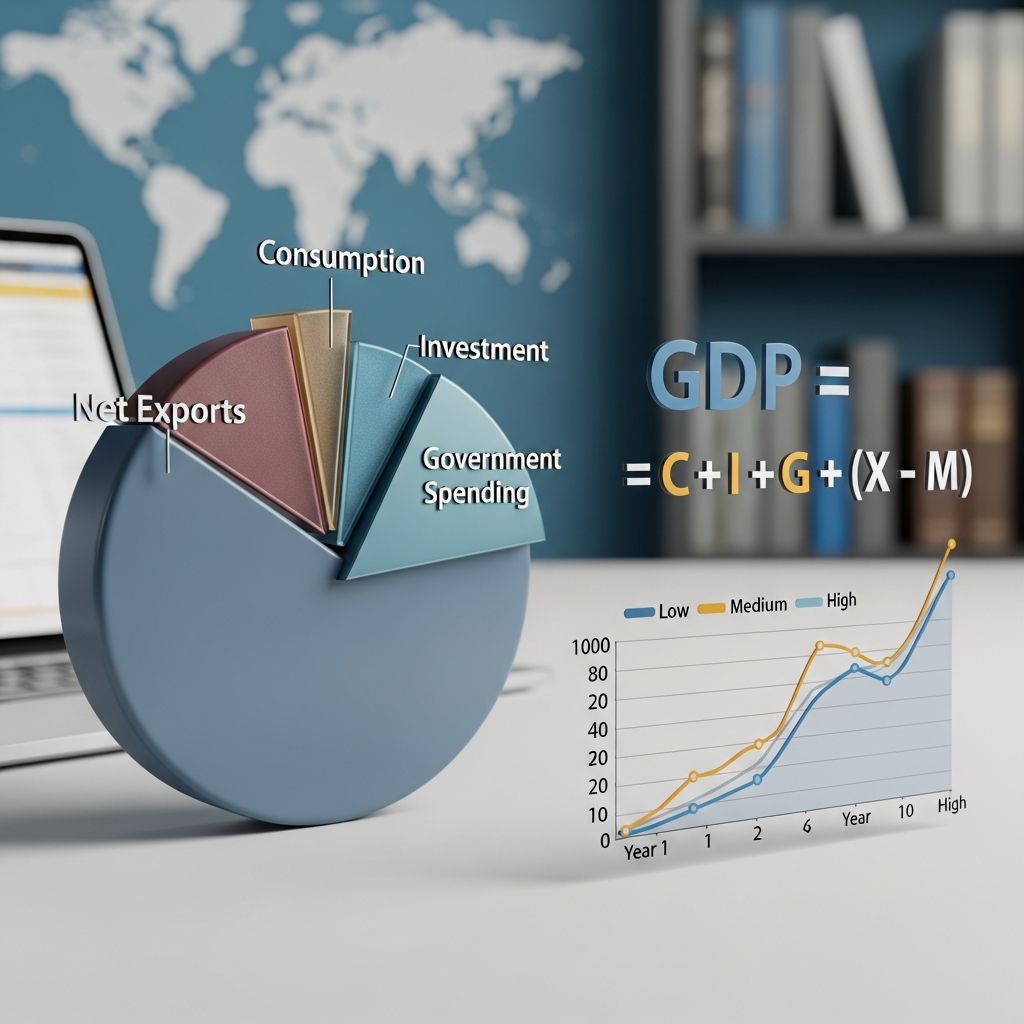
The fundamental GDP formula used by economists and government statisticians worldwide is expressed as:
GDP = C + I + G + (X − M)
This elegant formula encapsulates all economic activity within a nation. Each letter represents a crucial component of total economic spending. Understanding what each component encompasses helps analysts and policymakers assess different segments of the economy and identify which sectors are driving growth or contraction. Let’s examine each component in detail to understand how they contribute to the overall economic picture.
Consumption (C): The Largest Component
Consumption represents the total amount of goods and services purchased by households and individuals within an economy. This is the largest component of GDP in most developed economies, typically accounting for 60-70% of total economic output. Consumer spending includes durable goods such as automobiles and appliances, non-durable goods like food and clothing, and services including healthcare, entertainment, and education.
Consumer confidence plays a vital role in determining consumption levels. When individuals feel optimistic about their employment prospects and financial future, they tend to spend more, which stimulates economic growth. Conversely, during periods of economic uncertainty or recession, consumers become more cautious, reducing spending and potentially slowing economic growth. Higher consumption is generally considered a sign of a healthy economy, as it signifies strong consumer confidence and purchasing power.
Investment (I): Building Future Capacity
Investment refers to the sum of a country’s expenditures on capital equipment, inventories, and housing. This component captures spending by businesses on machinery, equipment, technology, and infrastructure, as well as residential investment in new homes and apartment buildings. Investment also includes changes in business inventories, which represent goods held for future sale.
It’s important to note that investment in this context refers to business investment in physical capital, not financial investment such as stock purchases or bond holdings. Financial investments represent transfers of existing assets rather than the creation of new productive capacity. Investment spending is crucial for long-term economic growth because it increases the economy’s productive capacity and enables future output expansion.
Government Spending (G): Public Sector Contributions
Government spending encompasses all expenditures made by federal, state, and local governments on goods and services. This includes salaries paid to government employees, construction and repair of roads and infrastructure, funding for public schools, military expenditures, and purchases of equipment and supplies. However, it’s crucial to understand that government spending in the GDP equation only includes purchases of final goods and services, not transfer payments such as Social Security or welfare benefits.
Transfer payments are excluded from GDP calculations because they represent redistribution of existing income rather than payment for newly produced goods or services. Government spending is financed through taxation, borrowing, or business revenue, and it plays a significant role in stabilizing the economy during downturns through fiscal stimulus programs.
Net Exports (X − M): International Trade Balance
Net exports represent a country’s total exports of goods and services minus its total imports of goods and services. When a nation exports more than it imports, net exports are positive, indicating a trade surplus. Conversely, when imports exceed exports, net exports are negative, reflecting a trade deficit.
Exports contribute positively to GDP because they represent domestically produced goods and services sold to foreign buyers. Imports are subtracted from GDP because they are expenditures on foreign-produced goods and services that should not be counted toward domestic production. The net exports component can significantly influence GDP growth rates, particularly for nations heavily dependent on international trade.
Three Methods for Calculating GDP
While the expenditure approach is the most commonly used method, economists recognize three distinct approaches to calculating GDP, each providing valuable perspectives on economic activity.
The Expenditure Approach
The expenditure approach, also known as the spending approach, calculates GDP by summing all expenditures made within an economy. This method is based on the principle that all products must be purchased by somebody, therefore the value of total output must equal people’s total expenditures in buying things. The formula is straightforward and intuitive: GDP = C + I + G + (X − M).
To illustrate this approach with an example, if consumers spend 50 billion on goods and services, businesses invest 30 billion in capital equipment and housing, government spends 40 billion on public services and infrastructure, and net exports equal 10 billion (exports minus imports), the total GDP would be 130 billion. The expenditure approach is particularly useful for tracking short-term economic fluctuations and understanding how different spending categories contribute to growth.
The Income Approach
The income approach measures GDP by adding all income earned in the economy, including wages, profits, interest, and rent. This method operates on the principle that the incomes of productive factors must equal the value of their product. According to national income accounting, incomes are typically divided into five categories: wages and salaries, corporate profits, interest and miscellaneous investment income, income earned by sole proprietors, and net income from transfer payments.
To convert net domestic income at factor cost to GDP using the income approach, two adjustments must be made: adding taxes on production and imports minus subsidies, and adding depreciation (capital consumption allowance) to convert from net domestic product to gross domestic product. For example, if total wages are 70 billion, corporate profits are 50 billion, rent is 10 billion, and interest is 20 billion, the GDP would total 150 billion. This approach provides insight into how income is distributed across different factors of production.
The Production Approach
The production approach, also known as the output approach, calculates overall economic value by summing the outputs of every class of enterprise and then deducting intermediate goods to avoid double counting. This method measures the value added by different sectors—agriculture, industry, and services—throughout the production process.
A key principle of this approach is that only final goods and services count toward GDP, not intermediate goods. For instance, if a bakery produces bread using flour, only the value of the final bread is counted in GDP, not the flour used in production (to prevent double counting). The production approach requires calculating the gross value of output at factor cost and subtracting each sector’s intermediate consumption to arrive at gross value added, which equals GDP at factor cost.
Understanding Final vs. Intermediate Goods
A critical concept in GDP calculation is the distinction between final and intermediate goods. Final goods and services are those purchased for end use by consumers, businesses, or governments. Intermediate goods and services are those used by businesses to produce other goods and services within the accounting year.
For example, when a car manufacturer purchases auto parts to assemble a vehicle and then sells the finished car, only the final car’s value is counted toward GDP, not the individual parts. However, if a consumer purchases replacement auto parts to install on their existing car, those are counted toward GDP because they represent a final sale to the end user. This distinction prevents double counting and ensures GDP accurately reflects the true value of economic production.
Components of GDP by Expenditure: Detailed Breakdown
| Component | Definition | Examples | Typical % of GDP |
|---|---|---|---|
| Consumption (C) | Private consumer spending on goods and services | Food, clothing, healthcare, entertainment | 60-70% |
| Investment (I) | Business spending on capital goods and housing | Machinery, factories, residential construction | 15-20% |
| Government Spending (G) | Government purchases of goods and services | Military, infrastructure, public education | 15-20% |
| Net Exports (X-M) | Exports minus imports of goods and services | Agricultural products, technology, services | -5% to 5% |
Nominal vs. Real GDP
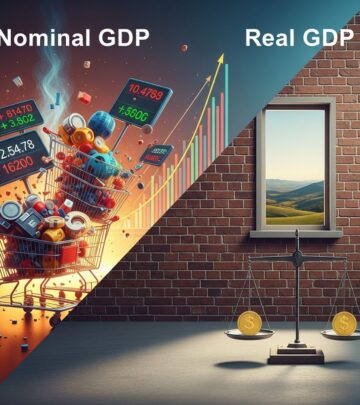
When analyzing GDP data, it’s important to distinguish between nominal GDP and real GDP. Nominal GDP represents the total value of all goods and services produced at current market prices over a time period, including the effects of inflation or deflation. This figure can be misleading because increases in GDP might simply reflect price increases rather than actual increases in production.
Real GDP, by contrast, adjusts for inflation or deflation to reflect the true change in production volume. Real GDP is calculated by using constant prices from a base year, allowing economists to compare economic output across different time periods on an apples-to-apples basis. When policymakers and economists discuss economic growth rates, they typically reference real GDP to ensure meaningful comparisons.
The Income Components of GDP
When calculating GDP using the income approach, economists break down national income into specific components. These include compensation of employees (wages and salaries), net operating surplus of private and public corporations, mixed income from self-employment and housing, and taxes on goods and services less subsidies. Understanding these income components reveals how economic value is distributed among workers, business owners, and government.
Frequently Asked Questions
Q: What is the most important component of GDP?
A: Consumption (C) is typically the most important component of GDP in developed economies, usually accounting for 60-70% of total economic output. Consumer spending directly reflects household confidence and purchasing power, making it a critical indicator of economic health.
Q: Why are transfer payments excluded from GDP?
A: Transfer payments like Social Security and unemployment benefits are excluded from GDP because they represent redistribution of existing income rather than payment for newly produced goods or services. They don’t contribute to current economic production.
Q: How does a trade deficit affect GDP?
A: A trade deficit (imports exceeding exports) reduces GDP because net exports become negative. This means foreign-produced goods are being purchased instead of domestically produced ones, reducing the contribution to national GDP.
Q: What’s the difference between investment and financial assets?
A: Investment in GDP refers to business spending on physical capital like machinery and buildings, plus residential construction. Financial investments like stock purchases don’t count toward GDP because they’re transfers of existing assets, not creation of new productive capacity.
Q: Why do economists use three different methods to calculate GDP?
A: The three methods provide different perspectives on economic activity. The expenditure approach shows spending patterns, the income approach reveals how value is distributed, and the production approach tracks value creation by sector. In theory, all three should yield identical GDP figures.
Q: How often is GDP calculated and reported?
A: Most countries calculate and release GDP data quarterly, with annual figures also available. The United States, for example, releases preliminary GDP estimates, revised estimates, and final estimates in the months following each quarter.
Key Takeaways
Understanding the components of GDP provides essential insight into how economies function and grow. The expenditure formula—GDP = C + I + G + (X − M)—captures all spending within an economy and serves as the foundation for economic analysis. Consumption represents household spending decisions, investment reflects business confidence in future growth, government spending shows public sector contributions, and net exports capture international trade dynamics.
The three calculation methods—expenditure, income, and production approaches—offer complementary perspectives on economic activity. Each method, when properly executed, yields the same GDP figure, confirming the internal consistency of national accounting systems. By mastering these components and calculation methods, individuals can better understand economic news, policy debates, and investment decisions that shape financial markets and national prosperity.
References
- GDP Formula – How to Calculate GDP, Guide and Examples — Corporate Finance Institute. Accessed 2025. https://corporatefinanceinstitute.com/resources/economics/gdp-formula/
- Gross Domestic Product — Wikipedia. Accessed 2025. https://en.wikipedia.org/wiki/Gross_domestic_product
- What is Gross Domestic Product (GDP)? Types, Calculation & Formula — India Macro Indicators. Accessed 2025. https://indiamacroindicators.co.in/resources/blogs/what-is-gross-domestic-product-gdp-types-calculation-formula
- GDP as Expenditure: The Components of GDP — The Economy 2.0. Core Economics. Accessed 2025. https://books.core-econ.org/the-economy/macroeconomics/03-aggregate-demand-03-components-of-gdp.html
- What’s the “G” in GDP? — Federal Reserve Bank of Richmond. 2025. https://www.richmondfed.org/research/national_economy/macro_minute/2025/what_is_the_g_in_gdp
- How Do Imports Affect GDP? — Federal Reserve Bank of St. Louis. 2018. https://www.stlouisfed.org/publications/page-one-economics/2018/09/04/how-do-imports-affect-gdp
- Measuring the Size of the Economy: Gross Domestic Product — Texas Gateway. Accessed 2025. https://texasgateway.org/resource/51-measuring-size-economy-gross-domestic-product
Similar Articles








Read full bio of Sneha Tete