Comparative Advantage: Definition and Trade Benefits
Understanding comparative advantage and how it drives international trade and economic growth.
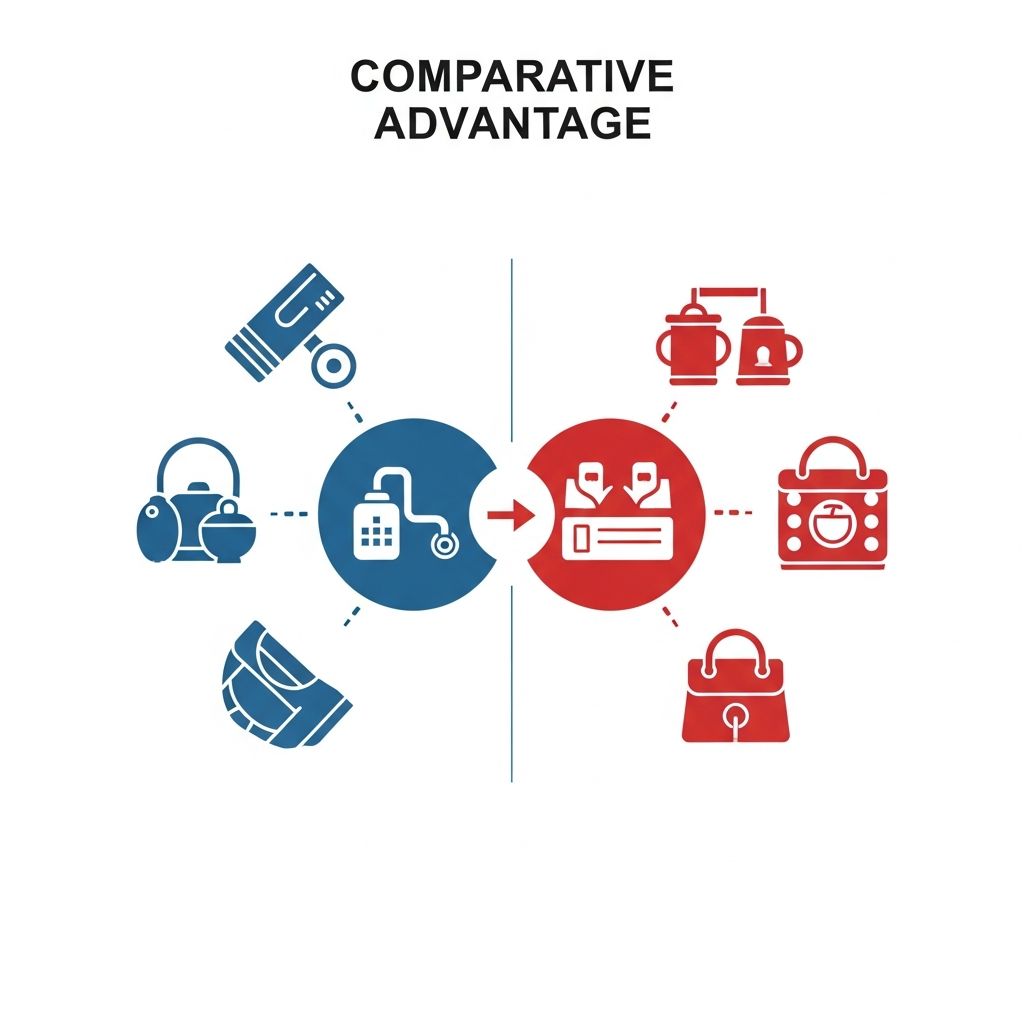
Comparative advantage is a fundamental concept in economics that explains why countries, businesses, and individuals benefit from trade and specialization. At its core, comparative advantage occurs when one country can produce a good or service at a lower opportunity cost than another country. This principle, first articulated by economist David Ricardo in 1817, remains one of the most important frameworks for understanding international economics and trade relationships.
Unlike intuition might suggest, a country doesn’t need to be the best at producing something to benefit from trade. Even if one nation can produce all goods more efficiently than another, both countries can still gain by specializing in what they do relatively better and trading with each other. This counterintuitive insight revolutionized economic thinking and continues to shape trade policy and international commerce today.
What Is Comparative Advantage?
Comparative advantage describes the economic reality that individuals, businesses, and nations can produce goods and services at different relative costs. Specifically, a party has a comparative advantage in producing a good if they can produce it at a lower opportunity cost than another party. This is distinct from being the most efficient or productive—what economists call absolute advantage.
The concept hinges on opportunity cost, which represents the value of what you give up when choosing one alternative over another. For example, if a worker can produce either one piece of cloth or three bottles of wine in one hour, the opportunity cost of producing one piece of cloth is three bottles of wine foregone. Understanding this trade-off is essential to grasping why comparative advantage matters in trade.
The theory suggests that if countries specialize in producing goods where they have a lower opportunity cost and then trade with other nations, the overall economic welfare and consumption possibilities for all trading partners increase. This principle applies not just to countries but also to businesses, individuals, and teams within organizations.
Comparative Advantage vs. Absolute Advantage
A common source of confusion in economics is the difference between comparative advantage and absolute advantage. Understanding this distinction is critical:
Absolute advantage occurs when one party can produce more of a good or service than another using the same amount of resources. For instance, if Country A can produce 1,000 tons of steel per month while Country B can only produce 500 tons using equal resources and labor, Country A has an absolute advantage in steel production.
Comparative advantage, by contrast, focuses on opportunity cost rather than total output. A country might have an absolute advantage in producing everything, yet both countries can still benefit from trade if they have different relative efficiencies or opportunity costs.
This distinction is crucial because it explains why trade occurs even when one nation is more efficient at producing all goods. A country with absolute advantage in multiple products might still find it beneficial to import certain goods if producing those goods domestically requires giving up more valuable production opportunities.
David Ricardo and the Origins of Comparative Advantage
The theory of comparative advantage was developed by British political economist David Ricardo in his 1817 work “On the Principles of Political Economy and Taxation.” Ricardo’s insight solved an economic puzzle that had puzzled even Adam Smith, one of the founding fathers of modern economics.
Ricardo illustrated his theory using a famous example involving England and Portugal, both producing wine and cloth. He noted that Portugal could produce both goods with less labor than England, meaning Portugal had an absolute advantage in both products. However, the relative costs differed: Portugal was relatively more efficient at producing wine, while England was relatively better at producing cloth.
Ricardo’s genius was demonstrating that despite Portugal’s absolute advantage in both goods, both countries would benefit if England specialized in cloth and Portugal specialized in wine, then traded with each other. This counterintuitive conclusion fundamentally changed how economists understood international trade and remains the foundation of free trade arguments to this day.
Understanding Opportunity Cost
To truly grasp comparative advantage, you must understand opportunity cost. Opportunity cost is the benefit or value foregone when choosing one alternative over another. In production decisions, it represents what a producer must give up to make one good instead of another.
Consider a practical example: A laborer can use one hour of work to produce either one unit of cloth or three units of wine. The opportunity cost of producing one unit of cloth is three units of wine. Conversely, the opportunity cost of producing one unit of wine is one-third unit of cloth.
When two producers have different opportunity costs for the same goods, the foundation for mutually beneficial trade exists. Each party can specialize in what they do at relatively lower opportunity cost and trade for what has higher opportunity cost for them. This specialization and exchange increase total output and allow both parties to consume more than they could in isolation.
A Simplified Example of Comparative Advantage
Consider two countries: Country A and Country B. Both nations want to consume a mix of rice cakes and banana bread. Let’s examine their production capabilities:
Country A’s production options: The workforce could make 1,000 rice cakes, 3,000 loaves of banana bread, or any combination splitting the workforce between these options.
Country B’s production options: The workforce could make 2,000 rice cakes, 2,000 loaves of banana bread, or any combination of the two.
From these numbers, Country B has an absolute advantage in rice cakes (2,000 vs. 1,000), while Country A has an absolute advantage in banana bread (3,000 vs. 2,000).
Now consider the opportunity costs:
In Country A: Producing 1,000 rice cakes costs 3,000 banana loaves foregone, so one rice cake costs 3 loaves. Alternatively, one loaf of banana bread costs 1/3 rice cake.
In Country B: Producing 2,000 rice cakes costs 2,000 banana loaves foregone, so one rice cake costs 1 loaf. Alternatively, one loaf of banana bread costs 1 rice cake.
Country A has a comparative advantage in banana bread (opportunity cost of 1/3 rice cake per loaf), while Country B has a comparative advantage in rice cakes (opportunity cost of 1 loaf per cake). If they specialize and trade, both countries can increase consumption beyond what’s possible with isolation.
How Comparative Advantage Drives International Trade
Comparative advantage provides the economic rationale for international trade. The theory of comparative advantage supports free trade and specialization among countries because it demonstrates that regardless of initial efficiency differences, international trade leads to higher aggregate output and consumption possibilities.
When countries specialize in goods where they have comparative advantage and trade for others, several benefits emerge:
Increased Efficiency: Resources are allocated to their most productive uses, reducing waste and inefficiency in the global economy.
Consumer Benefits: Consumers access a wider variety of goods at lower prices than domestic production alone would allow.
Economic Growth: Specialization allows countries to develop expertise, improve technology, and achieve economies of scale in their focused industries.
Competitive Advantage: Industries become more competitive as companies focus on core competencies and trade for complementary goods and services.
Limitations and Complexities in Real-World Trade
While comparative advantage theory provides powerful insights, real-world international trade is more complex than textbook examples suggest. Several factors complicate the straightforward application of comparative advantage theory:
Multiple Goods and Countries: Economic models typically examine two countries and two goods for simplicity. In reality, hundreds of countries trade thousands of goods and services, creating intricate networks of comparative advantages that shift constantly.
Trade Barriers: Tariffs, quotas, subsidies, and other protectionist measures distort comparative advantage signals and prevent countries from fully specializing according to their true comparative advantages.
Factor Mobility: The theory assumes capital and labor don’t move between countries, but in practice, capital flows internationally and skilled workers migrate, affecting production capabilities.
Quality and Differentiation: Modern trade increasingly involves differentiated products where quality, brand, and specialization matter more than simple price competition based on comparative advantage.
Geographic and Economic Distance: Countries that are geographically closer and economically similar tend to trade more with each other, suggesting that proximity and similarity matter beyond pure comparative advantage calculations.
Dynamic Comparative Advantages: Comparative advantages aren’t static. Countries can develop new capabilities through investment in education, technology, and infrastructure, changing their relative efficiencies over time.
Practical Applications of Comparative Advantage
Comparative advantage extends beyond international trade to inform business strategy, organizational management, and individual career decisions. Companies often organize divisions around comparative advantages, outsourcing functions where they’re relatively less efficient and focusing resources on core competencies. Similarly, individuals benefit from specializing in work where they have comparative advantage relative to their peers, even if they could theoretically do everything themselves.
Frequently Asked Questions
Q: Can a country have a comparative advantage in everything?
A: No. Comparative advantage is relative—it’s about which goods a country produces at lower opportunity cost compared to other goods it could produce. Even the most efficient country must make trade-offs and has comparative advantage in some goods but not others.
Q: Does comparative advantage mean countries should specialize completely?
A: In theory, complete specialization maximizes gains from trade. In practice, countries maintain diverse production for security, employment, and political reasons. Partial specialization still captures many benefits of comparative advantage.
Q: How does comparative advantage explain current trade patterns?
A: Comparative advantage helps explain why countries export certain goods and import others, but real trade patterns also reflect trade policy, geography, history, and factor endowments rather than comparative advantage alone.
Q: Is comparative advantage still relevant in the modern economy?
A: Yes. While modern economies are more complex, comparative advantage remains fundamental to understanding why trade occurs and why countries benefit from economic integration and specialization.
Q: How do I identify comparative advantage in business?
A: Analyze what your business can produce or provide at lower opportunity cost than competitors. Focus on activities that leverage your unique strengths and outsource where others have relative advantage.
References
- Definition of Comparative Advantage — Economics Help. 2025. https://www.economicshelp.org/blog/glossary/comparative-advantage/
- Comparative Advantage: Definition, Economics, & Facts — Britannica Money. 2024. https://www.britannica.com/money/comparative-advantage
- Comparative Advantage — Corporate Finance Institute. 2024. https://corporatefinanceinstitute.com/resources/economics/comparative-advantage/
- Lesson Summary: Comparative Advantage and Gains from Trade — Khan Academy. 2024. https://www.khanacademy.org/economics-finance-domain/ap-macroeconomics/basic-economics-concepts-macro/scarcity-and-growth/a/lesson-summary-comparative-advantage-and-gains-from-trade
- On the Principles of Political Economy and Taxation — David Ricardo. 1817. Historical economic text establishing comparative advantage theory.
- Comparative Advantage — Econlib. 2024. https://www.econlib.org/library/Topics/Details/comparativeadvantage.html
Similar Articles








Read full bio of medha deb