Companies Owned by Google: Complete Guide to Alphabet’s Portfolio
Discover Google's corporate empire: explore Alphabet's subsidiaries and investments across technology, innovation, and beyond.
Understanding Alphabet Inc. and Its Corporate Structure
Alphabet Inc. is a multinational conglomerate holding company that was established in 2015 as part of a strategic restructuring of Google, one of the world’s most recognizable technology companies. Headquartered in Mountain View, California, Alphabet serves as the parent company for a diverse portfolio of subsidiaries operating across multiple technological sectors. The restructuring was a deliberate move by Google’s founders Larry Page and Sergey Brin to create a more flexible corporate structure that would allow various business divisions to operate independently while benefiting from centralized resources and strategic oversight.
The decision to create Alphabet as a holding company was instrumental in allowing Google to diversify beyond its core search engine business. Rather than confining all operations under the Google umbrella, the new structure enabled the company to pursue ambitious ventures in emerging technologies such as autonomous driving, artificial intelligence, biotechnology, and space exploration without constraining innovation or taking excessive risks with the primary revenue-generating search business.
The Core Business: Google and Its Evolution
Google remains the crown jewel of Alphabet’s portfolio and continues to be the primary revenue driver for the conglomerate. Founded in 1998 by Larry Page and Sergey Brin, Google revolutionized how people search for and access information on the internet. The search engine has become so ubiquitous that “Google it” has become synonymous with internet searching across the globe.
Over the decades, Google has expanded far beyond its original search engine functionality. The company has developed and acquired numerous products and services that have become integral to the digital ecosystem. Google Maps, launched in 2005, transformed navigation and location-based services. Android, the mobile operating system introduced in 2007, has become the world’s most widely used operating system for smartphones and tablets. Google Play provides a marketplace for applications and digital content, while Chrome remains one of the most popular web browsers globally.
Major Acquisitions and Subsidiaries
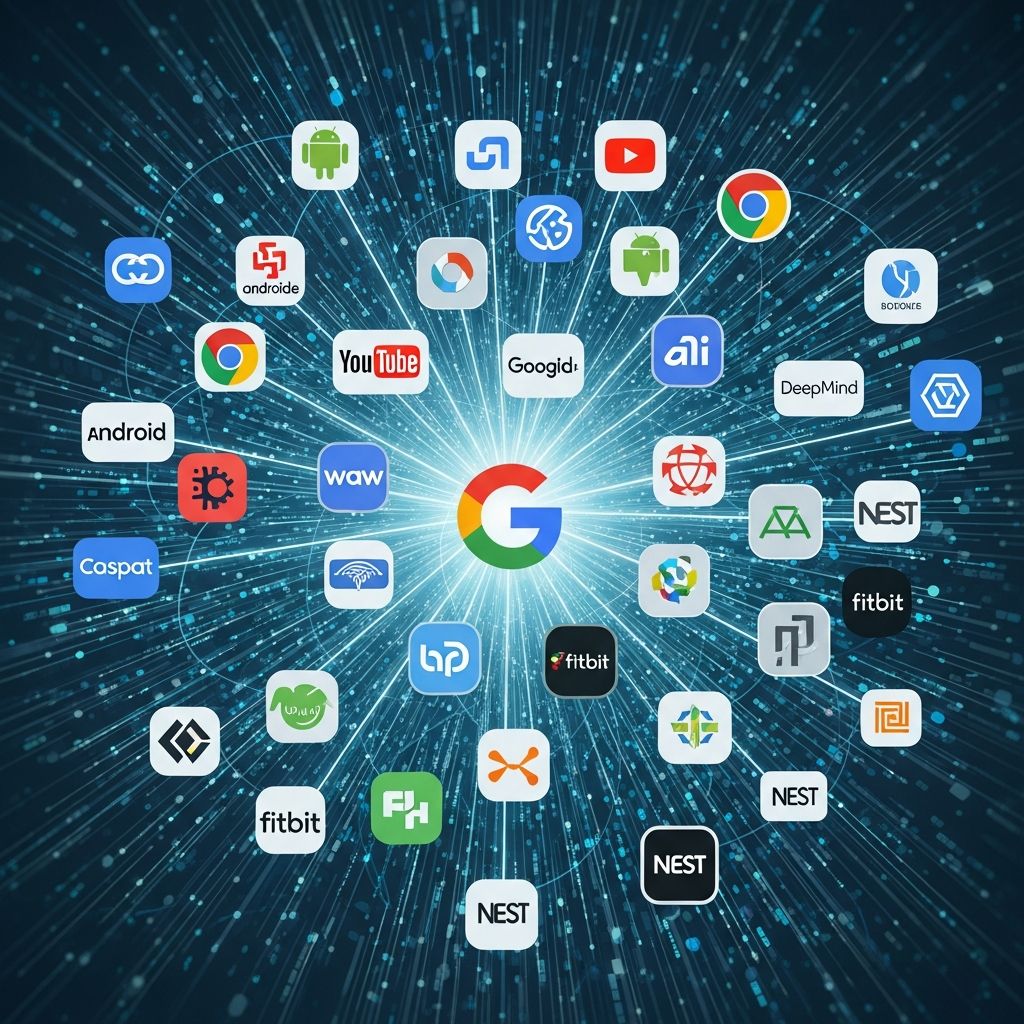
Alphabet’s growth strategy has heavily relied on strategic acquisitions of companies with innovative technologies and established user bases. These acquisitions have significantly expanded Alphabet’s reach and capabilities across various sectors.
YouTube and Digital Media
YouTube, acquired in 2006 for $1.65 billion, stands as one of the most important acquisitions in Alphabet’s portfolio. The video-sharing platform has become the world’s largest video content repository and streaming service, with billions of daily active users. YouTube generates substantial advertising revenue and has fundamentally changed how people consume media, from entertainment to educational content.
Navigation and Mapping Technologies
Waze, a crowdsourced navigation application developed in Israel and acquired by Google in 2013, complements Google Maps by offering real-time traffic information and user-contributed navigation data. This acquisition strengthened Alphabet’s position in the navigation and location services market.
Smart Home and IoT
Nest, acquired in early 2014, positioned Alphabet in the growing smart home and Internet of Things (IoT) market. Nest specializes in home security products and services, including smart thermostats and security cameras, enabling Alphabet to participate in the connected home ecosystem.
Advertising Technology
DoubleClick, acquired in 2008, provides programmatic advertising management services that help publishers and advertisers optimize their digital advertising campaigns. This acquisition strengthened Google’s already dominant position in digital advertising infrastructure.
Health and Fitness
Fitbit, acquired in 2021, brought wearable fitness technology into Alphabet’s portfolio. The company produces smartwatches and fitness trackers that monitor health metrics, integrating personal health data collection with Alphabet’s broader technology ecosystem.
Enterprise and Analytics Solutions
Looker, a business intelligence and data analytics platform acquired in 2020, provides enterprise customers with advanced analytics and data visualization tools. This acquisition expanded Alphabet’s presence in the enterprise software market.
Cybersecurity and Threat Intelligence
Mandiant, a leading cybersecurity firm acquired in early 2022, enhanced Alphabet’s cybersecurity capabilities with threat intelligence and incident response expertise. Additionally, Alphabet acquired Israeli security startup Siemplify for $500 million in 2022 to further bolster its cybersecurity offerings.
Artificial Intelligence and Education Tech
Photomath, an AI-driven mobile application that helps users solve mathematical problems, was acquired in 2023, demonstrating Alphabet’s commitment to educational technology powered by artificial intelligence. This acquisition reflects the company’s focus on leveraging AI for practical applications across various domains.
Application Delivery
Cameyo, a virtual application delivery company, was acquired in 2024, expanding Alphabet’s capabilities in enterprise application delivery and virtualization technologies.
Moonshot Ventures and Emerging Technologies
Beyond traditional acquisitions, Alphabet operates several experimental divisions pursuing breakthrough technologies through its “moonshot” factory approach. These ventures operate with longer time horizons and higher risk tolerances than core business operations.
Autonomous Driving with Waymo
Waymo, one of Alphabet’s most ambitious ventures, focuses on developing autonomous vehicle technology. The company has been at the forefront of self-driving car development, conducting extensive testing and pilot programs in various cities. Waymo represents a significant long-term investment in transforming transportation and mobility.
Life Sciences and Biotechnology
Alphabet’s health and biotechnology initiatives extend beyond fitness tracking to encompass pharmaceutical research, genomic sequencing, and disease prevention technologies. These ventures align with broader goals of extending human healthspan and understanding biological processes at the molecular level.
Robotics and Automation
Alphabet maintains investments in robotics research and development, exploring applications ranging from industrial automation to service robotics that could transform various industries.
Space Technology
Through various initiatives, Alphabet has explored space launch technology and satellite internet services, positioning itself in the emerging commercial space industry.
Google’s Digital Ecosystem Products
Beyond separate subsidiaries, Google itself maintains an extensive portfolio of interconnected products and services:
- Google Books: A digital library project launched in 2004 that has digitized millions of books, making them searchable and accessible online.
- Google Cloud: Enterprise cloud computing services that compete with Amazon Web Services and Microsoft Azure, offering storage, computing power, and AI services to businesses.
- Google Workspace: Productivity tools including Gmail, Docs, Sheets, and Meet that provide alternatives to Microsoft Office and enable remote collaboration.
- Google Assistant: An AI-powered virtual assistant integrated across devices and services.
- Google Photos: A cloud-based photo storage and organization service.
- Google Home: Smart speaker and display devices for home automation and voice control.
The Organizational Benefits of the Holding Company Structure
The creation of Alphabet as a holding company provided several strategic advantages. First, it allowed subsidiaries to operate with greater independence while maintaining access to Alphabet’s capital, talent, and technological expertise. This structure minimizes regulatory and legal concerns that might arise if all operations remained under a single corporate umbrella, particularly regarding antitrust issues.
Second, the holding company structure enables risk compartmentalization. Experimental moonshot ventures can pursue ambitious but uncertain goals without jeopardizing the core Google business or investor confidence. Each subsidiary maintains separate financial reporting and operational independence.
Third, the structure facilitates the type of innovation and entrepreneurial risk-taking that characterized Google’s growth from its inception. Talented engineers and entrepreneurs can lead distinct ventures with more autonomy than would be possible within a traditional hierarchical structure.
Financial Performance and Market Position
The Alphabet portfolio has demonstrated remarkable financial performance and growth. The company saw substantial increases in profits and market share, particularly during the COVID-19 pandemic, driven by increased usage of internet services including YouTube and Google Cloud. Alphabet ranks among the world’s largest and most valuable companies, competing with peers such as Apple, Amazon, and Microsoft for market capitalization and technological influence.
Leadership and Governance
Google’s cofounders Larry Page and Sergey Brin remained actively involved in Alphabet’s leadership following the 2015 restructuring. However, in 2019, they stepped back from day-to-day management roles, with Sundar Pichai assuming the CEO position at Google and reporting to Page. This transition demonstrated the company’s ability to develop deep executive talent while maintaining founder involvement at the board level.
Challenges and Regulatory Landscape
Despite its success, Alphabet faces significant regulatory scrutiny and legal challenges. In late 2024, the European Court of Justice upheld a €2.42 billion fine against Google for antitrust violations related to its shopping service. Additionally, the US Department of Justice has proposed significant changes to address Google’s search monopoly, indicating ongoing regulatory pressure on the company’s dominant market position.
Future Direction and Expansion
Alphabet continues to pursue diversification and expansion within the technology landscape. The company’s founders explicitly indicated their intention to move beyond internet technology into emerging fields, with particular focus on artificial intelligence, quantum computing, renewable energy, and life sciences. This continued evolution suggests that future acquisitions and ventures will further expand the company’s footprint across technological frontiers.
Frequently Asked Questions
Q: What is the relationship between Google and Alphabet Inc.?
A: Google is a subsidiary of Alphabet Inc., which was created in 2015 as a holding company to restructure Google’s operations. Alphabet manages Google alongside numerous other subsidiaries, allowing the company to diversify while maintaining Google’s independence and focus on its core search and advertising business.
Q: Why did Google create Alphabet as a holding company?
A: The holding company structure allowed Google to pursue experimental and high-risk ventures without jeopardizing its core business, minimize regulatory concerns, and enable subsidiaries to operate with greater independence while maintaining access to shared resources and capital.
Q: How many companies does Alphabet own?
A: Alphabet owns numerous subsidiaries and investments across various technology sectors. Major subsidiaries include Google, YouTube, Waymo, Nest, Fitbit, Mandiant, and many others, though the exact number varies as the company continues to acquire and develop new ventures.
Q: What is Waymo and what does it do?
A: Waymo is Alphabet’s autonomous vehicle company focused on developing self-driving car technology. The company conducts extensive testing and pilot programs for autonomous vehicles that could revolutionize transportation and mobility.
Q: Does Alphabet own YouTube?
A: Yes, Alphabet owns YouTube, which was acquired in 2006. YouTube is one of Alphabet’s most valuable subsidiaries and serves as the world’s largest video-sharing platform with billions of daily active users.
Q: What recent acquisitions has Alphabet made?
A: Recent acquisitions include Photomath (AI-powered math application) in 2023, Cameyo (virtual application delivery) in 2024, and Siemplify (cybersecurity startup) in 2022. Alphabet continues to strategically acquire companies that complement its broader technology vision.
References
- Alphabet Inc — EBSCO Research Starters. 2024. https://www.ebsco.com/research-starters/history/alphabet-inc
Similar Articles








Read full bio of Sneha Tete