Community Property Laws: 9-State Guide For Home Buyers
Understand how community property rules affect home buying, ownership, and financing in specific U.S. states for informed decisions.

Community property laws govern how assets and debts acquired during marriage are owned and divided, primarily in nine U.S. states where spouses share equal ownership regardless of who earned or purchased them.
These rules significantly influence real estate transactions, mortgage applications, and estate planning, especially when buying a home. Unlike common law states, where property defaults to the earning spouse, community property presumes joint ownership.
Defining Community Property and Its Core Principles
Community property encompasses all income, real estate, personal items, and debts obtained by either spouse during marriage, treated as jointly owned with each holding a 50% undivided interest.
- Applies to earnings from employment or business activities post-marriage.
- Extends to purchases like homes or vehicles funded by marital funds.
- Includes debts such as mortgages or credit cards incurred jointly or individually during wedlock.
Separate property, by contrast, includes pre-marital assets, inheritances, or gifts received by one spouse, remaining individual unless commingled.
States Operating Under Community Property Regimes
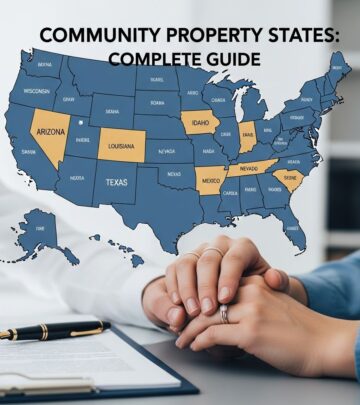
Nine states adhere to community property systems, with slight variations in application.
| State | Key Features |
|---|---|
| Arizona | Equal division; quasi-community rules for out-of-state assets. |
| California | Strict 50/50 split mandated by statute. |
| Idaho | Community of acquests; excludes gifts/inheritances. |
| Louisiana | Civil law influence; dual community/separate classifications. |
| Nevada | Joint management; equal ownership presumption. |
| New Mexico | Applies to residents; flexible transmutation rules. |
| Texas | Equitable but often equal division; strong separate property protections. |
| Washington | Defined by statute; both spouses control but with sale restrictions. |
| Wisconsin | Marital property variant; income from separate assets is shared. |
These states recognize the marital partnership as equal contributors to financial growth.
How Assets Become Community or Remain Separate
Any property acquired post-marriage defaults to community status unless proven otherwise.
- Community Assets: Salary, bonuses, rental income from marital purchases, retirement contributions during marriage.
- Separate Assets: Pre-marriage holdings, personal injury awards (non-economic portions), life insurance proceeds.
Commingling occurs when separate funds mix into joint accounts, potentially converting them to community property if traceability is lost.
Implications for Purchasing a Home
Buying a home in a community property state requires both spouses’ involvement, even if only one is on the title.
Lenders demand signatures from non-borrowing spouses on mortgage documents to perfect security interests in community real estate.
- Failure to obtain spousal consent can invalidate sales or liens.
- Homes bought with community funds are presumed jointly owned.
- Out-of-state properties funded by community assets may qualify as quasi-community property in states like California.
Management and Control During Marriage
Spouses can independently manage community property, similar to separate assets, but restrictions apply to major actions.
- Selling or encumbering real estate needs joint execution and acknowledgment.
- Gifts over half the community require consent.
- Wills cannot bequeath more than 50% without agreement.
This balances autonomy with spousal protections.
Division Upon Divorce or Death
Divorce courts divide community property equally, focusing on classification disputes.
In California, statutes enforce 50/50 splits; Texas allows equitable adjustments.
- Pets, investments, and debts split per guidelines.
- Separate property stays individual unless transmuted.
Upon death, community assets pass half to survivors, half per will (limited to own share).
Federal Tax Considerations
The IRS treats community income as split 50/50 for tax purposes in these states, affecting filing status and deductions.
Publication 555 outlines rules: community property includes marital acquisitions while domiciled in such states.
Navigating Mortgages in Community Property Jurisdictions
Homebuyers must disclose marital status; non-titled spouses sign deeds of trust.
This ensures lender protection against future claims. Refinances similarly require dual involvement.
| Scenario | Requirement |
|---|---|
| Married buyer, spouse not on loan | Spouse signs mortgage docs. |
| Joint purchase | Both on title and loan. |
| Postnuptial transmutation | Agreement to classify as separate. |
Strategies to Protect Separate Property Interests
Premarital agreements or postnuptial contracts can opt into separate property regimes.
- Maintain separate accounts for pre-marital funds.
- Trace investments clearly to origins.
- Use tenancy in common titling where allowed.
Courts scrutinize commingling; documentation is crucial.
Quasi-Community Property Rules
Some states extend rules to assets acquired elsewhere if funded by community resources.
Arizona and California classify such real estate as quasi-community, subject to equal division.
Frequently Asked Questions
What if I move from a community property state?
The law of your domicile at acquisition governs, but situs state rules apply to realty.
Can I sell community property alone?
No, for real estate; joint consent required.
Are debts shared equally?
Yes, those incurred during marriage.
How does this affect credit reports?
Joint debts impact both scores in community states.
What about domestic partnerships?
Some states like Washington extend rules to registered partners.
Planning Ahead for Real Estate Transactions
Consult attorneys for state-specific advice before purchasing. Understand titling options like joint tenancy to align with goals.
These laws promote marital equity but demand careful navigation in home financing.
References
- Community property | Wex | US Law | LII / Legal Information Institute — Cornell Law School. 2022-07. https://www.law.cornell.edu/wex/community_property
- Community property – Wikipedia — Wikipedia. Accessed 2026. https://en.wikipedia.org/wiki/Community_property
- RCW 26.16.030: Community property defined—Management and control — Washington State Legislature. Accessed 2026. https://app.leg.wa.gov/rcw/default.aspx?cite=26.16.030
- The 9 Community Property States Explained — LawDepot. Accessed 2026. https://www.lawdepot.com/us/resources/family-articles/community-property-states/
- What Is a Community Property State? — Experian. Accessed 2026. https://www.experian.com/blogs/ask-experian/what-is-community-property-state/
- Publication 555 (12/2024), Community Property — Internal Revenue Service. 2024-12. https://www.irs.gov/publications/p555
Similar Articles








Read full bio of Sneha Tete