Communism: Characteristics, Pros, Cons, and Examples
Explore communism's core principles, advantages, disadvantages, and real-world applications.

Understanding Communism: A Comprehensive Overview
Communism is a political and economic ideology whose goal is the creation of a communist society, a socioeconomic order centered on common ownership of the means of production, distribution, and exchange that allocates products in society based on need. As an ideology born in the 19th century, communism set as its objective the building of a classless society in which all means of production and all that is produced is owned in common by all members of society. The ideology emerged from the works of German scholars Karl Marx and Friedrich Engels, who founded communist theory and outlined their vision in seminal works like The Communist Manifesto (1848).
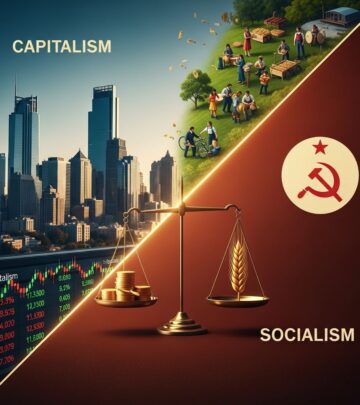
The fundamental distinction between communism and other economic systems lies in its approach to property ownership and wealth distribution. Unlike capitalism, which emphasizes private property and profit-driven markets, communism advocates for the abolition of private property and the establishment of a system where resources are collectively owned and distributed based on individual need rather than market forces.
Core Characteristics of Communism
Communist ideology is built upon several defining characteristics that distinguish it from other economic and political systems:
Classless Society
One of the most fundamental characteristics of communism is the elimination of social classes. In a communist society, there would be no distinction between the wealthy elite and the working poor. The division between the bourgeoisie (owning class) and the proletariat (working class) that defines capitalist societies would cease to exist. Instead, all members of society would occupy roughly equal social and economic positions.
Common Ownership of Means of Production
Communism advocates for collective ownership of major means of production, such as mines, factories, mills, and natural resources. Rather than individuals or corporations controlling these productive assets for profit, they would be owned and operated by the community as a whole. This collective control extends to all significant economic resources necessary for societal production and distribution.
Absence of Private Property
A communist society entails the absence of private property and personal ownership of productive resources. While Marx distinguished between private property (productive resources) and personal property (consumer goods), the elimination of private property rights represents a cornerstone of communist ideology. Citizens would not own businesses, land used for production, or other capital assets.
No Government or Currency
According to communist theory, there is no government or currency in a fully realized communist society. Money and the state would eventually disappear as society evolved beyond the need for such institutions. Production and distribution would be coordinated through communal planning rather than market mechanisms or government mandate.
Distribution Based on Need
The communist principle of distribution follows the maxim “From each according to his ability, to each according to his needs.” Rather than rewarding individuals based on their contribution or market demand, goods and services would be distributed according to what people need to survive and thrive, regardless of their productive capacity.
The Distinction Between Communism and Socialism
A common source of confusion involves the difference between communism and socialism. Karl Marx used the terms somewhat interchangeably, but modern theorists have identified important distinctions. According to Marx’s framework, communism encompasses two distinct phases:
The Transitional Phase (Socialism)
The first phase, widely regarded as socialism, is a transitional system in which the working class controls the government and economy yet still pays people according to how long, hard, or well they work. In this phase, capitalism and private property exist, though to a limited degree. The state remains present to enforce these arrangements and prevent counterrevolution.
The Final Phase (True Communism)
In Marx’s fully realized communism, society has no class divisions, government, or personal property. The production and distribution of goods is based upon the principle “From each according to his ability, to each according to his needs.” This represents the ultimate goal that socialist societies are theoretically working toward.
An early distinction between the two ideologies is that socialism aims to socialize production, whereas communism aims to socialize both production and consumption in the form of common access to final goods. The distribution principle in socialism is “to each according to his contribution,” while communism follows “to each according to his needs.”
Theoretical Advantages of Communism
Proponents of communism argue that the system offers several significant benefits:
Economic Equality
The most compelling theoretical advantage of communism is the elimination of economic inequality. By abolishing private property and class divisions, communism promises to create a society where wealth and resources are distributed equitably among all citizens. No individual would accumulate excessive wealth while others languish in poverty, theoretically creating a more just and fair society.
Elimination of Exploitation
According to communist theory, capitalism inherently exploits workers by extracting surplus value from their labor. Communism would eliminate this exploitation by removing the capitalist class that profits from workers’ labor. Workers would receive the full value of their contributions rather than seeing a portion extracted as profit for business owners.
Meeting Basic Needs
A communist system would theoretically ensure that all members of society have their basic needs met—food, shelter, healthcare, and education would be provided according to individual requirements rather than ability to pay. This eliminates poverty and deprivation as systemic features of the economy.
Reduced Alienation
Marx argued that workers under capitalism experience alienation from their labor, their products, and their humanity. Communist theory suggests that when workers own and control the means of production, they would find work more meaningful and fulfilling, reducing the psychological and social costs of labor.
Elimination of Competitive Pressure
Communism would theoretically eliminate the competitive pressure that characterizes capitalist economies. Individuals would cooperate rather than compete for resources, potentially reducing stress, anxiety, and the wasteful duplication of effort that competition can generate.
Practical Disadvantages and Criticisms of Communism
Despite its theoretical attractions, communism faces substantial practical challenges and criticisms:
Absence of Market Incentives
Without price signals and profit motives, central planners struggle to efficiently allocate resources according to societal needs. The absence of market incentives reduces individuals’ motivation to work productively, innovate, or develop new technologies. Without personal financial rewards, why would individuals exert themselves beyond minimum effort?
Centralized Planning Inefficiency
Communist economies require extensive central planning to coordinate production and distribution across the entire society. This centralized approach has historically proven inefficient, leading to surpluses of some goods, shortages of others, and widespread waste. Market economies, by contrast, use price mechanisms to coordinate supply and demand with minimal central direction.
Difficulty in Determining Individual Needs
Implementing the principle “to each according to his needs” requires someone or some institution to determine what each individual needs. This opens the door to arbitrary decision-making, corruption, and the imposition of planners’ preferences over individuals’ actual preferences. How would a society determine whether someone needs a modest apartment or a spacious home?
Concentration of Political Power
Every communist society that has been established has required a powerful central government to enforce collective ownership and suppress private economic activity. This concentration of power has repeatedly led to authoritarian regimes, political repression, and human rights abuses. The theoretical goal of a stateless society has never been achieved in practice.
Reduced Innovation and Progress
Capitalism’s competitive pressures and profit motives drive technological innovation and economic progress. By eliminating these incentives, communism may reduce the pace of innovation and development. Historical communist economies have generally lagged capitalist economies in technological advancement and consumer goods availability.
Violation of Individual Liberty
Communism requires the elimination of individuals’ right to private property and their freedom to engage in economic activity. Many argue this violates fundamental human rights and freedoms. The forced collectivization and economic controls implemented in communist societies have often required repressive measures to prevent individuals from pursuing private economic interests.
Historical Examples of Communist Systems
While no society has achieved Marx’s theoretical vision of communism, several nations have adopted communist political systems and attempted to implement communist economic principles:
The Soviet Union
The Union of Soviet Socialist Republics (1922-1991) represented the first major attempt to build a communist society. Under Vladimir Lenin and later Joseph Stalin, the Soviet Union implemented centralized economic planning, collectivized agriculture, and concentrated political power in the Communist Party. While claiming to work toward communism, the Soviet system remained in the transitional socialist phase throughout its existence, with the state retaining significant control and a Communist Party elite wielding considerable power and privilege.
China
The People’s Republic of China, established in 1949 under Mao Zedong, adopted communist ideology and implemented radical economic reorganization. China’s experience with strict communism, particularly during the Great Leap Forward and Cultural Revolution, resulted in economic chaos and millions of deaths. In recent decades, China has incorporated market mechanisms into its economy while maintaining Communist Party political control, creating a hybrid system.
Cuba
Following Fidel Castro’s 1959 revolution, Cuba established a communist system that has persisted despite the end of the Cold War. Cuba’s economy operates under central planning with limited private enterprise, though recent reforms have allowed some market activities. The system has provided universal healthcare and education but has struggled with economic efficiency and consumer goods availability.
Vietnam
Vietnam adopted communism under Ho Chi Minh following independence from France. Like China, Vietnam has gradually introduced market reforms since the 1980s while maintaining Communist Party political control. This market-oriented socialism has generated stronger economic growth than more rigidly communist systems.
North Korea
The Democratic People’s Republic of Korea under the Kim family has maintained one of the world’s most rigid communist systems. North Korea’s centrally planned economy remains largely isolated from global markets and has struggled with chronic poverty and food shortages, illustrating the practical challenges of implementing communist economics.
Comparing Communism with Other Economic Systems
| Characteristic | Communism | Socialism | Capitalism |
|---|---|---|---|
| Ownership of Production | Collective/Community | Mixed/State and Private | Private/Individual |
| Distribution Principle | According to Needs | According to Contribution | According to Market Forces |
| Private Property | Eliminated | Limited | Protected and Encouraged |
| Government Role | Eventually Absent | Active in Economy | Limited/Regulatory |
| Economic Incentives | Collective Benefit | Mixed Incentives | Profit and Competition |
| Social Classes | Eliminated | Reduced | Present and Persistent |
Frequently Asked Questions About Communism
Q: Has true communism ever been successfully implemented?
A: No country has achieved Marx’s theoretical vision of true communism with a classless, stateless society based purely on need. Every attempt has remained in the transitional socialist phase, with powerful central governments and ruling Communist Party elites maintaining significant control and privilege.
Q: What is the difference between communism and totalitarianism?
A: Communism is an economic and political ideology focused on collective ownership and classless society. Totalitarianism is a system of government with absolute authority over all aspects of public and private life. While not all communist systems are totalitarian, and not all totalitarian systems are communist, communist systems have historically tended toward totalitarianism due to the need for centralized control.
Q: Could communism work in theory but not in practice?
A: Many economists and political theorists argue that while communism may sound appealing in theory, practical implementation faces insurmountable obstacles related to human nature, information problems, and incentive structures. The consistent failure of communist economies to match capitalist economies in productivity and innovation suggests fundamental theoretical challenges, not merely implementation difficulties.
Q: Is communism the same as socialism?
A: While related, they are distinct. Socialism is a broader political and economic philosophy that advocates social ownership and democratic control of the economy. Communism is more specifically Marxist socialism that emphasizes class struggle, revolution, and the ultimate goal of a classless society. Socialism can exist without communism, but communism is a specific form of socialism.
Q: Why do communist economies struggle with innovation?
A: Without profit incentives and market competition, individuals and organizations have reduced motivation to develop new technologies, improve processes, or create innovative products. The absence of financial rewards for entrepreneurship and innovation means fewer resources flow toward research and development compared to capitalist economies.
Q: Can elements of communism coexist with capitalism?
A: Yes, most modern economies are mixed systems incorporating elements of both capitalism and socialism. Socialist welfare programs, public education, healthcare, and infrastructure exist within primarily capitalist economies. Similarly, some communist countries have introduced limited market mechanisms while maintaining state control over major industries.
References
- Communism | Definition, History, Varieties, & Facts — Britannica. Accessed November 2025. https://www.britannica.com/topic/communism
- Communism — Wikipedia. Accessed November 2025. https://en.wikipedia.org/wiki/Communism
- What is communism? — Communist Crimes. Accessed November 2025. https://communistcrimes.org/en/commemoration/what-communism
- Communism — Fiveable Principles of Microeconomics. Accessed November 2025. https://fiveable.me/key-terms/principles-microeconomics/communism
Similar Articles








Read full bio of Sneha Tete