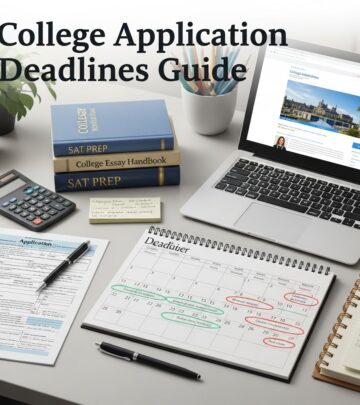
College Scholarship Requirements: 9 Essential Criteria For 2026
Unlock funding for your higher education by mastering the essential eligibility criteria, application strategies, and maintenance tips for top scholarships.

Securing a college scholarship can transform your educational journey by alleviating tuition costs and recognizing your achievements. This guide details the fundamental criteria that scholarship providers evaluate, drawing from established programs to help high school seniors prepare effectively for the 2026 application cycle.
Understanding Core Eligibility Criteria
Most scholarships target high school seniors planning to enroll in accredited four-year institutions. Common prerequisites include completing four years of U.S. high school or equivalent, intending fall enrollment post-graduation, and meeting academic benchmarks.
- High School Completion: Applicants typically must graduate in spring 2026 from a U.S. school, territory, or military base, ensuring readiness for college-level work.
- Enrollment Intent: Proof of acceptance or plans to attend an accredited college in fall 2026 is often required.
- Residency Rules: Many programs prioritize U.S. citizens, permanent residents, or specific state residents, with some open to DACA recipients.
Academic Performance Standards
Scholarship committees prioritize students with proven academic excellence. A minimum cumulative unweighted GPA is a universal benchmark, varying by program from 2.4 to 3.75.
| Scholarship Type | Minimum GPA | Additional Academic Notes |
|---|---|---|
| High-Achiever Awards | 3.75 unweighted | Requires SAT/ACT/AP/IB scores; strong teacher recommendations |
| General Merit | 3.0-3.5 | Renewable with 3.5+ maintenance GPA; 24 credits/year[10] |
| Need-Based | 2.4-2.5 | Financial need demonstration; state residency preferred |
Programs like the Jack Kent Cooke Foundation emphasize unweighted GPAs above 3.75 alongside standardized test submissions, without score minimums but requiring participation. University-specific awards, such as those at Nebraska institutions, auto-qualify perfect ACT (36) or SAT (1570-1600) scorers.
Standardized Testing Expectations
While test-optional trends persist, many scholarships mandate scores from SAT, ACT, AP, or IB exams to gauge potential. Test-optional policies exist, but submitting strong results enhances competitiveness.
- Preferred tests: ACT/SAT before February deadlines for priority consideration.
- Auto-qualifiers: Perfect scores guarantee entry into elite programs like Presidential Scholars.
- No minimums in some cases, but scores must be official and recent.
For 2026 applicants, early testing aligns with November admission deadlines for scholarship notifications by February.
Financial Need and Income Thresholds
Need-based scholarships scrutinize family finances via FAFSA or detailed reviews. Family gross incomes up to $95,000 qualify for comprehensive evaluations including assets.
- FAFSA Priority: Submit by February 1, 2026, for bundled aid offers.
- Income Caps: Adjusted gross income limits apply, with holistic reviews.
- Demonstrated Need: Essential for awards like those prioritizing financial hardship alongside merit.
Complete FAFSA summaries and college applications to two+ schools for sweepstakes-style scholarships.
Application Processes and Deadlines
Timely submission is critical. Priority dates like November 1, 2025, yield February 2026 notifications.
- Apply to colleges by early deadlines.
- Submit supplemental scholarship forms by February 1.
- Upload transcripts and test scores via portals like MyRED.
- Pay enrollment deposits by May 1; final transcripts by June 1.
National programs open August-September 2026 for 2026-2027 graduates, closing by late September.
Building a Competitive Profile
Beyond basics, committees seek leadership, service, and passion. Highlight extracurriculars, recommendations, and personal narratives.
- Recommendations: From teachers attesting to enthusiasm and challenge-seeking.
- Leadership/Service: Key for departmental awards; include in supplemental apps.
- Essays: Articulate goals, resilience, and fit with program values.
For Coca-Cola Scholars, current enrollment in U.S. schools (excluding abroad) is mandatory.
Renewal and Maintenance Obligations
Awards often renew for eight semesters if conditions are met.
- Maintain 3.5+ GPA[10].
- Enroll in 24 credits annually.
- Meet program-specific criteria yearly[10].
Review award terms upon receipt to avoid forfeiture[10].
Strategies for Maximizing Opportunities
Cast a wide net: Combine merit, need-based, and niche scholarships.
- Start early: Align testing, GPAs, and FAFSA.
- Use directories for high school seniors.
- Target state/university perks for residents.
- Prepare documents: Transcripts, scores, financials.
Diversify applications to mitigate rejection risks.
Frequently Asked Questions
What GPA do most scholarships require?
Typically 3.0+, with top programs demanding 3.75 unweighted.
Are test scores always needed?
No, but preferred or required in many cases; official submissions boost chances.
When should I file FAFSA for scholarships?
By February 1, 2026, for priority aid packages.
Can international students apply?
Limited; most require U.S. residency or citizenship.
How to maintain scholarships?
Uphold GPA and credit minimums annually[10].
References
- How to Apply – Jack Kent Cooke Foundation — Jack Kent Cooke Foundation. 2026. https://www.jkcf.org/our-scholarships/college-scholarship-program/how-to-apply/
- Scholarships | Undergraduate Office of Admissions — University of Nebraska-Lincoln. 2026. https://admissions.unl.edu/cost/scholarships/
- Top Scholarships for 2026: Your Complete Guide — Fastweb. 2026. https://www.fastweb.com/college-scholarships/articles/top-scholarships-for-2026
- Apply to be a Coke Scholar — Coca-Cola Scholars Foundation. 2026. https://www.coca-colascholarsfoundation.org/apply/
- Presidential Scholars Program — University of Nebraska System. 2026. https://nebraska.edu/presidential-scholars
Similar Articles








Read full bio of medha deb