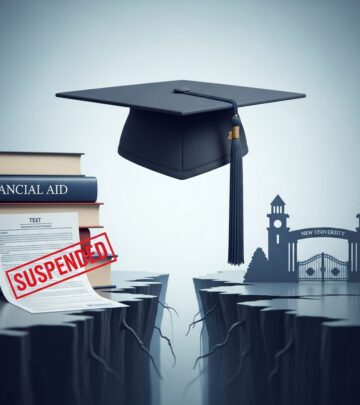
Understanding College Course Failure and Recovery
Navigate the impact of failing a college class and discover pathways to academic recovery.

College represents a significant investment in time, money, and effort. For most students, the goal is straightforward: complete courses, maintain academic standing, and graduate on schedule. However, failing a class can disrupt this plan, creating unexpected challenges across multiple areas of student life. Understanding what happens when a course doesn’t go as planned is the first step toward recovery.
The Immediate Impact on Academic Standing
When a student receives a failing grade, the consequences ripple through their academic record immediately. A failing grade—typically recorded as an “F”—carries a point value of 0.0 on the standard 4.0 grade scale. This numerical designation means the failed course directly reduces overall academic performance metrics.
The Grade Point Average, or GPA, serves as a comprehensive measure of academic achievement across all coursework. Every course taken contributes to this calculation, weighted by credit hours. A single failing grade can cause a noticeable dip in cumulative GPA, particularly in the early stages of a college career when fewer courses have been completed. For example, a student with an otherwise perfect record who fails a three-credit course may see their overall GPA decline by as much as 0.75 to 1.0 points, depending on total credits completed.
The severity of this impact extends beyond the numerical value. Many institutional policies and external requirements tie directly to minimum GPA thresholds. Scholarship eligibility, honors program participation, and even membership in academic clubs often require maintaining specific GPA minimums. Understanding these thresholds helps students recognize the scope of potential consequences.
Navigating Academic Probation and Institutional Warnings
When a student’s GPA falls below institutional thresholds—often around 2.0—the college may place them on academic probation. This status functions as both a warning and a structured intervention plan. Academic probation is not merely a record notation; it comes with tangible requirements and restrictions that directly affect the student’s college experience.
During probation, students typically must meet specific conditions to continue enrollment. These requirements often include:
- Regular meetings with an academic advisor to develop improvement plans
- Attendance at mandatory study skills workshops or academic support programs
- Limitations on course load—potentially being restricted to part-time status
- Participation in tutoring or supplemental instruction programs
- Demonstrated progress toward GPA recovery in subsequent semesters
The duration and intensity of probation varies by institution, but most colleges provide a defined timeframe—often one or two semesters—for students to demonstrate improvement. Failure to meet probation requirements can result in academic suspension or dismissal, which represents one of the most severe consequences a student can face.
Financial Aid and Scholarship Consequences
Many students rely on financial aid packages—including grants, loans, and scholarships—to afford college tuition and living expenses. These funding sources typically come with explicit academic performance requirements tied to “satisfactory academic progress” standards. A failing grade can jeopardize this crucial financial support in multiple ways.
Financial aid administrators evaluate satisfactory academic progress using several metrics beyond GPA. These include the percentage of courses completed with passing grades and the pace at which students complete required credit hours. A failed course counts as both a failed grade and an incomplete credit hour, potentially triggering aid suspension or reduction. Additionally, many merit-based scholarships explicitly require maintaining minimum GPA levels—often 3.0 or higher—and may be lost permanently or temporarily when this threshold is breached.
The financial consequences extend further when students must retake a failed course. Taking the course again requires paying full tuition and fees for that credit hour twice, which can amount to hundreds or thousands of dollars depending on the institution and course type. For students working with limited financial resources, this doubling of expense represents a significant hardship.
Graduation Timeline and Long-Term Academic Planning
A failed course disrupts the carefully planned sequence of academic progression, particularly when that course serves as a prerequisite for subsequent classes. Prerequisite courses form the foundation for more advanced study in a discipline; without passing the foundational course, students cannot register for the next level of coursework. This creates a cascading delay effect that extends graduation timelines.
Consider a student pursuing a degree in engineering who fails a required mathematics course in the second semester. That student cannot move forward into courses that depend on that mathematics foundation, such as physics or engineering fundamentals. Even if they pass all other courses on schedule, they cannot progress until the failed course is completed with a passing grade. This domino effect can push graduation back by a semester or more.
The practical implications of delayed graduation include:
- Extended tuition and education-related expenses for an additional semester or year
- Postponed entry into the job market and delayed career progression
- Disruption of post-graduation plans, including relocations or advanced degree programs
- Potential need for summer courses or additional evening classes to recover lost progress
- Extended housing costs or commuting requirements while completing studies
Graduate School Admissions and Future Educational Opportunities
The consequences of course failure extend beyond the undergraduate experience. Graduate school admissions processes place significant weight on academic transcripts. Admissions officers review entire records, and a failing grade raises questions about an applicant’s ability to manage rigorous graduate-level coursework. While a single failing grade may not automatically disqualify a candidate, it requires explanation and demonstrates a blemish on an otherwise clean record.
This impact proves especially significant for competitive graduate programs in fields like medicine, law, and engineering, where admissions processes are highly selective. A low undergraduate GPA—potentially caused by course failures—can substantially reduce acceptance prospects. Students considering graduate education should view failing a course not merely as an undergraduate setback but as a potential barrier to future educational advancement.
The Psychological and Emotional Dimension
Beyond the measurable academic and financial consequences, course failure carries psychological weight. Many students experience significant emotional responses including disappointment, frustration, shame, and diminished self-confidence. These feelings can linger and affect motivation and performance in subsequent courses, potentially creating a negative cycle where initial failure leads to continued struggle.
The emotional toll proves particularly acute for students who previously experienced academic success or who face pressure from family or peer expectations. Course failure can trigger identity challenges, as students may question their abilities, intelligence, or suitability for their chosen field of study. Addressing these psychological dimensions through counseling services, peer support groups, or conversations with academic advisors becomes as important as addressing the academic aspects of recovery.
Strategic Recovery and Retaking Failed Courses
Most colleges and universities permit students to retake failed courses, offering a pathway to grade recovery. The retake process typically involves registering for the course again and completing it with a passing grade. When a course is retaken, policies vary regarding how grades are recorded. Some institutions replace the failed grade with the new grade in GPA calculations, while others include both grades. Understanding your specific institution’s retake policies proves essential before pursuing this strategy.
Retaking a course successfully requires identifying the underlying causes of the initial failure. Did the student struggle with the material fundamentals? Were time management or study skills insufficient? Did personal circumstances interfere with coursework? Were there issues with the instructor’s teaching style or course delivery? Honest self-assessment helps students address root causes rather than simply repeating the same patterns that led to failure initially.
Successful recovery often involves:
- Meeting with the professor or visiting office hours to understand specific deficiencies
- Enrolling in tutoring services or peer study groups focused on the course material
- Developing a structured study schedule with dedicated time for coursework
- Reducing course load in the semester of retake to allow more focus on the challenging material
- Utilizing academic support services such as writing centers or subject-specific labs
Working With Academic Advisors and Support Resources
Academic advisors serve as crucial allies in recovery planning. These professionals understand institutional policies, degree requirements, and pathways forward. An advisor can help develop a realistic plan for retaking courses, adjusting academic pace, and meeting requirements within feasible timelines. They also connect students with institutional resources that support academic recovery.
Beyond advising, most colleges offer comprehensive support services specifically designed to help struggling students. Tutoring centers provide subject-specific instruction, writing centers offer support with academic writing, and study skills workshops teach techniques for improved learning and retention. Learning specialists can evaluate whether underlying learning differences contribute to academic struggle. Counseling services address the emotional and psychological dimensions of academic difficulty.
Preventing Future Course Failures
Once a student has recovered from an initial failure, preventing future failures becomes paramount. Proactive strategies include:
- Monitoring academic progress early in each semester rather than waiting until midterm exams
- Seeking help immediately when coursework becomes challenging rather than waiting until problems accumulate
- Establishing regular study routines and realistic time management practices
- Attending all class sessions and participating actively in discussions and activities
- Building relationships with instructors and peers who can provide support and perspective
- Adjusting course load if current pace proves unsustainable
Frequently Asked Questions
How significantly does one failed course impact overall GPA?
The impact depends on the course’s credit hours and total credits completed. A student who has completed fewer total credits will see a more dramatic GPA impact from a single failure than a student who has completed many courses. Early failures typically have greater impact.
Can a retaken course ever be erased from a transcript?
Policies vary by institution. Most colleges maintain both grades on the transcript but calculate GPA using only the newer grade. Some institutions use an averaging method. Students should verify their specific institution’s policy before assuming grades will be replaced.
Does financial aid automatically return after grade improvement?
Financial aid suspension due to course failure typically requires formal appeal and demonstration of satisfactory academic progress. Automatic restoration is uncommon; students usually must petition and show evidence of commitment to recovery before aid is restored.
How long does academic probation typically last?
Duration varies, but most institutions provide one to two semesters for students to bring GPA above the probation threshold. Specific requirements and timelines should be clarified with academic advisors when probation is initiated.
Will a failed course prevent admission to graduate school?
A single failure is not automatically disqualifying, but it requires explanation and consideration by admissions committees. Multiple failures or patterns of poor performance prove more concerning than isolated incidents. Students should address this directly in graduate applications if relevant.
References
- What Happens If You Fail a Class in College? — Potomac University. https://potomac.edu/what-happens-if-you-fail-a-class-in-college/
- What to Do If You Fail a College Class — StraighterLine. https://straighterline.com/blog/fail-a-college-class
- What Happens if You Fail a Class in College? — Bold.org. https://bold.org/blog/what-if-you-fail-a-college-class/
- What Happens if You Fail a College Class: A Road Back to Success — College Raptor. https://www.collegeraptor.com/find-colleges/articles/questions-answers/what-happens-if-you-fail-a-class-in-college/
Similar Articles








Read full bio of Sneha Tete