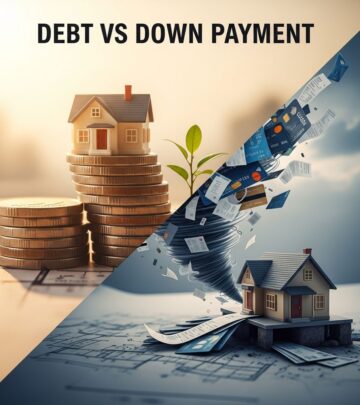
Clear Credit Card Debt Before Home Purchase?
Explore how tackling credit card balances impacts mortgage approval, rates, and your financial future when buying a home.

Reducing or eliminating credit card debt prior to pursuing a mortgage often improves your chances of approval and better terms. High revolving debt can elevate your debt-to-income ratio and hinder credit scores, making home loans harder to secure.
Understanding Debt’s Role in Mortgage Qualification
Credit card balances directly influence key mortgage lending criteria. Lenders scrutinize your overall financial health through metrics like debt-to-income (DTI) ratio and credit utilization. A DTI above 43% frequently leads to denials, while ideal levels stay under 36% for prime rates. Credit card debt contributes to DTI by factoring in minimum monthly payments alongside proposed mortgage costs.
Revolving credit, unlike fixed installment loans, signals ongoing financial pressure to underwriters. Balances exceeding 30% of limits drag down FICO scores, where amounts owed comprise 30% of the calculation. This unsecured debt contrasts with mortgages, which are secured by property and carry lower rates typically below 7%, versus credit cards averaging over 20%.
Key Financial Metrics Affected by Credit Card Balances
- Debt-to-Income Ratio (DTI): Calculated as total monthly debt payments divided by pretax income. Adding mortgage estimates, high card minimums push DTI higher, risking rejection.
- Credit Utilization: Balances relative to limits; keeping under 30% bolsters scores. Paying down cards frees capacity, signaling responsibility.
- Payment History: Consistent minimums maintain scores, but large balances raise red flags for affordability.
| Metric | Ideal Range | Impact of High Credit Card Debt |
|---|---|---|
| DTI | <36% | Increases by minimum payments, often exceeding limits |
| Utilization | <30% | Pushes above threshold, lowers score by 30+ points |
| Credit Score | 700+ | Drops due to high balances, leading to higher rates |
Mortgage debt differs fundamentally: secured, long-term (15-30 years), and lower interest, viewing it as an investment via equity buildup. Credit cards represent high-cost, short-term consumption debt.
Strategic Timing for Debt Reduction
Target payoff 3-6 months pre-application allows score recovery. Prioritize high-interest cards first, as rates dwarf mortgage costs—saving thousands long-term. For example, $10,000 at 22% APR accrues $2,200 yearly interest versus negligible on a refinanced mortgage portion.
Partial paydown suffices if DTI fits guidelines. Lenders include minimums (often 3-4% of balance), so slashing balances proportionally eases burden without zeroing out.
Scenarios Where Payoff Isn’t Urgent
Not all debt mandates immediate clearance. Consider these cases:
- Strong Credit Profile: Scores 700+ tolerate moderate utilization without score hits.
- Ample Budget Room: If payments fit comfortably alongside savings for down payment and reserves, proceed cautiously.
- Defined Repayment Roadmap: Structured plan to zero balances post-closing mitigates risks, accounting for homeownership costs like taxes and upkeep.
Experts caution against overextending; high debt signals risk, inflating rates or limiting loan size. Vice-chair Dottie Herman advises substantial reduction for affordability.
Alternatives to Full Payoff
Balance aggressively without depleting savings:
- Debt Consolidation: Transfer to 0% promo balance transfers or personal loans at lower rates, preserving cash.
- Refinance Existing Home: If owning, tap equity for cards at mortgage rates, simplifying payments.
- Budget Optimization: Cut expenses to accelerate paydown while building reserves.
Affordability calculators reveal mortgage capacity post-debt adjustments.
Long-Term Financial Planning Integration
Home buying amplifies expenses: principal/interest, taxes (1-2% property value), insurance ($1,500+/year average), maintenance (1% value annually). Layering card payments strains budgets, risking delinquency. Surveys show 91% prioritize mortgages over cards, underscoring secured debt priority.
Post-purchase, redirect payments to cards. National data: mortgage debt dwarfs cards ($12.6T vs. consumer levels), but per-person card burdens equate to significant monthly outlays. Average card payment $273 rivals student loans.
Steps to Prepare Financially
- Review Reports: Pull free annualcreditreport.com data; dispute errors.
- Calculate DTI: Include all obligations plus estimated mortgage.
- Pay Down Strategically: Avalanche method (highest interest first).
- Build Reserves: 3-6 months expenses plus 2-20% down payment.
- Shop Lenders: Prequalify without hard inquiries.
Common Pitfalls to Avoid
- Closing cards post-payoff: Hurts utilization and history.
- Ignoring inquiries: Multiple harden scores.
- New debt: Recent activity tanks scores.
Delinquency stats: Cards 8x more likely past 90 days vs. student loans, amplifying lender caution.
FAQs
Can I buy a home with $10,000 credit card debt?
Possible if DTI <43% and score solid; paydown improves odds.
How much debt is too much for a mortgage?
DTI over 43-50% risks denial; aim under 36%.
Does paying off cards raise my score instantly?
Yes, utilization drops reflect in 30 days; full rebuild 3+ months.
Should I refinance to pay cards?
Viable if owned home; lower rates save money but extends term.
Impact of 50% utilization on mortgage?
Severe score drop, higher rates, potential denial.
(Word count: 1678)
References
- The math does not lie… mortgage interest rates vs. those of credit cards — Fred & Martin. 2023-05-23. https://fredandmartin.com/en/blog/2023-05-23-the-math-does-not-lie-mortgage-interest-rates-vs-those-of-credit-cards/
- Should You Pay Off Credit Card Debt Before Buying a Home? — Experian. N/A. https://www.experian.com/blogs/ask-experian/should-you-pay-off-credit-card-debt-before-buying-home/
- Credit Card Debt and Mortgages: How One Affects the Other — MWLoan. N/A. https://www.mwloan.com/blog/credit-card-debt-and-mortgages-how-one-affects-the-other/
- Should I pay my credit cards or my mortgage payments? — Miller Miller Law. N/A. https://millermillerlaw.com/should-i-pay-my-credit-cards-or-my-mortgage-payments/
- How Mortgage Debt Differs From Other Types of Debt — Elevate. N/A. https://www.elevate.com/article/how-mortgage-debt-differs-from-other-debt
- Should you buy a home if you have credit card debt? Here’s what experts say — CBS News. N/A. https://www.cbsnews.com/news/should-you-buy-a-home-if-you-have-credit-card-debt-heres-what-experts-say/
- Student Loan Debt vs Credit Card & Mortgage Debt (Compared) — Education Data. N/A. https://educationdata.org/student-loan-debt-vs-other-debts
Similar Articles








Read full bio of medha deb