Circular Flow of Income: Understanding Economic Movement
Explore how money, goods, and services flow through economic sectors.
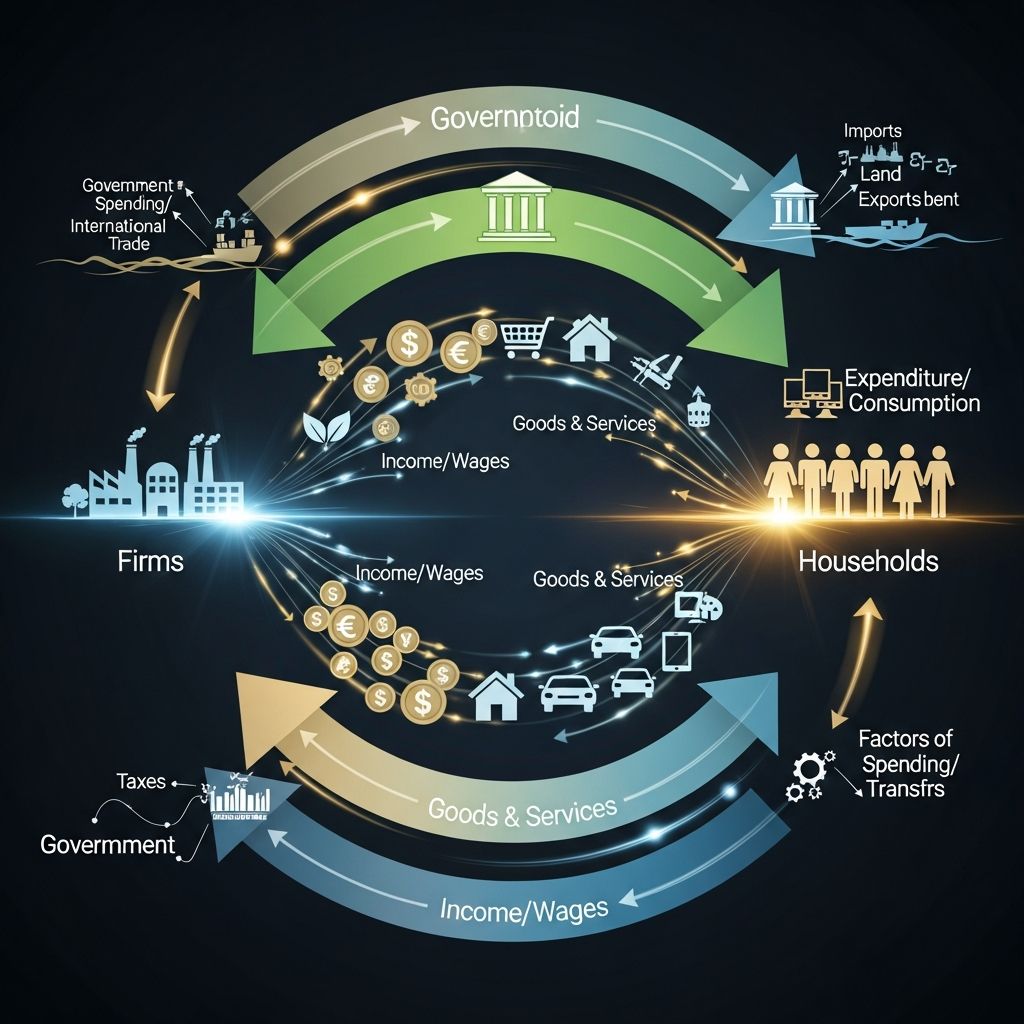
Circular Flow of Income: Definition and Core Concept
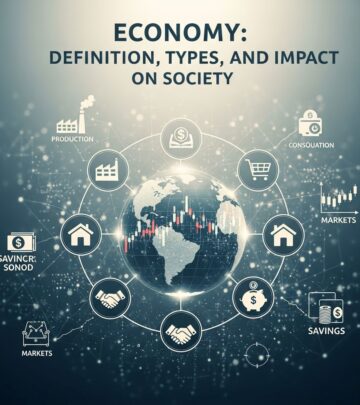
The circular flow of income is a fundamental economic model that illustrates how money, goods, and services move between different sectors of an economy. This economic framework demonstrates the interconnected relationships between households, firms, government, financial institutions, and foreign entities in generating and distributing wealth throughout the economic system. The model provides a comprehensive view of national income and gross domestic product (GDP) by tracking the continuous movement of funds through various economic participants.
At its heart, the circular flow model reveals an essential truth about modern economies: money continuously circulates from one sector to another in a predictable pattern. When households purchase goods and services from firms, money flows from consumers to businesses. Simultaneously, firms pay wages and other forms of compensation to workers, creating a reverse flow of income back to households. This reciprocal movement creates the circular pattern that gives the model its name.
The Basic Two-Sector Model
The simplest representation of the circular flow involves only two main economic sectors: households and firms. In this fundamental model, the relationship is straightforward and illustrates the core principle of economic activity. Households, acting as consumers, purchase goods and services that firms produce. Simultaneously, households serve as owners of factors of production—including land, labor, capital, and enterprise—which they provide to firms.
Firms compensate households for these factors of production through various forms of payment:
- Wages paid for labor services
- Rent paid for land or natural resources
- Interest paid for capital investment
- Profits distributed to business owners
This exchange creates two distinct flows. The physical flow moves goods and services from firms to households, while the monetary flow moves income from firms back to households. Money spent by households on consumption becomes the revenue for firms, which then distribute this revenue back to households as factor payments. In this simplified model, if households spend all their income without saving, the circular flow continues indefinitely in perfect balance.
Accounting Principles and Flow Balance
A critical principle underlying the circular flow model is that all flows must balance. According to fundamental accounting rules, every dollar entering a sector must eventually leave it. For firms, this means that all revenue received must be paid out as compensation for factors of production. The total value of goods and services produced by firms—measured as the outflow from the firm sector—ultimately represents income flowing to households.
This balance principle applies universally across all sectors within the model. When analyzing the firm sector specifically, the revenues received from household spending must equal the total payments made for all inputs used in production. In a simplified economy where labor is the only input, 100% of firm revenues flow back to workers as wages. However, in real economies with multiple inputs, firm revenues are distributed among all factor payments: wages for labor, interest for capital, rent for land, and profits for entrepreneurship.
The fundamental accounting identity can be expressed as:
Income = Spending
This identity ensures that the circular flow remains balanced and continuous, preventing money from disappearing from the economic system or accumulating indefinitely in any single sector.
The Role of Savings and Investment
While the basic two-sector model assumes households spend all their income, real-world economies are more complex. Households typically save a portion of their income rather than spending everything immediately. Similarly, firms retain earnings for business expansion and other purposes. These savings represent leakages from the basic circular flow, breaking the continuous cycle of spending and income.
To maintain economic flow despite these leakages, the financial sector plays a crucial role. Banks and other financial institutions collect savings from households and firms, then redistribute these funds as loans for investment purposes. When households deposit savings into financial institutions, those funds become available for firms to borrow for capital investment, expansion, and other productive activities. This linkage between household savings and firm investment represents one of the most important relationships in macroeconomics.
The financial sector essentially channels idle resources—money that would otherwise sit unused—into productive investment that stimulates economic growth and employment. Without this intermediary function, savings would represent a complete loss from the circular flow, reducing overall economic activity and GDP.
The Four-Sector Model: Adding Government
Real economies include a government sector that significantly affects the circular flow of income. Government represents both a consumer of goods and services and a provider of certain goods that markets alone cannot efficiently supply. The government sector participates in the circular flow through multiple channels:
- Purchasing goods and services from firms
- Employing workers and paying wages
- Collecting taxes from households and firms
- Providing transfer payments and public services
Government spending injects money into the economy, increasing demand for goods and services. However, government also collects revenue through taxation, which represents a leakage from the circular flow. The net effect depends on whether government spending exceeds tax revenues (deficit spending), equals tax revenues (balanced budget), or falls short of tax revenues (budget surplus).
Government also participates in financial markets by borrowing funds to finance deficit spending. When government debt exceeds revenues, the financial sector must provide lending to cover the gap. This government borrowing competes with private investment for available funds in financial markets, potentially affecting interest rates and the level of private investment.
The Five-Sector Model: International Trade and Capital Flows
The most comprehensive representation of the circular flow includes a fifth sector representing foreign economies and international economic relationships. An open economy participates in global trade and financial markets, creating additional flows of money and goods across national borders. The foreign sector connects to the domestic economy through two primary channels:
Trade in Goods and Services
When domestic firms export goods and services to foreign countries, money flows into the economy from abroad. Conversely, when households and firms import foreign goods, money flows out of the domestic economy. The net effect on the circular flow depends on whether exports exceed imports (trade surplus) or imports exceed exports (trade deficit).
International Capital Flows
Foreign investors may choose to invest in domestic financial assets, bringing capital into the economy and increasing available investment funds. Alternatively, domestic investors may invest abroad, removing capital from the domestic economy. These international capital flows significantly impact the financial sector and the funds available for domestic investment.
The foreign sector transforms a closed economy model into an open economy framework, reflecting the reality that modern economies are deeply integrated into global markets. International trade and finance create both opportunities and vulnerabilities, as external economic conditions can significantly influence domestic economic activity.
The Financial Sector: The Heart of the Circular Flow
The financial sector occupies a central position in the complete circular flow model, acting as the crucial link between saving and investment. This sector encompasses banks, stock markets, bond markets, and other financial institutions that facilitate the transfer of funds from savers to borrowers. The financial sector balances multiple flows of money:
Inflows to the Financial Sector:
- Household savings and deposits
- Business retained earnings
- Government borrowing needs
- Foreign investment capital
Outflows from the Financial Sector:
- Loans to firms for investment
- Government loans and credit
- Consumer credit to households
- Investment abroad
A fundamental accounting identity governs the financial sector: all money flowing in must equal all money flowing out. This principle is expressed mathematically as:
Investment + Government Borrowing = Private Savings + Foreign Investment
This equation demonstrates that the funds available for domestic investment come from three sources: private household and business savings, government borrowing, and foreign investment. The financial sector ensures that the circular flow remains balanced by matching available funds with investment opportunities.
How GDP Connects to the Circular Flow
The circular flow model directly relates to GDP measurement through two fundamental approaches: the expenditure approach and the income approach. Both approaches must yield identical results, as they measure the same economic activity from different perspectives.
The expenditure approach measures GDP by summing all spending in the economy: consumption by households, investment by firms, government spending, and net exports (exports minus imports). These expenditures represent the outflows from different sectors into firms, which then produce goods and services.
The income approach measures GDP by summing all factor payments: wages to workers, rent to landowners, interest to capital providers, and profits to entrepreneurs. These factor payments represent the income flowing from firms to households and represent the value of production from an income perspective.
Both approaches must equal the total production value in the economy, confirming that the circular flow accurately represents economic activity and provides a framework for understanding and measuring national income.
Equilibrium and Economic Growth
The circular flow model reaches equilibrium when injections into the economy equal leakages from it. Injections include investment spending, government spending, and export revenues—all money flowing into the circular flow from external sources. Leakages include savings, taxes, and import spending—all money flowing out of the circular flow.
When injections exceed leakages, the circular flow accelerates, and economic output expands. This expansion continues until production constraints force prices upward or input costs rise. When leakages exceed injections, the circular flow contracts, reducing economic output and employment. Policymakers and central banks often attempt to manage these flows to maintain steady economic growth and low unemployment.
Key Characteristics of the Circular Flow Model
Understanding the circular flow requires recognizing several important characteristics that define how the model operates:
- Continuous Movement: Money continuously circulates through the economy without beginning or end points
- Balance Requirements: Accounting rules ensure that inflows equal outflows for each sector
- Interconnectedness: All sectors depend on flows from other sectors for their operation
- GDP Measurement: The model provides a framework for calculating national income and economic output
- Policy Impact: Government and central bank actions affect the circular flow by changing injections and leakages
Practical Implications and Real-World Applications
Understanding the circular flow has significant practical implications for economic policy and business decisions. Policymakers use the model to understand how their actions affect the broader economy. For example, tax increases represent an increase in leakages, which may reduce overall economic activity. Conversely, government spending increases represent injections that can stimulate economic growth.
Businesses use the circular flow framework to understand consumer demand patterns and plan production accordingly. When households save more and spend less, firms face reduced revenues and may decrease investment. Understanding these relationships helps businesses anticipate market conditions and adjust strategies accordingly.
International economists use the circular flow model extended to include foreign sectors to understand trade relationships and capital flows. Trade imbalances, foreign investment patterns, and exchange rate movements all affect the circular flow and have implications for domestic employment and growth.
Limitations and Assumptions
While the circular flow model provides valuable insights into economic relationships, it operates based on certain simplifying assumptions. The basic model assumes perfect information, rational economic actors, and constant factor prices. Real economies deviate from these assumptions in significant ways. Additionally, the model may not fully capture the complexity of modern financial systems, the impact of technological change, or the effects of market imperfections and monopolistic competition.
Despite these limitations, the circular flow remains an essential tool for understanding macroeconomic principles and the fundamental relationships driving economic activity. It provides an accessible framework for analyzing how money flows through the economy and how different sectors depend on one another.
Frequently Asked Questions
Q: Why is the circular flow model important in economics?
A: The circular flow model is important because it illustrates the fundamental relationships between different sectors of the economy, demonstrates how income and spending are related, and provides a framework for understanding GDP measurement and macroeconomic policy.
Q: What sectors are included in the complete circular flow model?
A: The complete five-sector model includes households, firms, government, the financial sector, and the foreign sector. Each sector participates in the circular flow through money flows and factor exchanges.
Q: How do savings affect the circular flow of income?
A: Savings represent leakages from the basic circular flow, as money saved is not immediately spent on consumption. However, the financial sector channels these savings into investment, which injects money back into the circular flow through business investment and capital spending.
Q: What is the relationship between circular flow and GDP?
A: The circular flow model demonstrates why the expenditure approach and income approach to calculating GDP must yield identical results. The total spending in the economy must equal the total income earned, confirming the balance of circular flows.
Q: How do international trade and foreign investment affect the circular flow?
A: International trade creates exports (injection) and imports (leakage) in the circular flow. Foreign investment injects capital into financial markets, while domestic investment abroad represents a leakage. These flows affect the balance of the circular flow and domestic economic activity.
Q: What happens when injections exceed leakages?
A: When injections exceed leakages, the circular flow accelerates and economic output expands. This expansion continues until constraints force adjustment, such as rising prices or increased unemployment pressure.
References
- The Circular Flow of Income — Social Science LibreTexts. Accessed 2025-11-29. https://socialsci.libretexts.org/Bookshelves/Economics/Introductory_Comprehensive_Economics/Economics_-_Theory_Through_Applications/18:_The_State_of_the_Economy/18.04:_The_Circular_Flow_of_Income
- Circular Flow Model: Overview, How It Works, and Implications — Corporate Finance Institute. Accessed 2025-11-29. https://corporatefinanceinstitute.com/resources/economics/circular-flow-model/
- Circular Flow of Income — GeeksforGeeks. Accessed 2025-11-29. https://www.geeksforgeeks.org/macroeconomics/circular-flow-of-income/
- Lesson Summary: The Circular Flow and GDP — Khan Academy. Accessed 2025-11-29. https://www.khanacademy.org/economics-finance-domain/ap-macroeconomics/economic-iondicators-and-the-business-cycle/21/a/the-circular-flow-and-gdp
- Understanding the Circular Flow Model in Economics — MasterClass. Accessed 2025-11-29. https://www.masterclass.com/articles/understanding-the-circular-flow-model-in-economics
Similar Articles








Read full bio of Sneha Tete