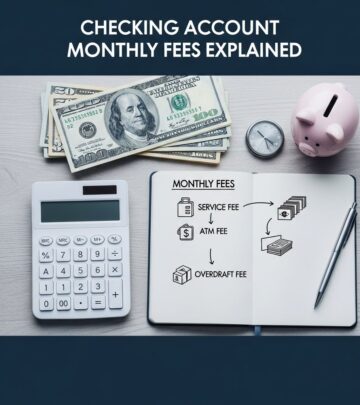
Understanding Checking Account Fees in 2026
Discover which checking accounts charge fees and which ones remain completely free.

When opening a checking account, many people assume they’re getting a straightforward service with minimal costs. However, the reality is more complex. While some checking accounts truly operate without any charges, others impose various fees that can significantly impact your finances over time. Understanding which accounts remain free and which ones charge for their services is essential for making an informed banking decision.
The Reality of Checking Account Costs
Not all checking accounts are free. In fact, the majority of checking accounts offered by traditional banks include monthly maintenance fees, with only about 37% of accounts available today having zero monthly charges. The landscape of checking account pricing has evolved considerably, and consumers need to understand the different fee structures before committing to any particular bank.
The average monthly maintenance fee across all checking accounts currently stands at $13.95. However, this varies significantly depending on whether you bank with a large institution or a smaller financial establishment. Large banks charge an average of $16.35 per month in maintenance fees, while smaller banks average just $10.95. This difference represents a substantial annual savings opportunity for those willing to explore alternatives to major national banks.
Breaking Down Common Checking Account Fees
Understanding the various fees associated with checking accounts helps you identify which charges to prioritize when comparing accounts. Banking fees fall into several distinct categories, each affecting your finances differently.
Monthly Maintenance Charges
The most common fee associated with checking accounts is the monthly maintenance fee. This charge appears on your statement each month and represents the bank’s cost to maintain your account. However, banks typically offer several ways to waive this fee, such as maintaining a minimum balance or setting up direct deposit. For example, Chase Total Checking charges $15 monthly but waives this fee with either a $1,500 minimum balance or $500 in total direct deposits.
The good news is that fewer banks are charging these fees than in the past. The percentage of checking accounts with no monthly maintenance fees has grown to more than 37%, up from 35.7% six months prior. This trend suggests that banks are responding to consumer preferences and competitive pressures by offering more fee-free alternatives.
Overdraft Fees
Overdraft fees occur when you withdraw more money than your account balance allows. When a transaction pushes your account into negative territory, the bank typically charges a fee for covering this shortfall. The current average overdraft fee is $30.82 per occurrence, which has declined 4% in recent months. While this represents an improvement, these fees still accumulate quickly for those who frequently overdraft their accounts.
Some checking accounts offer overdraft protection or free overdraft services to help customers avoid these charges. For instance, Capital One 360 Checking provides no-fee overdrafts on Capital One-approved transactions and free overdraft protection transfers. Similarly, Ally Bank’s Spending Account doesn’t charge overdraft fees at all.
Out-of-Network ATM Fees
Using an ATM that doesn’t belong to your bank’s network typically triggers fees. The average out-of-network ATM fee is $4.55 per transaction, and these charges can accumulate rapidly for regular users. Someone using out-of-network ATMs just a few times monthly could easily spend over $100 annually on these fees alone.
Many free checking accounts address this concern by offering ATM fee reimbursements or access to extensive ATM networks. Axos Essential Checking provides unlimited domestic ATM fee reimbursements, while Capital One 360 Checking customers can access more than 70,000 free nationwide ATMs. These features make it possible to avoid ATM fees entirely.
Finding Truly Free Checking Accounts
Several checking accounts operate without monthly maintenance fees, overdraft charges, or other common banking fees. These accounts represent the best option for cost-conscious consumers seeking genuine banking value.
Notable Free Checking Options
Capital One 360 Checking stands out as a completely fee-free option with no monthly fees, overdraft fees, or minimum balance requirements. The account also earns 0.10% APY on all balances and offers access to over 70,000 free ATMs nationwide. Additionally, customers can potentially access banking services in person through Capital One branches in eight states and Washington D.C., plus Capital One cafes in more than 15 states and Washington D.C..
Ally Bank’s Spending Account eliminates monthly maintenance fees and overdraft charges while providing free standard checks and reimbursement of up to $10 per statement cycle for out-of-network ATM fees. The account also offers modest interest earnings at 0.10% APY on balances under $15,000 and 0.25% APY with a minimum daily balance of $15,000. Customer service representatives are available 24/7.
Axos Essential Checking removes monthly service fees, overdraft fees, and insufficient fund fees while providing unlimited domestic ATM fee reimbursements. Opening this account requires no minimum deposit, making it accessible to anyone looking for a completely free checking solution.
Bask Bank’s Interest Checking account charges no monthly maintenance fees, overdraft fees, international transaction fees, or incoming wire fees while offering a competitive 1.00% APY on all balances. Bank5 Connect goes even further, offering 2.00% APY for customers maintaining a $100 minimum balance and reimbursing up to $15 monthly for out-of-network ATM fees.
Credit Union Alternatives
Credit unions often provide more favorable fee structures than traditional banks. Alliant Credit Union offers checking accounts with no monthly fees and reimburses up to $20 per month in ATM fees from other banks. The account provides one of the higher interest rates available on checking accounts. Membership requires meeting eligibility requirements or applying to become an Alliant Credit Union Foundation advocate with a $5 donation.
Fee Waiver Strategies
If you prefer banking with a larger institution but want to avoid monthly fees, several strategies can help you waive these charges entirely.
Minimum Balance Requirements
Most traditional banks offer fee waivers when you maintain a specified minimum balance. Bank of America Advantage Plus, for example, waives its $12 monthly fee with a $1,500 minimum balance. While maintaining such a balance requires capital that could otherwise be invested, this approach works well for those with stable finances and higher account balances.
Direct Deposit Qualification
Many banks waive monthly fees for customers who receive regular direct deposits. The required deposit amount varies by institution. Wells Fargo Everyday Checking waives its $10 monthly fee with $500 in total monthly direct deposits, while some banks require higher amounts. This strategy works particularly well for employed individuals who already receive paychecks through direct deposit.
Combination Approaches
Some accounts use tiered waiver systems allowing multiple paths to eliminate fees. PNC Bank Virtual Wallet Account charges only $7 monthly but waives this fee with either a $500 minimum balance or $500 in total direct deposits. This flexibility accommodates different customer circumstances.
Comparing Account Structures
| Bank | Monthly Fee | Overdraft Fees | ATM Benefits | Interest Earnings |
|---|---|---|---|---|
| Capital One 360 | None | None | 70,000+ free ATMs | 0.10% APY |
| Ally Bank | None | None | Up to $10 reimbursement | 0.10%-0.25% APY |
| Axos Essential | None | None | Unlimited reimbursement | Not specified |
| Bask Bank | None | None | Not specified | 1.00% APY |
| Chase Total Checking | $15 | Standard | Fee-based | None |
| Wells Fargo Everyday | $10 | Standard | Fee-based | None |
Frequently Asked Questions
Can I find a checking account with no fees whatsoever?
Yes. Multiple checking accounts offer completely free services with no monthly fees, overdraft charges, or ATM fees. Capital One 360 Checking, Ally Bank’s Spending Account, and Axos Essential Checking represent popular zero-fee options. However, you may need to accept trade-offs such as lower interest rates or fewer in-person banking locations.
Why do some banks charge for checking accounts while others don’t?
Banks generate revenue through various channels including interest income, loan origination, and fee collection. Larger banks tend to rely more heavily on fee income, while online-focused banks and credit unions often operate with lower overhead costs, allowing them to offer free accounts. The competitive banking landscape also pressures institutions to attract customers through favorable fee structures.
How much can checking account fees cost annually?
The cumulative annual cost of checking account fees can be substantial. With an average monthly maintenance fee of $13.95, customers pay approximately $167.40 yearly just for maintaining their account. Adding overdraft fees and ATM charges can easily push annual costs above $300. This makes finding a truly free account particularly worthwhile.
Are free checking accounts worth the trade-offs?
Free checking accounts typically offer fewer perks than premium accounts, such as lower interest rates or limited in-person banking options. However, for most customers, the fee savings outweigh these disadvantages. The amount saved annually can exceed $200, representing significant value that justifies any minor inconveniences.
Should I prioritize ATM access or low fees?
Both factors matter, but the importance depends on your banking habits. If you frequently use ATMs from different networks, prioritize accounts offering generous ATM fee reimbursements or access to extensive free ATM networks. If you rarely use ATMs, focus on finding accounts without monthly maintenance or overdraft fees.
Recent Trends in Checking Account Fees
The checking account fee landscape has shifted favorably for consumers in recent months. Checking account fees declined across all major categories in the latest survey period, marking a rare occurrence in banking. Monthly maintenance fees dropped 3.1% compared to the previous survey, overdraft fees decreased 4%, and combined ATM fees fell 1.7%.
This positive trend reflects increasing consumer awareness and competition among financial institutions. Banks recognize that customers increasingly compare fee structures and switch to competitors offering better value. Online banking platforms and credit unions have intensified this competition by promoting fee-free accounts, forcing traditional banks to reevaluate their pricing strategies.
The percentage of checking accounts with no monthly maintenance fees has grown steadily, now representing over 37% of available accounts. This expansion of fee-free options suggests that the trend toward lower-cost banking will likely continue, providing consumers with more choices and better long-term value.
Making Your Checking Account Decision
Selecting the right checking account requires evaluating your specific banking needs and priorities. Consider how frequently you use ATMs, whether you receive direct deposits, your typical account balance, and your need for in-person banking services. Compare multiple options using the fee structures and features outlined above, calculating your potential annual costs under each scenario.
For most consumers, a completely free checking account represents the optimal choice. The elimination of monthly fees, overdraft charges, and ATM fees provides substantial annual savings that justify any minor trade-offs. By taking time to research available options and understand fee structures, you can ensure your checking account works for you rather than against your financial goals.
References
- MyBankTracker Checking Account Guide — MyBankTracker. March 2026. https://www.mybanktracker.com/checking
- Checking Account Fees Survey 2026: Analyzing Averages and Trends — MoneyRates. 2026. https://www.moneyrates.com/research-center/bank-fees/
- Best Free Checking Accounts For March 2026 — Bankrate. March 2026. https://www.bankrate.com/banking/checking/best-free-checking-accounts/
- 6 Best No-Fee Checking Accounts of 2026 — Chime. 2026. https://www.chime.com/blog/best-no-fee-checking-accounts/
- 10 Best Checking Accounts for March 2026 — NerdWallet. March 2026. https://www.nerdwallet.com/banking/best/checking-accounts
Similar Articles








Read full bio of medha deb