Check Holds Explained
Discover why banks place holds on checks, how long they last, and strategies to access your funds faster.

Check holds represent a standard banking practice where financial institutions temporarily restrict access to deposited check funds to verify legitimacy and prevent fraud. Governed by federal laws, these holds balance customer convenience with risk management, typically lasting one to two business days for most transactions.
The Fundamentals of Check Holds
When you deposit a check via mobile app, ATM, or branch, the bank credits your account balance immediately for record-keeping. However, the funds enter a pending status during the hold period, meaning you cannot withdraw or spend them until clearance. This delay occurs because banks must route checks through clearing systems like the Federal Reserve to confirm the issuing bank’s payment.
The core purpose is fraud prevention. Without holds, institutions risk releasing funds on invalid checks, leading to overdrafts, fees, and losses for customers and banks alike. Regulation CC, enacted via the Expedited Funds Availability Act (EFAA) of 1987, standardizes these timelines to protect consumers while allowing verification time.
Legal Framework: Regulation CC Guidelines
Under Regulation CC, banks must make funds available by specific deadlines. For local checks deposited in person, the first $225 becomes accessible the next business day, with the remainder following by the second business day. Non-local or certain other checks follow similar rules but may extend holds.
| Check Type | Standard Availability | Exceptions |
|---|---|---|
| Local Checks (in-person deposit) | $225 next day; rest by day 2 | Up to 7 days for large amounts |
| ATM/Mobile Deposits | Full by day 2 | Longer for new accounts |
| Government Checks (Treasury, Postal) | Next business day | Rare holds |
| Cashier’s Checks | Next business day | Subject to verification |
This table summarizes key timelines based on federal rules, helping predict fund access.
Common Triggers for Extended Holds
Banks apply longer holds in riskier scenarios to mitigate potential losses. Factors include:
- New Accounts: Accounts under 30 days old face holds up to 9 business days on deposits over certain thresholds, as history is limited.
- Large Deposits: Amounts exceeding $5,525 trigger extended reviews.
- Redeposited Checks: Previously returned items may hold up to 7 days.
- Unusual Activity: Frequent overdrafts or suspected fraud prompt caution.
- Check Source: Foreign or unfamiliar banks extend to 6-7 days.
Institutions notify customers of holds via mailed notices or app alerts, detailing duration and reasons.
Step-by-Step: How Check Processing Leads to Holds
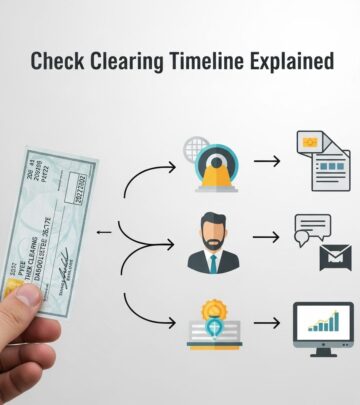
- Deposit Submission: You hand over or scan the check; provisional credit appears.
- Clearinghouse Routing: Bank sends to Federal Reserve or clearing network for issuer validation.
- Verification: Issuer confirms funds; process takes 1-2 days typically.
- Hold Release: Funds unlock automatically upon clearance notice.
- Potential Return: Even post-hold, checks can bounce, incurring fees.
This sequence underscores why immediate access isn’t feasible for all deposits.
Impact on Daily Banking and Budgeting
Holds disrupt cash flow, especially for those living paycheck-to-paycheck. Writing checks against held funds risks overdrafts, with fees up to $35 per incident. Businesses face payroll delays, and emergencies become challenging without alternatives like overdraft protection.
Proactive planning helps: Track deposit cutoffs (often 2-4 PM), maintain buffers, and use apps for real-time status checks. Understanding your bank’s policy, outlined in deposit agreements, empowers better decisions.
Strategies to Minimize or Avoid Check Holds
Reduce reliance on paper checks with modern alternatives:
- Direct Deposit: Payroll ACH transfers clear same-day.
- Wire Transfers: Instant but fee-based for urgency.
- P2P Apps (e.g., Zelle): Funds available immediately.
- Cash Deposits: No holds, fully accessible.
- Verify Check Legitimacy: Confirm issuer funds before deposit.
For unavoidable checks, deposit early in person at branches for faster processing versus ATMs.
Bank-Specific Policies and Variations
While Regulation CC sets minimums, banks like Wells Fargo extend to 7 days for risks, Regions offers $225 day-one access, and Bank of America emphasizes electronic options. Credit unions follow similar rules, prioritizing member protection.
Review your statements or app for hold notices. Representatives cannot override holds, as they comply with federal mandates.
Frequently Asked Questions (FAQs)
What triggers a check hold at my bank?
Holds arise from new accounts, large sums over $5,525, redeposits, or fraud risks, per Regulation CC.
How long can a bank legally hold my check?
Most clear by business day 2; exceptions allow up to 7-9 days with notice.
Can I access any funds during a hold?
Yes, the first $225 is available next day for many deposits.
Why use electronic payments over checks?
They avoid holds entirely, providing same-day access and reducing fraud.
What if a held check bounces after release?
You may face fees; banks protect via holds but cannot guarantee post-release.
Navigating Disputes and Exceptions
If a hold seems excessive, request your bank’s funds availability policy. Regulation CC requires disclosure. For errors, file complaints with the Consumer Financial Protection Bureau. Extended holds over 7 days without justification violate rules.
New technologies like real-time payments (RTP) promise faster clearance, potentially reducing holds in the future.
References
- What Is a Check Hold? — SoFi. 2023. https://www.sofi.com/learn/content/what-is-a-check-hold/
- Check Deposit Hold FAQs — Regions Bank. 2024. https://www.regions.com/personal-banking/deposit-holds
- Bank of America Deposit Holds: What Are They and Other FAQs — Bank of America. 2024. https://www.bankofamerica.com/deposits/deposit-holds-faqs/
- Understanding Check Holds — MyCreditUnion.gov (NCUA). 2023-10-01. https://mycreditunion.gov/about/news-blog/understanding-check-holds
- Deposit Hold Questions — Wells Fargo. 2024. https://www.wellsfargo.com/help/checking-savings/deposit-holds-faqs/
- A Guide to Regulation CC Compliance — Federal Reserve Board. 2024. https://www.federalreserve.gov/supervisionreg/guide-regulation-cc-compliance.htm
Similar Articles








Read full bio of Sneha Tete