Chart of Accounts: Definition, Structure, and Implementation
Master the fundamentals of chart of accounts and streamline your financial record-keeping.
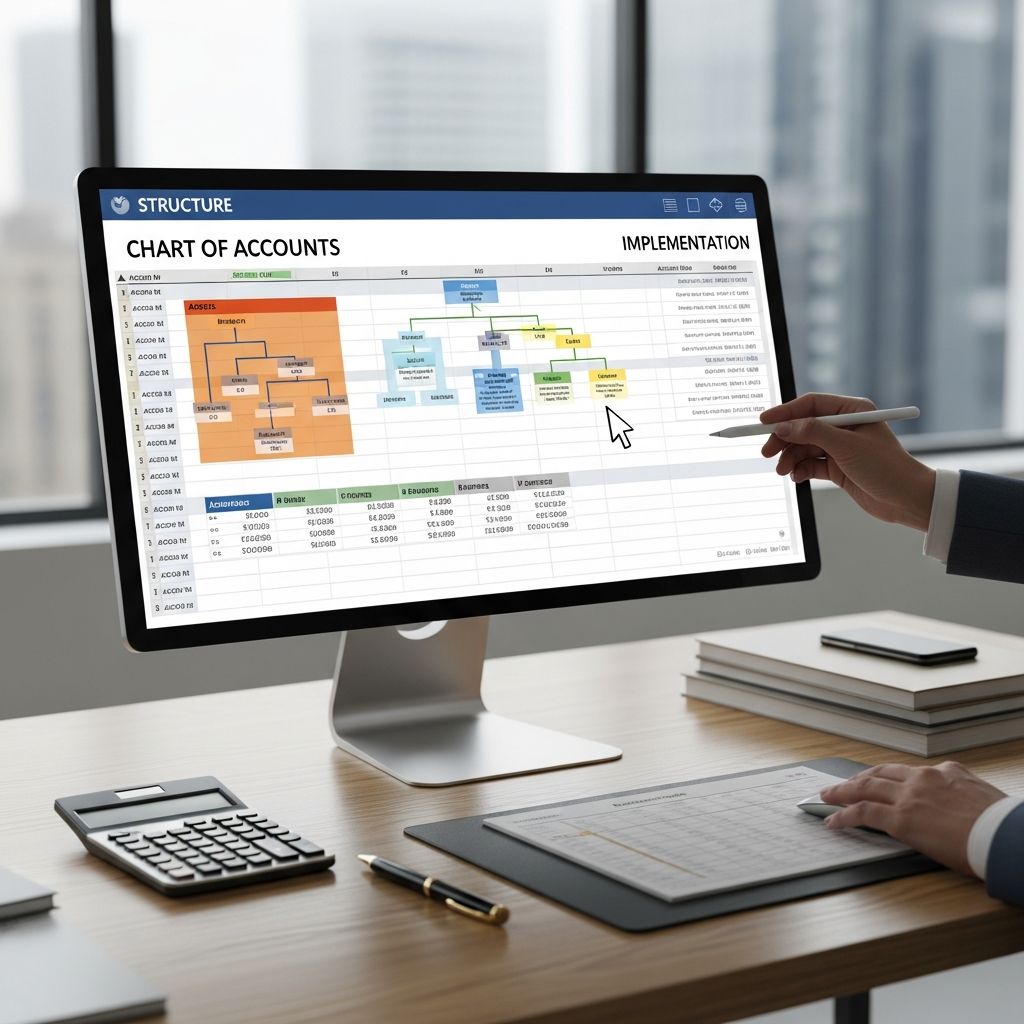
A chart of accounts (COA) serves as the foundational framework for any organization’s financial record-keeping system. It is essentially a comprehensive listing of all financial accounts maintained by a company in its general ledger, organized systematically to facilitate accurate transaction recording and financial reporting. The chart of accounts is more than just a simple directory—it is a strategic tool that enables businesses to track their financial health, generate accurate financial statements, and make informed business decisions.
What Is a Chart of Accounts?
A chart of accounts is a catalog that reflects the entirety of a business’s finances by separating revenue, expenses, assets, liabilities, and equity into different accounts. Each account in the chart is assigned a unique alphanumeric code and a descriptive name, allowing accountants and financial managers to quickly locate and post transactions to the appropriate accounts. This systematic approach ensures consistency in financial reporting and helps maintain the integrity of the accounting records.
At its core, the chart of accounts functions as the central reference point for the company’s general ledger, which is the master record of all transactions. By organizing accounts into logical categories and subcategories, the chart of accounts makes it easier for employees to understand where transactions should be recorded and helps external auditors verify the completeness and accuracy of the company’s financial statements.
The Purpose and Importance of a Chart of Accounts
The primary purpose of a chart of accounts is to provide a structured framework for recording, organizing, and reporting financial transactions. Without a well-designed chart of accounts, businesses would struggle to maintain accurate financial records, generate timely reports, or identify trends in their financial performance.
Key purposes include:
– Facilitating accurate and consistent transaction recording across the organization- Enabling the generation of accurate financial statements such as balance sheets and income statements- Providing managers with insights into cash flow patterns and financial performance- Supporting external audits by demonstrating a clear, organized financial structure- Allowing for detailed analysis of revenue, expenses, assets, and liabilities by department or business segment- Ensuring compliance with accounting standards such as GAAP (Generally Accepted Accounting Principles) or IFRS (International Financial Reporting Standards)
Structure and Main Categories of a Chart of Accounts
Most charts of accounts follow a standardized structure organized into five primary categories, though some organizations may expand this to seven categories by separating gains and losses as distinct line items. Understanding these main categories is essential for properly structuring a chart of accounts.
Balance Sheet Accounts
Balance sheet accounts record the company’s financial position at a specific point in time and include three primary categories:
Assets represent everything the company owns that has economic value. Assets are further subdivided into current assets (cash, accounts receivable, inventory) and non-current assets (property, equipment, long-term investments). Current assets are those that can be converted to cash or used within one year, while non-current assets provide long-term value to the organization.
Liabilities represent all debts and obligations the company owes to external parties. Similar to assets, liabilities are divided into current liabilities (accounts payable, short-term loans) and non-current liabilities (long-term debt, lease obligations). This distinction helps businesses understand their short-term and long-term financial obligations.
Equity represents the net worth of the business—the difference between total assets and total liabilities. Equity accounts may include common stock, treasury stock, retained earnings, and owners’ contributions. This category reflects the residual claim that owners have on the company’s assets after all debts have been settled.
Income Statement Accounts
Income statement accounts record the company’s financial performance over a specific period and include two primary categories:
Revenue accounts record all income generated by the company from its core business operations and other sources. This includes sales revenue, service income, interest income, and other forms of earnings. Proper categorization of revenue allows management to analyze which business segments or product lines are performing well.
Expense accounts record all costs incurred in generating revenue and operating the business. This includes cost of goods sold, salaries and wages, rent, utilities, marketing expenses, and depreciation. Detailed tracking of expenses enables management to identify cost-saving opportunities and understand the profitability of different business activities.
Account Numbering Systems
The numbering system used in a chart of accounts is critical for organizing and retrieving account information efficiently. Account numbers may consist of numerical, alphabetic, or alpha-numeric characters, and they serve multiple purposes beyond simple identification. A well-designed numbering system provides information about the account’s classification, department, and function within the organization.
Traditional Numbering Approach: Many organizations use a tiered numbering system where the first digit or digits indicate the account type (assets, liabilities, equity, revenue, expenses). For example:
– Accounts 1000-1999: Assets- Accounts 2000-2999: Liabilities- Accounts 3000-3999: Equity- Accounts 4000-4999: Revenue- Accounts 5000-5999: Expenses
Enhanced Numbering Systems: More sophisticated numbering systems may include additional digits representing the company division, department, or specific account function. For instance, a five-digit account number might be structured as: 1-20-101, where the first digit represents the account type, the second and third digits represent the department, and the final digits specify the particular account.
This hierarchical approach makes it easier to post transactions in computerized accounting systems, which often allow accountants to enter account numbers instead of scrolling through alphabetical lists. Additionally, account numbers enable the presentation of accounts in numeric order, which can improve efficiency in financial analysis and reporting.
What Is Included in a Chart of Accounts
A comprehensive chart of accounts includes line items for every account in a business’s general ledger. Each line typically contains the following elements:
– Account number (unique identifier)- Account name or description- Account type classification (asset, liability, equity, revenue, or expense)- Whether the account is a balance sheet or income statement account- Any relevant notes or guidelines for posting transactions to the account- Sub-accounts or cost centers associated with the main account
The level of detail in a chart of accounts varies depending on the size and complexity of the organization. A small business might have 50-100 accounts, while a large corporation with multiple divisions might maintain 1,000 or more accounts. The key is to create a chart that is detailed enough to provide useful financial information without becoming so complex that it creates inefficiencies in transaction posting and reporting.
Contra Accounts
A specialized type of account found in most charts of accounts is the contra account. Contra accounts are accounts with negative balances that offset other accounts on the balance sheet. These accounts are crucial for maintaining accurate financial reporting while preserving the audit trail of transactions.
Common examples of contra accounts include:
– Accumulated depreciation (offsets fixed assets to show net book value)- Allowance for doubtful accounts (offsets accounts receivable to reflect the estimated uncollectible amount)- Deferred interest (offset against receivables rather than classified as a liability)
Rather than directly reducing the original asset account, contra accounts allow organizations to maintain the historical cost of assets while separately tracking accumulated reductions. This approach provides management and external stakeholders with more transparency about asset valuation and the company’s credit quality.
Creating and Maintaining a Chart of Accounts
Developing an effective chart of accounts requires careful planning and consideration of the organization’s specific needs, industry standards, and accounting requirements. Several best practices should guide this process:
Alignment with Financial Statements: The chart of accounts should be structured to align with the organization’s balance sheet and income statement format, making it straightforward to compile financial statements from the underlying account data.
Industry Standards: Many industries have established standard chart of accounts formats. Consulting these standards during development ensures consistency with industry peers and facilitates comparisons and benchmarking.
Future Scalability: The numbering system should include sufficient gaps and room for expansion to accommodate future business growth, new product lines, or organizational restructuring without requiring a complete renumbering of accounts.
Clear Account Descriptions: Each account should have a clear, descriptive name that explains the types of transactions that belong in that account. This reduces the likelihood of improper transaction posting and makes the chart easier to use.
Regular Review and Updates: Accounts should be added to the chart as needed to accommodate new business activities or reporting requirements. However, accounts are typically not removed, especially if any transactions have been posted to them or if they maintain a non-zero balance, as this preserves the historical integrity of the financial records.
Chart of Accounts Compared to Balance Sheet
A common misconception is that a chart of accounts and a balance sheet are the same thing. However, they serve different purposes. A chart of accounts is a listing of all accounts available for recording transactions, while a balance sheet is a financial statement that reports the company’s assets, liabilities, and equity at a specific point in time. The chart of accounts provides the underlying infrastructure and account data that feed into the balance sheet, but the balance sheet itself summarizes only the final balances of specific accounts at a given date.
Trial Balance and Account Verification
One important application of the chart of accounts is the generation of a trial balance—a list of all active general ledger accounts and their respective debit and credit balances. The trial balance serves as a verification tool to test the completeness of the accounting records. If the total debits equal the total credits in the trial balance, it suggests that the accounts are being correctly maintained from a mathematical perspective.
However, a balanced trial balance does not guarantee that there are no errors in individual ledger entries. Transactions may be posted to incorrect accounts, recorded in the wrong period, or entered with incorrect amounts while still producing a balanced trial balance. Therefore, while the trial balance is a useful preliminary verification tool, it must be supplemented with other audit procedures and internal controls.
Frequently Asked Questions
What is the standard chart of accounts?
A standard chart of accounts lists all the accounts that record everything a company owns, earns, and spends, as well as the company’s net worth. It is divided into balance sheet accounts and income statement accounts, which feed respectively into the balance sheet and income statement—the company’s two most important financial statements.
How many accounts should a chart of accounts contain?
The number of accounts depends on the size and complexity of the organization. Small businesses might operate with 50-100 accounts, while large corporations may maintain 1,000 or more accounts across multiple divisions and business units.
Can accounts be deleted from a chart of accounts?
Accounts are typically not removed from a chart of accounts, especially if transactions have been posted to them or if they maintain a non-zero balance, as this preserves the historical accuracy and auditability of financial records.
What is the difference between the chart of accounts and the general ledger?
The chart of accounts is the index or catalog of all accounts available in the general ledger. The general ledger is the actual record-keeping system where all transactions are posted to their respective accounts.
Why is account numbering important?
Account numbering systems enable faster data entry in computerized accounting systems, allow accounts to be presented in numeric order for analysis, and can encode information about account type, department, and function within the account number itself.
Conclusion
A chart of accounts is an essential component of any organization’s financial management infrastructure. By providing a systematic, organized framework for recording and tracking financial transactions, the chart of accounts enables businesses to generate accurate financial statements, support informed decision-making, and maintain compliance with accounting standards. Whether you’re a small business owner establishing your first accounting system or a financial manager optimizing an existing chart of accounts, understanding the structure, purpose, and best practices for chart of accounts development is critical to financial success.
References
- Chart of Accounts — Wikipedia. 2024. https://en.wikipedia.org/wiki/Chart_of_accounts
- Chart of Accounts: Definition, Best Practices, and Examples — NetSuite. 2024. https://www.netsuite.com/portal/resource/articles/accounting/chart-of-accounts.shtml
Similar Articles








Read full bio of Sneha Tete