Charge Cards vs. Credit Cards: Key Differences
Discover how charge cards and credit cards differ in payments, limits, fees, and rewards to choose the best option for your financial needs.
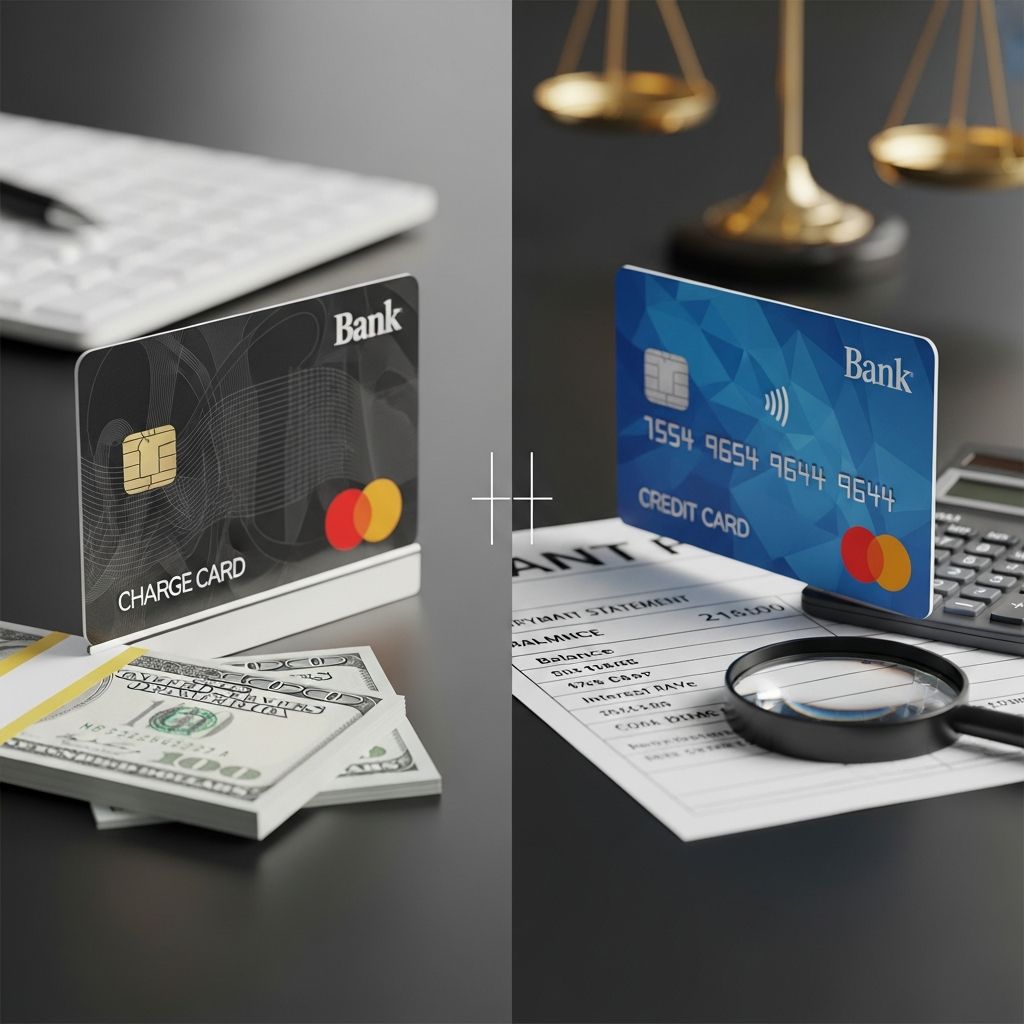
Charge cards and credit cards both enable purchases without immediate cash outlay, but their operational mechanics diverge significantly, affecting repayment obligations, spending flexibility, and cost structures. Charge cards demand full balance settlement each billing cycle, while credit cards permit revolving balances with interest accrual.
Understanding the Fundamentals of Payment Instruments
Modern payment tools like charge and credit cards streamline transactions for individuals and businesses alike. These instruments extend purchasing power beyond available cash, fostering economic activity. However, selecting the appropriate type hinges on grasping their distinct features, from liability management to reward ecosystems.
Charge cards emerged as tools for high-value, disciplined spenders, often linked to premium networks. Credit cards, conversely, dominate everyday use with broader accessibility. Both report to credit bureaus, influencing scores through payment patterns, yet their credit utilization impacts vary.
Core Operational Mechanics
How Charge Cards Function
Charge cards operate on a pay-in-full model. Upon usage, charges accumulate until the statement closes, at which point the entire balance becomes due. This structure eliminates revolving debt options, promoting fiscal discipline. Issuers approve transactions dynamically, assessing real-time factors like account history and liquidity rather than enforcing rigid caps.
- Statement issuance triggers a fixed due date for complete repayment.
- Non-compliance incurs penalties, potentially including account suspension.
- No interest applies to timely paid balances, minimizing long-term costs.
Credit Cards in Action
Credit cards establish a revolving line of credit with a predefined limit. Users can pay minimally each month, carrying forward unpaid portions at interest rates typically ranging from 15% to 30% APR. This flexibility suits variable cash flows but risks debt accumulation if mismanaged.
- Minimum payments cover interest plus a balance sliver, often 1-4% of total owed.
- Exceeding limits triggers declines or overlimit fees.
- Grace periods delay interest on new purchases if balances clear fully.
Comparative Analysis: Features Side-by-Side
To illuminate distinctions, consider this structured overview of pivotal attributes:
| Feature | Charge Card | Credit Card |
|---|---|---|
| Repayment Requirement | Full balance monthly | Minimum payment (1-4% of balance) |
| Spending Limit | No preset; dynamic approval | Fixed credit line |
| Interest Charges | None if paid in full | Accrues on carried balances |
| Annual Fees | Common, especially premium | Variable; many fee-free |
| Late Payment Penalties | Fees plus possible restrictions | Fees and interest continuation |
| Credit Reporting | Payments to bureaus; low utilization impact | Full activity; utilization affects scores |
This table, derived from issuer practices, underscores charge cards’ suitability for controlled, high-spend environments versus credit cards’ adaptability for stretched payments.
Spending Capacity and Limits Explained
Credit cards impose static limits, calculated from income, credit history, and debt levels. Utilization above 30% can harm scores, per bureau guidelines. Charge cards forgo this, evaluating purchases via algorithms considering cash flow and past behavior. This enables substantial expenditures, ideal for seasonal businesses or large procurements, without maxing out.
Dynamic limits adapt: consistent payers may access higher amounts seamlessly. However, erratic patterns prompt scrutiny, ensuring sustainability.
Cost Structures: Fees, Interest, and Penalties
Interest absence defines charge cards’ appeal—no compounding on paid balances. Yet, annual fees from $95 to $550 fund lavish perks. Late payments trigger fees ($30-40) and potential holds, enforcing compliance.
Credit cards layer interest atop principal for unpaid sums, escalating costs rapidly. No-fee variants exist, but rewards cards mirror charge fees. Both penalize tardiness, though credit cards allow partial remediation via minimums.
Rewards and Perks Landscape
Both categories entice with incentives. Credit cards proffer cashback (1-5%), miles, or points redeemable flexibly. Charge cards elevate this with elite travel protections, concierge services, and statement credits, often yielding 1-5% returns on targeted spends.
- Charge perks: Airport lounge access, purchase safeguards, vendor rebates.
- Credit perks: Introductory APRs, balance transfers, retail discounts.
Premium charge cards target frequent travelers or executives, amplifying value through exclusivity.
Impact on Credit Profiles
Payment history dominates scores (35% FICO weight). Charge cards bolster profiles via on-time full payments, sidestepping utilization pitfalls since no limits exist. Credit cards demand vigilant utilization management; high ratios (over 30%) ding scores.
Both build history positively with responsible use. Charge cards may report differently, sometimes excluding from utilization ratios, per issuer policies.
Eligibility and Approval Pathways
Credit cards scrutinize FICO scores (typically 670+), income, and debt-to-income ratios. Charge cards emphasize business viability or personal liquidity, occasionally waiving hard pulls for established entities.
- Credit: Personal guarantees common for unsecured.
- Charge: Bank balance minimums or revenue proofs prioritized.
Strategic Selection for Personal and Business Use
Opt for charge cards if cash flows align with full monthly payouts and high rewards beckon. Businesses with steady inflows benefit from credit-building sans utilization risks. Credit cards fit irregular incomes, emergency buffers, or debt consolidation via low APRs.
Hybrid strategies exist: pair both for coverage. Assess spending volume—charge for bulk buys, credit for daily.
Potential Pitfalls and Risk Mitigation
Charge cards risk account freezes on lapses, disrupting operations. Credit cards foster debt cycles via minimums masking true costs. Mitigate via autopay, budget tracking apps, and periodic reviews.
Future Trends in Card Evolution
Digital wallets integrate both seamlessly. Buy-now-pay-later hybrids blur lines, offering installment options on charge-like platforms. Regulatory scrutiny on fees and transparency shapes offerings.
Frequently Asked Questions
Can charge cards help improve credit scores?
Yes, on-time full payments report positively, enhancing payment history without utilization burdens.
Do charge cards charge interest?
No, provided balances clear fully; late portions may accrue interest or fees.
Are spending limits truly unlimited on charge cards?
Not absolutely; approvals hinge on financial health, preventing unchecked spending.
Which is better for businesses?
Charge cards suit predictable revenues; credit cards offer payment flexibility for growth phases.
How do they differ from debit cards?
Debit pulls funds immediately; both cards defer payment, with charge requiring full settlement.
References
- Charge Card vs. Credit Card: Key Differences — Ramp. 2023-10-15. https://ramp.com/blog/charge-cards-vs-credit-cards
- Charge Card vs. Credit Card: What’s the Difference? — Experian. 2024-05-20. https://www.experian.com/blogs/ask-experian/what-is-the-difference-between-charge-cards-and-credit-cards/
- Charge Card vs. Credit Card: Key Differences — Equifax. 2024-02-12. https://www.equifax.com/personal/education/credit-cards/articles/-/learn/charge-vs-credit-cards/
- Understanding Credit Cards vs Charge Cards — American Express India. 2023-11-08. https://www.americanexpress.com/in/credit-know-how/how-do-credit-cards-work/
- Charge Card vs. Credit Card — Citi. 2024-01-22. https://www.citi.com/credit-cards/understanding-credit-cards/charge-card-vs-credit-card
Similar Articles








Read full bio of medha deb