Understanding Certificates of Deposit: Rates, Terms & Benefits
Explore CD investing: Learn how to earn guaranteed returns up to 4.50% APY with fixed rates and FDIC protection.
Understanding Certificates of Deposit: A Complete Guide to Safe Investing
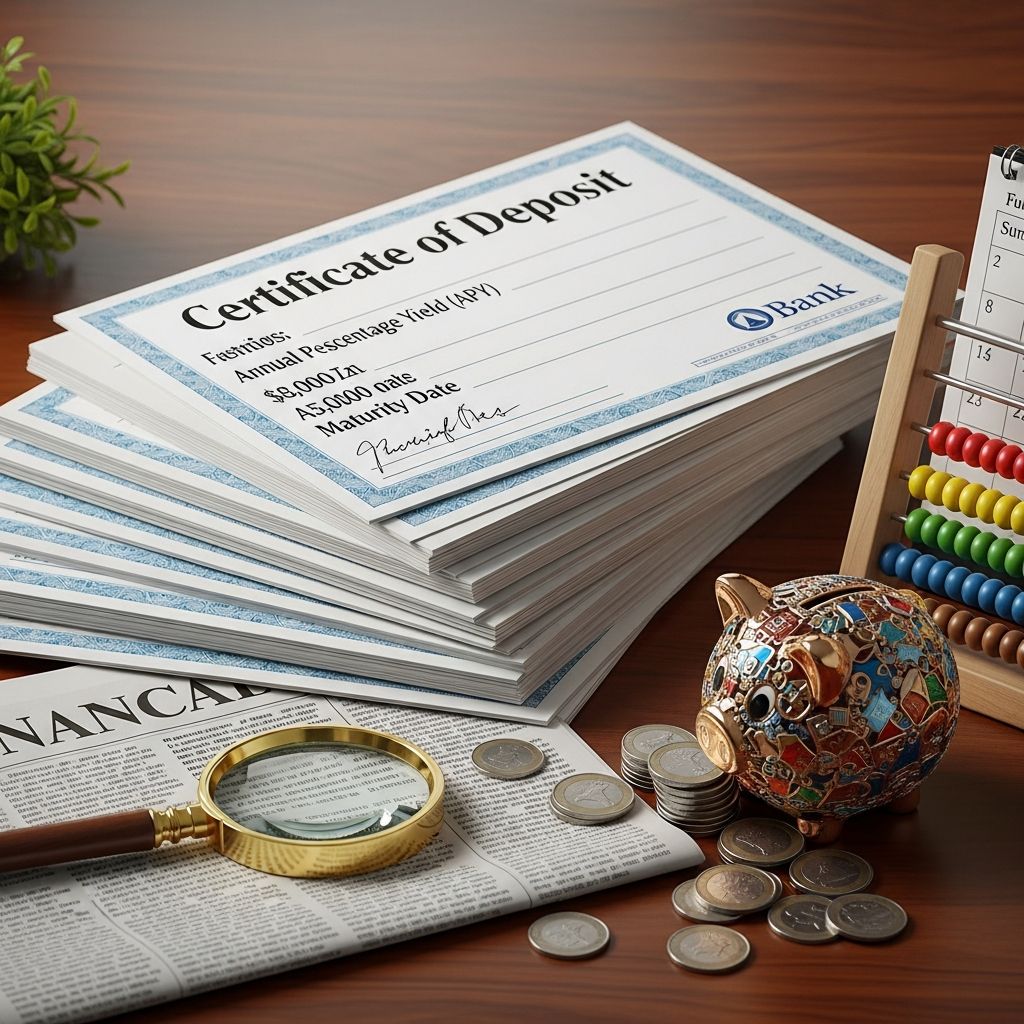
A certificate of deposit (CD) is a savings account that locks your money for a fixed term in exchange for a guaranteed interest rate. Unlike traditional savings accounts where interest rates fluctuate, CDs provide predictability and safety for your investments. If you’re looking for a secure way to grow your money with guaranteed returns and FDIC protection up to $250,000, CDs might be the ideal solution for your financial goals. Current CD rates reach up to 4.50% APY at top banks, making them significantly more attractive than traditional savings accounts.
What is a Certificate of Deposit?
A certificate of deposit is essentially a financial product where you agree to deposit a sum of money with a bank or credit union for a predetermined period. In exchange for this commitment, the financial institution guarantees you a fixed interest rate for the entire term. CD terms typically range from 3 months to 5 years, with longer terms generally offering higher rates. The longer you commit your money, the more interest the bank is willing to pay you, rewarding your loyalty and providing them with predictable funding.
The structure of a CD is straightforward: you deposit your initial investment, choose your term length, and the bank calculates exactly how much interest you’ll earn by maturity. This transparency allows you to plan your finances precisely, knowing your exact returns before making any commitment.
How CDs Work: The Mechanics
Understanding how CDs function is essential before investing. When you open a CD, you deposit an initial amount and lock it in for your chosen term at a fixed interest rate. During this period, your money earns interest, and you cannot access it without incurring penalties.
Consider this practical example: If you put $10,000 in a 1-year CD earning 4.40% APY, you’ll earn about $440 in interest. However, if you deposit the same $10,000 in a 3-year CD earning 4.15% APY, you’ll earn almost $1,300 total—about $850 more despite the lower rate, thanks to the longer time period and compound interest.
Term Length and Interest Rates
CD terms can range from a few months to several years, with term length being a crucial factor in determining your returns. Typically, longer terms offer higher interest rates because you’re committing your money for an extended period, providing the bank with greater funding certainty. However, current market conditions have created what economists call an inverted yield curve, meaning some shorter-term CDs are actually paying higher rates than longer-term options.
Early Withdrawal Penalties
One critical aspect of CD investing is understanding early withdrawal penalties. If you need to access your funds before maturity, you’ll face penalties that can significantly reduce your earnings or even your principal. The Federal Deposit Insurance Corporation (FDIC) has established standard penalties based on CD term length:
- For CDs with terms shorter than 90 days: Either the interest earned on what you withdrew or seven days’ worth of interest on the amount withdrawn, whichever is greater
- For CDs with terms ranging from 90 days to 12 months: 90 days’ worth of interest
- For CDs with terms from 12 months to 60 months: 180 days’ worth of interest
- For CDs with terms greater than 60 months: 365 days’ worth of interest
It’s possible to lose part of your initial deposit if your early withdrawal penalty exceeds the interest earned. For example, if you have to pay a 90-day penalty but have only earned 60 days of interest, the remaining 30 days’ worth would be taken from your principal.
Types of CDs Available
Beyond traditional CDs, financial institutions offer specialized CD products to meet different investor needs. Bump-up CDs are particularly attractive in a rising rate environment, allowing you to take advantage of higher rates without starting over. These CDs give you the option to “bump up” to a higher rate if your bank raises rates during your term, typically limited to one or two rate increases. Banks currently offering bump-up CDs include Rising Bank and Credit One Bank.
Current CD Rates: Comparing Your Options
As of November 2025, the average one-year CD is 1.93 percent APY, with the most competitive banks offering APYs of up to 4.25 percent on one-year terms. Top CD rates reach up to 4.50% APY, well above traditional savings account yields. However, rates vary significantly between institutions, and online banks and credit unions often offer substantially higher APYs than traditional brick-and-mortar banks.
For instance, while major banks like Chase and Bank of America might offer CD rates around 0.01 to 0.03 percent, online banks frequently offer rates of 4 percent or higher on similar terms. This significant difference underscores the importance of shopping around before committing your money.
Key Factors That Determine CD Rates
Understanding what influences CD rates helps you time your investments strategically. Four primary factors determine CD rates: Federal Reserve interest rate changes, CD term length, bank competition, and Treasury yields.
Federal Reserve Interest Rate Changes
The Federal Reserve interest rate changes are the primary driver of CD rates, with yields typically moving up and down alongside the Fed funds rate. When the Fed raises rates, banks can afford to offer higher CD rates to remain competitive. Conversely, when the Fed cuts rates, CD offerings typically decline as well.
Bank Competition for Deposits
Bank competition for deposits can push CD rates higher, especially among online banks and smaller institutions seeking new customers. Market conditions significantly affect this dynamic. When banks are flush with deposits, they have less incentive to offer high CD rates. When they need more funding, rates tend to rise as institutions compete for your money.
Treasury Yield Influences
U.S. Treasury yields significantly influence CD rates because banks invest much of their deposit funding in government securities. When Treasury yields rise, banks can afford to pay higher rates on CDs. When Treasury yields fall, CD rates typically follow. Banks use the money from customer deposits for two main purposes: making loans and investing in safe securities like Treasury bonds. The return they earn on these investments affects how much they can afford to pay depositors.
How to Open a Certificate of Deposit
Opening a CD is a straightforward process that typically involves five key steps.
Step 1: Choose Your CD Type and Term Length
First, select the type of CD that aligns with your financial goals and rate expectations. Choose a term that matches your savings timeline, whether it’s funding a vacation in 12 months or saving for a down payment in five years. Consider your liquidity needs, interest rate expectations, and savings goals when making this decision. Bankrate’s CD calculator can help you project your potential earnings across various terms and deposit amounts.
Step 2: Shop Around for the Best CD Rates
CD rates can vary widely between banks and credit unions, so it pays to compare your options thoroughly. Look beyond your primary bank—while major banks offer convenience and name recognition, they typically offer much lower CD rates than smaller institutions. Online banks, in particular, often provide the most competitive yields. Also, review minimum deposit requirements and early withdrawal penalties, which can vary significantly by bank or credit union. Some institutions don’t require an opening deposit while others commonly require $1,000 or more.
Step 3: Gather Required Documentation
Opening a CD requires providing your personal information and government-issued ID. Most banks will ask for basic verification to comply with regulatory requirements and prevent fraud.
Step 4: Complete Your Application
After you’ve selected a bank and CD product, complete the application process. This typically involves filling out forms with your personal and financial information.
Step 5: Fund Your CD and Set Up Interest Disbursements
After approval, you’ll need to fund your CD to start earning interest. There are several ways to fund your CD:
- ACH transfer from an external bank account (typically takes 2-3 business days)
- Wire transfer (usually same-day funding but may involve a fee)
- Check deposit by mail
- Cash deposit at a branch location
When your CD is funded, you can choose how to receive your interest disbursements. Most banks offer two primary options: reinvest the interest in your CD to take advantage of compound growth, or receive interest payments via check, direct deposit, or transfer to another account. You can typically choose to receive disbursements monthly, quarterly, or annually. Reinvesting typically maximizes returns through compounding, making it an attractive option for long-term investors.
Safety and FDIC Insurance Protection
One of the most significant advantages of CD investing is the guaranteed safety of your principal. You will not lose money on a CD if you keep your money in the CD until maturity at an FDIC-insured bank. Your principal and earned interest are federally insured up to $250,000 per depositor, per bank. This protection makes CDs one of the safest investment vehicles available, particularly appealing for conservative investors.
Sample CD Investment Returns
To illustrate how CD investments accumulate over time, consider these examples at 4.00% APY:
| Amount | CD Term | Total Interest | Final Value |
|---|---|---|---|
| $10,000 | 1 year | $400 | $10,400 |
| $10,000 | 3 years | $1,248.64 | $11,248.64 |
| $10,000 | 5 years | $2,166.53 | $12,166.53 |
When CDs Are the Right Choice
CDs work best for short-term savings goals with specific timelines. If you’re saving for a house down payment in 18 months, a vacation in 12 months, or any other goal with a defined end date, CDs provide the perfect vehicle for guaranteed returns. The fixed nature of CD rates allows you to determine up front exactly how much interest you’ll have earned by the time your CD matures. Additionally, locking in a CD rate can benefit you if the going rates on new CDs fall before your CD’s term is up.
Frequently Asked Questions About CDs
Q: What is the difference between a CD and a savings account?
A: The primary difference is that CDs lock your money for a fixed term at a guaranteed rate, while savings accounts offer variable rates and allow unlimited withdrawals. CDs typically offer higher interest rates in exchange for the commitment period.
Q: Can I withdraw my money early from a CD?
A: Yes, you can withdraw early, but you’ll face an early withdrawal penalty. The penalty amount depends on your CD’s term length and can range from several days to an entire year’s worth of interest, potentially reducing your principal.
Q: How much do I need to open a CD?
A: Minimum deposit requirements vary by bank. Some institutions don’t require an opening deposit, while others require $1,000 or more. Jumbo CDs typically require even larger initial deposits.
Q: Are CDs FDIC insured?
A: Yes, CDs at FDIC-insured banks are protected up to $250,000 per depositor, per bank. This makes them one of the safest investment options available.
Q: What happens when my CD matures?
A: When your CD reaches maturity, your principal plus accumulated interest becomes available. You can choose to withdraw the funds, open a new CD, or let the bank automatically renew your CD under the new rate environment.
Q: Should I reinvest my interest or take it as payments?
A: Reinvesting your interest maximizes returns through compound growth, making it ideal for long-term investors. Taking regular interest payments works better if you need current income from your investments.
References
- How To Open A Certificate of Deposit (CD) — Bankrate. 2025-11-29. https://www.bankrate.com/banking/cds/how-to-open-a-cd/
- How Do CDs Work? Learn about rates and terms — Bankrate. 2025-11-29. https://www.bankrate.com/banking/cds/how-do-cds-work/
- 4 Key Factors That Determine CD Rates — Bankrate. 2025-11-29. https://www.bankrate.com/banking/cds/key-factors-that-determine-cd-rates/
- How To Invest With CDs — Bankrate. 2025-11-29. https://www.bankrate.com/banking/cds/how-to-invest-in-cds/
- What Is A CD (Certificate Of Deposit)? — Bankrate. 2025-11-29. https://www.bankrate.com/banking/cds/what-is-a-cd/
- Historical CD Interest Rates 1984-2025 — Bankrate. 2025-11-29. https://www.bankrate.com/banking/cds/historical-cd-interest-rates/
Similar Articles








Read full bio of medha deb