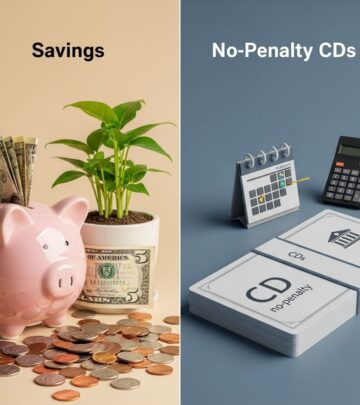
CDs vs Savings Accounts: Key Differences
Discover how Certificates of Deposit stack up against savings accounts in rates, access, and safety to choose the best for your goals.

Certificates of Deposit (CDs) and savings accounts serve as foundational tools for growing your money safely, but they cater to different financial needs. CDs lock in higher, fixed interest rates for a set period, ideal for committed savers, while savings accounts prioritize liquidity with variable rates suitable for everyday access.
Understanding the Fundamentals of Each Option
Both products are offered by banks and credit unions, providing a low-risk way to earn interest on deposits. A
CD
requires an initial deposit held for a predetermined term, typically from a few months to several years, rewarding you with a guaranteed rate. In contrast, asavings account
functions like a flexible holding spot where you can add or remove funds freely, though rates adjust with market conditions.FDIC insurance covers both up to $250,000 per depositor per bank, ensuring principal protection against bank failure. This shared safety net makes them preferable to riskier investments for conservative savers.
Interest Rates: Fixed Rewards vs Variable Potential
**CDs** shine with higher, locked-in annual percentage yields (APYs). For instance, terms often yield more than standard savings due to the commitment involved. This predictability shields against rate drops, guaranteeing your earnings regardless of economic shifts.
**Savings accounts**, especially high-yield variants, offer competitive but fluctuating rates. They may outpace CDs during rising rate environments but lag in falling ones. Online banks frequently provide superior yields without physical branches.
| Feature | CDs | Savings Accounts |
|---|---|---|
| Rate Type | Fixed | Variable |
| Typical APY Range | Higher (e.g., 4-5% for short terms) | Lower but competitive (e.g., 3-4.5%) |
| Rate Stability | Guaranteed for term | Changes with Fed funds rate |
Access and Liquidity: Commitment vs Flexibility
The core tradeoff lies in fund availability. CDs penalize early withdrawals, often forfeiting interest or a portion of principal, enforcing discipline for long-term goals. Maturity options range from 1 month to 10 years, after which funds return with interest.
Savings accounts allow unlimited deposits and typically six withdrawals per month without fees, perfect for emergency funds or short-term needs. Post-2020 regulatory changes removed some transaction limits, enhancing usability.
- CDs: Best for money you won’t touch, like down payments.
- Savings: Ideal for rainy-day reserves with quick access.
Minimum Deposits and Fees: Entry Barriers Compared
CDs often demand $500-$1,000 minimums, though some start lower. No monthly fees apply, but early exit costs deter interruptions.
Savings accounts usually open with $0-$100, with fees waived by maintaining balances or direct deposits. High-yield options from fintechs minimize costs entirely.
Types of CDs and Savings Accounts to Consider
CD variations include:
- Standard CDs: Fixed rate, term-based.
- No-Penalty CDs: Early access without fees after a lock period.
- Bump-Up CDs: Allow rate increases if market rises.
- Step-Up CDs: Scheduled rate hikes over time.
Savings options feature:
- Traditional: Basic rates from brick-and-mortar banks.
- High-Yield Online: Superior APYs from digital providers.
- Money Market Accounts: Check-writing perks with tiered rates.
Current Market Rates and Trends
As of recent data, CD rates for 12-month terms hover around 4.5-5.25% APY, outpacing high-yield savings at 4-5%. Federal Reserve policies influence this: cuts lower variable savings faster than fixed CDs. Shop multiple institutions for top yields.
Tax Implications and Compounding Effects
Interest from both is taxable as ordinary income, reported via Form 1099-INT. CDs compound daily or monthly, paying at maturity; savings often compound daily with monthly crediting, allowing reinvestment. Longer terms amplify compounding in CDs.
Pros and Cons Breakdown
| Aspect | CD Pros | CD Cons | Savings Pros | Savings Cons |
|---|---|---|---|---|
| Rates | Higher, fixed | No upside if rates rise | Potential to rise | Lower baseline, drops possible |
| Access | Disciplined saving | Penalties, illiquidity | Anytime withdrawals | Transaction limits |
| Fees | Usually none | Early withdrawal | Often waivable | Possible maintenance |
Strategic Use Cases for Maximum Benefit
Laddering CDs for Balanced Access
Distribute funds across staggered maturities (e.g., 3,6,12 months) to capture high rates while regaining liquidity periodically. Reinvest maturing portions.
High-Yield Savings for Dynamic Needs
Park emergency funds (3-6 months expenses) here for instant access amid job changes or uncertainties. Transfer excesses to CDs.
Hybrid Approach
Core emergency in savings, goal-specific sums in CDs. Automate transfers to build both seamlessly.
Risks and Inflation Considerations
Neither beats inflation consistently long-term; real returns may erode purchasing power. CDs protect against rate declines but not rises. Diversify with I-Bonds or TIPS for inflation hedging.
How to Select the Right Institution
- Verify FDIC/NCUA membership.
- Compare APYs via depositaccounts.com or bankrate.com.
- Review terms, penalties, minimums.
- Prioritize online banks for yields, locals for service.
Frequently Asked Questions
What happens if I need money early from a CD?
You’ll face penalties, typically 90-180 days’ interest forfeiture. Opt for no-penalty versions if flexibility matters.
Are online bank rates safer?
Yes, if FDIC-insured; they compete aggressively without overhead.
Can rates on savings exceed CDs?
Occasionally during hikes, but rarely sustained.
What’s best for a down payment in 2 years?
A 24-month CD locks optimal rates.
Do credit unions offer better deals?
Often yes, with similar insurance via NCUA.
Steps to Get Started Today
- Assess goals and timeline.
- Gather documents (ID, SSN).
- Research top rates.
- Open online or in-branch.
- Fund and monitor.
References
- CD vs Savings Account: Differences, Rates & Which Is Better — SBICAL Bank. 2025. https://www.sbical.bank/education-center/cd-vs-savings-account
- Savings account vs CD (Certificate of Deposit): Which should I choose — Bank of America Better Money Habits. 2025. https://bettermoneyhabits.bankofamerica.com/en/saving-budgeting/money-market-vs-cd-vs-savings
- CDs vs. Savings Accounts: Where to Put Your Extra Money — PNC Insights. 2025. https://www.pnc.com/insights/personal-finance/save/cds-vs-savings-accounts.html
- CD vs Savings Accounts: Key Differences — F&M Bank Blog. 2025. https://www.myfmbank.com/blog/post/what-is-the-difference-between-a-certificate-of-deposit-and-savings-accounts
- CD vs. Savings Account: What’s the Difference? — Capital Bank. 2025. https://www.capitalbank.com/cd-vs-savings-account-whats-the-difference/
- CD vs. Savings Account: Which Should You Choose? — Ally. 2025. https://www.ally.com/stories/save/cd-vs-savings-account/
- CD vs. high-yield savings accounts: Which to choose? — Fidelity Learning Center. 2025-05-19. https://www.fidelity.com/learning-center/smart-money/cd-vs-high-yield-savings
Similar Articles








Read full bio of medha deb