CDs vs. High-Yield Savings: Maximize Your Earnings
Discover which savings option—Certificates of Deposit or high-yield accounts—delivers superior returns based on your financial goals and liquidity needs.

Choosing between a Certificate of Deposit (CD) and a high-yield savings account can significantly impact how quickly your savings grow. Both options provide FDIC insurance and low-risk growth, but they differ in rate stability, access to funds, and suitability for various financial situations. This guide breaks down their features, compares returns, and helps you decide which aligns with your goals.
Understanding Certificates of Deposit
Certificates of Deposit represent a commitment to park your money with a bank or credit union for a predetermined period, typically ranging from a few months to five years. In return, you receive a fixed interest rate that remains unchanged until maturity. This structure appeals to those seeking predictability amid fluctuating markets.
Key characteristics include:
- Fixed APY: Locks in the rate at the time of purchase, shielding against rate drops.
- Term lengths: Shorter terms (3-12 months) offer slightly lower rates, while longer ones (3-5 years) yield higher returns.
- Early withdrawal penalties: Accessing funds before maturity often incurs fees, such as 90-180 days’ interest.
- FDIC/NCUA protection: Covers up to $250,000 per depositor per institution.
CDs excel when interest rates are high, as they guarantee that yield. For instance, longer-term CDs historically provide 0.35%-0.45% higher APYs than comparable savings options at the same bank.
Exploring High-Yield Savings Accounts
High-yield savings accounts, often offered by online banks, deliver competitive variable rates that surpass traditional savings by several multiples. These accounts prioritize flexibility, allowing deposits and withdrawals without fixed timelines.
Standout features encompass:
- Variable APY: Rates adjust with market conditions, potentially rising but also falling.
- Unlimited deposits: Add funds anytime to compound growth.
- Liquidity: Withdraw freely, though some limit transactions to six per month.
- FDIC/NCUA insurance: Same $250,000 coverage as CDs.
Ideal for emergency funds or short-term needs, these accounts compound interest daily in many cases, enhancing earnings on fluid balances. Online institutions keep overhead low, passing savings as higher yields.
Core Differences: A Side-by-Side Analysis
To illustrate, here’s a comparison table highlighting pivotal distinctions:
| Feature | Certificate of Deposit (CD) | High-Yield Savings Account |
|---|---|---|
| Interest Rate Type | Fixed for term duration | Variable, market-driven |
| Access to Funds | Restricted until maturity; penalties apply | Flexible withdrawals (limits may apply) |
| Deposits | Single initial deposit | Ongoing additions allowed |
| Typical APY Edge | Often 0.35%-0.45% higher | Competitive but adjustable |
| Best For | Long-term savings commitment | Emergency funds, liquidity |
| Risk Level | Low (FDIC-insured) | Low (FDIC-insured) |
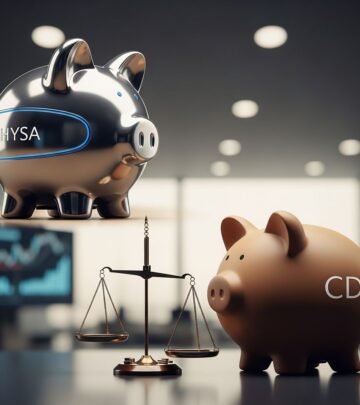
This table underscores CDs’ rate advantage versus high-yield savings’ adaptability.
Which Generates More Interest? Real Scenarios
Actual earnings hinge on deposit size, duration, and rate environment. Suppose you invest $10,000:
- 1-Year CD at 5% APY: Yields ~$512 (compounded monthly, no withdrawals).
- HYSA at 4.65% average APY: ~$472, but could exceed $500 if rates rise mid-year.
CDs typically outperform over fixed periods due to higher baseline rates. However, if rates climb, a HYSA captures increases without reinvestment hassles. Conversely, falling rates favor locked-in CD yields. Inflation poses a shared risk: if it outpaces APY, real returns diminish.
Pros and Cons of Each Option
CD Advantages and Drawbacks
- Pros: Predictable returns, higher rates for commitment, promotes disciplined saving.
- Cons: Illiquidity, penalties erode gains, missed opportunities if rates rise.
High-Yield Savings Advantages and Drawbacks
- Pros: Easy access, rate upside potential, no penalties.
- Cons: Rate volatility, potentially lower yields, transaction caps.
When to Choose CDs Over High-Yield Savings
Opt for CDs if:
- You have surplus cash beyond 3-6 months’ expenses.
- Rates are peaking, per Federal Reserve signals.
- You’re funding a known goal, like a home down payment in 2 years.
- Discipline against impulsive spending is needed.
Laddering CDs—splitting funds across staggered maturities—balances liquidity and yield.
When High-Yield Savings Outshines CDs
Select high-yield savings when:
- Building or maintaining an emergency fund.
- Anticipating rate hikes or short-term needs.
- Preferring simplicity without maturity tracking.
- Funds require frequent access.
These accounts suit dynamic finances, like job transitions or variable income.
Strategies to Optimize Both Account Types
Hybrid approaches maximize benefits:
- Core-Dual Strategy: Emergency fund in HYSA; excess in CDs.
- CD Laddering: Divide investments (e.g., $20,000 into four $5,000 CDs maturing quarterly) for periodic access.
- Rate Shopping: Use aggregators for top APYs; online banks often lead.
- Auto-Transfers: Funnel paycheck surpluses into HYSA for compounding.
Monitor Fed rate changes: cuts favor CDs; hikes boost HYSAs.
Factors Influencing Current Rates
As of recent data, top CDs yield 4.5%-5.5% for 1-5 years, while HYSAs hover at 4%-5%. Economic policies, inflation, and bank competition drive variances. Online-only providers dominate high yields due to lower costs. Always verify current rates, as they fluctuate.
Frequently Asked Questions
Are CDs safer than high-yield savings?
Both are equally safe with FDIC/NCUA insurance up to $250,000.
Can I lose money in these accounts?
Principal is protected, but inflation may reduce purchasing power.
What’s the minimum deposit required?
Varies; HYSAs often start at $0-$100, CDs at $500-$1,000.
How often do rates change for HYSAs?
Weekly or monthly, tied to federal funds rate.
Are there tax implications?
Interest is taxable as ordinary income annually.
Final Thoughts on Building Wealth
Neither option is universally superior—CDs secure higher fixed returns for patient savers, while high-yield savings offer agility for the unpredictable. Assess your timeline, risk tolerance, and liquidity needs. Regularly review and adjust to capture optimal yields, ensuring your savings foundation strengthens over time.
References
- CD vs. high-yield savings accounts: Which to choose? — Fidelity. 2024. https://www.fidelity.com/learning-center/smart-money/cd-vs-high-yield-savings
- CD vs High Yield Savings — PNC Insights. 2024. https://www.pnc.com/insights/personal-finance/save/cd-vs-high-yield-savings.html
- CD vs. High Yield Savings Account: Which Is Right for You? — Synchrony Bank. 2024. https://www.synchrony.com/blog/bank/cd-vs-high-yield-savings
- CD vs. High-Yield Savings Account: Which Should I Choose? — NerdWallet. 2024. https://www.nerdwallet.com/banking/learn/faq-cd-or-highyield-savings
- $10,000 CD vs. $10,000 high-yield savings account — CBS News. 2024. https://www.cbsnews.com/news/10000-cd-vs-10000-high-yield-savings-what-experts-recommend-now/
- Savings account vs CD (Certificate of Deposit): Which should I choose — Bank of America Better Money Habits. 2024. https://bettermoneyhabits.bankofamerica.com/en/saving-budgeting/money-market-vs-cd-vs-savings
- High-yield savings accounts vs. CDs vs. money market funds — Vanguard. 2024. https://investor.vanguard.com/investor-resources-education/article/high-yield-savings-vs-cd-vs-money-market
Similar Articles








Read full bio of medha deb