CDs: Interest vs Dividends Explained
Unravel the mystery: Do certificates of deposit pay reliable interest or variable dividends? Get the facts on earnings.
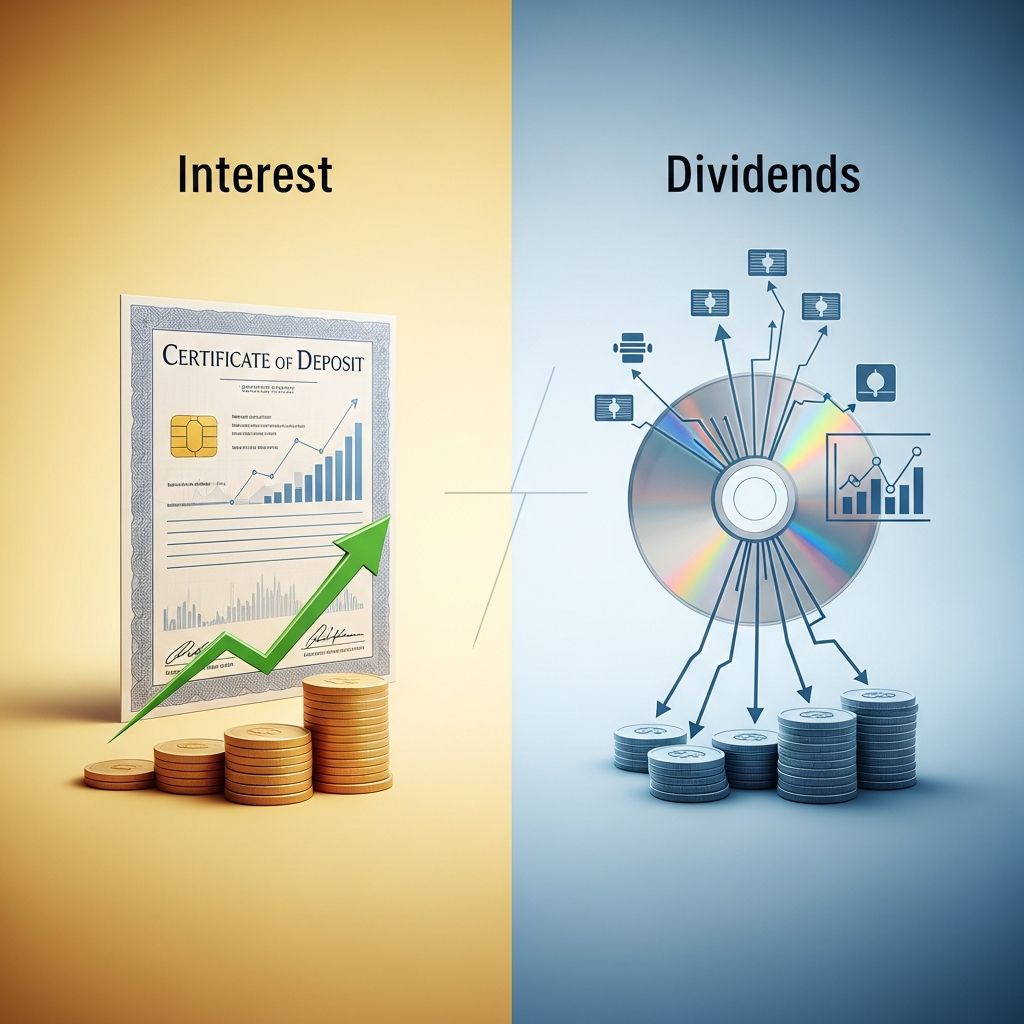
Certificates of deposit (CDs) represent a cornerstone of conservative investing, offering predictable returns for funds committed over a fixed period. A frequent question among savers is whether these instruments generate interest or dividends. In essence, bank-issued CDs pay interest, providing a fixed or variable rate on the principal deposit. Credit unions, operating under cooperative structures, often label these earnings as dividends, though the underlying mechanism mirrors traditional interest calculations.
Understanding the Fundamentals of CD Earnings
At their core, CDs lock in your money for a predetermined term, ranging from weeks to years, in exchange for compensation from the financial institution. Banks compensate depositors with interest, calculated based on the principal, rate, and time held. This contrasts with stocks, where dividends reflect company profits shared with shareholders. CDs from banks guarantee returns without market volatility, backed by FDIC insurance up to $250,000 per depositor.
Credit unions use ‘dividend’ terminology because members technically own shares in the cooperative. However, the dividend rate functions identically to a bank’s interest rate, dictating the percentage yield on the deposit. Fixed dividend rates remain constant throughout the term, ensuring stability.
Key Distinctions Between Interest and Dividends in CDs
- Terminology by Institution: Banks universally cite interest; credit unions cite dividends to align with their member-owned model.
- Calculation Basis: Both employ similar formulas, focusing on principal multiplied by rate over time, often with compounding.
- Guarantee Level: Interest on bank CDs is contractually fixed; credit union dividends are similarly reliable but insured by NCUA up to $250,000.
- Tax Treatment: Earnings from both are taxed as ordinary income, reported on Form 1099-INT or equivalent.
This semantic difference rarely impacts actual returns but influences how institutions market their products. Savvy investors focus on the Annual Percentage Yield (APY), which accounts for compounding and provides a standardized comparison metric.
How Financial Institutions Compute CD Returns
Understanding computation methods empowers better decision-making. Most CDs use the simple interest formula initially: Interest = Principal × Rate × Time. For a $10,000 deposit at 4% over one year, this yields $400.
Compounding elevates returns by recalculating interest on the growing balance. The formula is A = P(1 + r/n)^(nt), where A is the final amount, P principal, r annual rate (decimal), n compounding periods per year, and t years. Monthly compounding on the same $10,000 at 4% produces approximately $408.16, demonstrating the power of frequency.
| Compounding Frequency | Final Amount ($10,000 @ 4%, 1 Year) | Earnings |
|---|---|---|
| Simple (None) | $10,400 | $400 |
| Annually | $10,400 | $400 |
| Quarterly | $10,407.04 | $407.04 |
| Monthly | $10,408.16 | $408.16 |
| Daily | $10,409.28 | $409.28 |
Note variations: Some banks use a 365-day year, others actual days (366 in leap years), potentially boosting earnings slightly.
Payout Schedules: When Do You Receive Earnings?
Timing of payouts varies, affecting cash flow and reinvestment opportunities. Common options include:
- At Maturity: Ideal for short terms (≤12 months); all earnings paid at term end.
- Monthly: Provides steady income, suitable for retirees.
- Annually: For longer terms, with final payout at maturity; allows compounding if reinvested.
For example, a 13-month CD might pay after 12 months plus maturity, enhancing liquidity without early withdrawal penalties.
Term Lengths and Their Influence on Yields
Longer commitments generally command higher rates, rewarding patience. Short-term CDs (3-6 months) offer liquidity with modest yields, while 5-year terms can exceed 4-5% APY in favorable markets.
- 3 months: Lower rates, quick access.
- 1 year: Balanced option.
- 5 years: Highest potential yields, but sensitive to rate changes.
Market conditions drive rates; rising environments favor new, higher-yield CDs, devaluing existing ones if sold early via brokered options.
Bank CDs vs. Brokered CDs: Critical Comparisons
| Feature | Bank CD | Brokered CD |
|---|---|---|
| Purchase | Direct from bank | Via brokerage |
| Liquidity | Locked; early withdrawal penalty | Tradable on secondary market |
| Rate Type | Fixed or variable | Typically fixed |
| Minimum Deposit | $500-$1,000 common | Often $1,000+ |
| Insurance | FDIC | FDIC if bank-issued |
Bank CDs prioritize simplicity and safety; brokered versions add flexibility but introduce market price risk.
Strategies to Maximize CD Performance
- Shop Rates: Compare across institutions; online banks often lead.
- Laddering: Divide funds across staggered maturities for liquidity and rate capture.
- Monitor APY:
- Reinvest: Roll matured funds into new CDs to compound gains.
Prioritize over nominal rates for true growth.
CD ladders, for instance, might allocate 20% each to 1-5 year terms, maturing sequentially for ongoing access.
Risks and Limitations of CD Investments
While low-risk, CDs aren’t flawless. Inflation can erode real returns if yields lag price increases. Early withdrawal incurs penalties, typically 3-6 months’ interest. Opportunity cost looms if stocks outperform. Brokered CDs face principal loss if sold in a rising rate environment.
Tax Implications for CD Earnings
All CD payouts—interest or dividends—are federally taxable as interest income, regardless of payout timing. Institutions issue 1099-INT forms. State taxes apply variably. Consider tax-advantaged accounts like IRAs for CDs to defer taxes.
Current Landscape and Future Outlook
As of 2026, CD rates hover around 4-5% for competitive terms, influenced by Federal Reserve policies. Monitor economic indicators for shifts; prolonged high rates favor longer terms.
Frequently Asked Questions (FAQs)
Do all CDs pay the same way?
No, banks pay interest, credit unions dividends, but mechanics are identical.
What’s better: simple or compound interest CDs?
Compound always yields more over time.
Can I lose money in a CD?
Not if held to maturity and within FDIC/NCUA limits; early withdrawal or brokered sales pose risks.
How does APY differ from the interest rate?
APY includes compounding effects, offering a fuller return picture.
Are CDs a good investment now?
Excellent for safety and yields beating savings accounts, but diversify for growth.
References
- How is interest calculated on a CD? — Chase Bank. 2023. https://www.chase.com/personal/banking/education/basics/how-is-interest-calculated-on-cds
- How CD Interest Is Calculated: Key Differences You Should Know — Western State Bank. 2024-04-10. https://www.wsbks.com/resources/westernstatebankblog/How-CD-Interest-Is-Calculated-Key-Differences-You-Should-Know_171110.aspx
- What Is a Dividend Rate on a CD? — DR Bank. 2024. https://drbank.com/whats-new/what-is-a-dividend-rate-on-a-cd/
- How does a CD work? | CD rates explained — Fidelity Investments. 2024. https://www.fidelity.com/learning-center/smart-money/how-does-a-cd-work
- What is a CD investment — Bank of America. 2024. https://bettermoneyhabits.bankofamerica.com/en/personal-banking/what-is-a-cd-investment
- Comparing Dividends and CD Interest — The Tranel Financial Group. 2023. https://thetranelfinancialgroup.com/comparing-dividends-and-cd-interest/
- Certificate of Deposit (CD) Dividends — BCU. 2024. https://help.bcu.org/s/article/Certificate-of-Deposit-CD-Dividends
Similar Articles








Read full bio of Sneha Tete