CD vs. Savings Account: How to Choose Wisely
Understand the pros, cons, and best uses of CDs and savings accounts so you can match each option to your goals and time horizon.

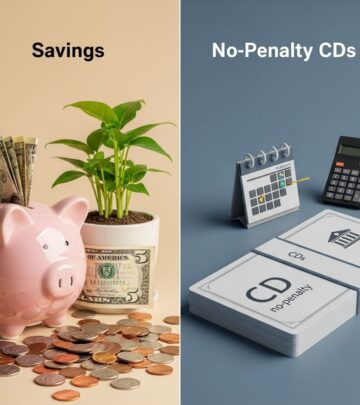
When you are setting money aside, two of the most common options are a certificate of deposit (CD) and a savings account. Both are low-risk, interest-bearing bank products, but they work differently and are better suited to different goals.
This guide walks through how CDs and savings accounts work, how they compare on interest and access to your money, and how to decide which is right for your situation. It follows the same core topics typically covered in an in-depth CD-versus-savings comparison article, but with fresh language and explanations.
What Is a Savings Account?
A savings account is a basic deposit account at a bank or credit union designed to help you store money safely while earning interest. You can add and withdraw funds as needed, making it suitable for short-term needs and emergency savings.
Key features of a typical savings account include:
- Liquidity: You can usually take money out at any time, often via online transfer, ATM, or branch withdrawal.
- Variable interest rate: The rate can change at the bank’s discretion, often in response to broader interest rate moves.
- FDIC or NCUA insurance: At banks, deposits are generally insured by the Federal Deposit Insurance Corporation (FDIC) up to $250,000 per depositor, per insured bank, per account ownership category. Credit unions have similar coverage via the National Credit Union Administration (NCUA).
- Low minimums: Many savings accounts have low or no minimum opening deposit requirements.
- Possible maintenance fees: Some institutions charge monthly fees if you do not meet balance or transaction criteria.
Because of their flexibility, savings accounts are often recommended for emergency funds, short-term goals, and money you might need on short notice.
What Is a Certificate of Deposit (CD)?
A certificate of deposit is a time deposit: you agree to leave your money on deposit for a fixed term in exchange for a typically higher, fixed interest rate. Terms commonly range from a few months to five years, though some institutions offer both shorter and longer terms.
Core characteristics of CDs include:
- Fixed term: You commit to keeping funds in the CD until maturity (e.g., 6 months, 12 months, 3 years).
- Fixed interest rate: The annual percentage yield (APY) is locked in when you open the CD and stays the same for the term.
- Early withdrawal penalties: Taking money out before the maturity date usually triggers a penalty, often forfeiting several months of interest.
- FDIC/NCUA insurance: Like savings accounts, CDs at insured institutions are typically covered up to $250,000 per depositor, per bank, per category.
- Limited additional deposits: Many CDs do not allow you to add funds after opening, though some “add-on CDs” are exceptions.
CDs are generally used for money you can set aside for a defined period, such as funds earmarked for a known expense at a future date.
CD vs. Savings Account: Side-by-Side Comparison
Although CDs and savings accounts share some traits, they differ in several key areas: interest rates, how stable those rates are, access to cash, and how well they fit different goals.
| Feature | Savings Account | Certificate of Deposit (CD) |
|---|---|---|
| Interest rate level | Generally lower than CD rates, though high-yield savings accounts can be competitive. | Typically higher than regular savings accounts for the same bank and time period. |
| Rate type | Variable – can change based on market conditions and bank policy. | Fixed for the term – does not change until maturity. |
| Access to funds | Flexible – withdrawals and deposits allowed, though some limits on monthly transactions may apply. | Restricted – access typically only at maturity; early withdrawals usually incur penalties. |
| Ideal use | Emergency funds, short-term savings, money you may need unexpectedly. | Medium-term goals with a clear time frame, funds you can lock away. |
| Minimum deposit | Often low or no minimum. | Frequently higher minimums, though some banks offer low-minimum CDs. |
| Insurance | FDIC/NCUA-insured up to standard limits if held at an insured institution. | FDIC/NCUA-insured up to standard limits if held at an insured institution. |
How Interest Rates Work for CDs and Savings Accounts
Interest is a central factor in choosing between a CD and a savings account. The way rates are set and how they can change over time affects both your earnings and your risk of missing better opportunities.
Average Rates and the Typical Gap
Historically, CDs tend to offer higher yields than savings accounts for the same institution and period because you are giving up liquidity in exchange for a better rate. FDIC data show that average CD rates are generally above average savings account rates, especially for terms of one year or longer.
However, the actual difference can vary by bank and market conditions. In competitive environments, top high-yield savings accounts may approach or even match some shorter-term CD rates, while longer-term CDs can still provide a premium.
Variable vs. Fixed: What That Means for You
- Variable savings rates: Banks can raise or lower savings rates, sometimes quickly, when benchmark interest rates move. If broader rates fall, your savings account APY might drop soon after.
- Fixed CD rates: Once you open a CD, the APY stays locked for the entire term, regardless of what happens in the market.
This leads to important trade-offs:
- If interest rates fall after you open a CD, a fixed rate can be an advantage because your yield is insulated from declines.
- If interest rates rise significantly, you could be stuck earning less than new, higher-paying CDs or savings accounts, unless you pay an early withdrawal penalty.
Access, Liquidity, and Penalties
How quickly you can reach your money—and at what cost—is another major difference between CDs and savings accounts.
Liquidity of Savings Accounts
Savings accounts are designed for relatively easy access. You can usually:
- Transfer funds to a checking account online or via mobile app
- Withdraw cash from an ATM if the account is linked to a card
- Visit a branch to move money
Banks may set limits on certain types of withdrawals or transfers, but in general you retain day-to-day control over the funds.
Access Limitations and Penalties for CDs
CDs, by contrast, are meant to remain untouched for the term. If you take money out early, you may face:
- Loss of interest: A typical penalty might be forfeiting several months of interest earnings.
- Reduced returns: After penalties, your effective yield could end up lower than that of a comparable savings account.
Some banks offer specialty CDs, such as “no-penalty CDs” that allow one or more withdrawals without a fee, or “bump-up CDs” that let you increase your rate once if market rates rise. These products can mitigate some access and rate-risk concerns, but usually with trade-offs like lower starting rates.
Safety and Risk: Are CDs and Savings Accounts Safe?
Both CDs and savings accounts at insured banks and credit unions are considered very low-risk.
- Deposit insurance: FDIC and NCUA insurance generally protect deposits up to $250,000 per depositor, per insured institution, per ownership category, in the event of a bank or credit union failure.
- Principal stability: Unlike stocks or bond funds, your account balance does not fluctuate with market prices.
- Interest certainty: With CDs, the interest rate is guaranteed for the term; with savings accounts, the principal is stable but the rate may change.
The main “risk” is not losing money outright, but potentially earning less interest than you could have if you had chosen a more suitable product for your time horizon and rate environment.
When a Savings Account Is the Better Choice
A savings account typically wins when access and flexibility are more important than squeezing out the last bit of yield.
You may prefer a savings account if:
- You are building or maintaining an emergency fund that you might need at any time.
- You have short-term goals (e.g., a vacation, minor home repair) without a firm date.
- Your income or expenses are unpredictable, and you need the option to dip into savings.
- You are starting with a small balance and want an account with low or no minimums.
- You expect interest rates to rise significantly and want to stay flexible rather than locking in current rates.
In these scenarios, the ability to deposit and withdraw freely often outweighs the potential extra interest from a CD.
When a CD Is the Better Choice
A CD is usually the better option when you have money you can set aside for a specific period and your priority is to lock in a predictable return.
Consider a CD if:
- You have a defined timeline for a large expense, such as tuition due next year or a home down payment in two years.
- You want to protect against falling interest rates by locking in a fixed yield.
- You are tempted to spend savings and want the discipline of a less accessible account.
- You have a lump sum that exceeds your immediate needs and can be partitioned into long-term savings.
Matching the CD term to your goal date helps you avoid early withdrawal penalties while capturing higher yields.
Using Both: Blended Strategies and CD Ladders
You do not have to choose only one of these products. Many people combine savings accounts and CDs to balance liquidity and yield.
Two-Bucket Approach
One common strategy is to divide your cash into two buckets:
- Bucket 1 – Liquid savings: Keep three to six months of essential expenses in a high-yield savings account for emergencies and short-term needs.
- Bucket 2 – Longer-term reserves: Place additional funds that you will not need soon into CDs to earn higher fixed rates.
CD Laddering
Another approach is a CD ladder, which spreads your money across several CDs with different maturity dates. For example:
- Open CDs that mature in 6 months, 12 months, 18 months, and 24 months.
- As each CD matures, you can either use the money or reinvest into a new long-term CD, depending on your needs and interest rates at that time.
This strategy can:
- Provide more frequent access points to part of your funds.
- Help reduce the risk of locking all your money in at a single rate and time.
- Allow you to gradually adjust to changing interest rate environments.
How to Choose: Key Questions to Ask Yourself
To decide between a CD and a savings account for a particular pool of money, consider the following questions:
- When will I likely need this money? If the answer is “any time,” savings may be best; if it is a specific date, a CD might fit.
- How important is flexibility? If you are uncomfortable locking money away, favor savings.
- What are current and expected interest rate trends? If you anticipate rate cuts, locking in a CD can be attractive; if you expect rising rates, variable-rate savings might be preferable.
- What are the minimum balance and fees? Ensure you understand account requirements and fees that could erode returns.
- Is the institution insured? Verify FDIC or NCUA coverage for peace of mind.
Frequently Asked Questions (FAQs)
Q: Which is safer, a CD or a savings account?
A: When held at an FDIC- or NCUA-insured institution within coverage limits, both CDs and savings accounts are considered very safe. The main difference is liquidity and how interest rates behave, not the safety of your principal.
Q: Can I lose money in a CD?
A: Your principal is generally protected up to insurance limits at insured institutions, but you can effectively “lose” some earnings if you withdraw early and pay penalties. In that case, your total return may be lower than expected, and in rare cases could be less than what you initially deposited if penalties exceed the interest you earned.
Q: Are high-yield savings accounts better than CDs?
A: A high-yield savings account can be better if you need flexibility and want to avoid early-withdrawal penalties, especially when rates are relatively high and may change. CDs can still be superior for money you will not need for a set period and when you value locking in a fixed rate.
Q: How do I decide what term length CD to choose?
A: Start with your time horizon. Choose a term that aligns with when you might need the money, so you avoid penalties. If you are unsure, you can split funds between multiple CDs with different maturities (a ladder) to keep some flexibility.
Q: Should I keep my emergency fund in a CD?
A: Most financial planners suggest keeping emergency funds in a liquid account, such as a high-yield savings or money market account, so you can access cash quickly without penalties. CDs are better for non-emergency money that you can confidently set aside.
References
- Money market vs. CD vs. savings — Bank of America Better Money Habits. 2024-03-18. https://bettermoneyhabits.bankofamerica.com/en/saving-budgeting/money-market-vs-cd-vs-savings
- CDs vs. savings accounts: Which one’s best for you? — Citizens Bank Learning. 2023-11-02. https://www.citizensbank.com/learning/cd-vs-savings-account.aspx
- Deposit Insurance at a Glance — Federal Deposit Insurance Corporation (FDIC). 2024-01-01. https://www.fdic.gov/resources/deposit-insurance
- National Rates and Rate Caps — Federal Deposit Insurance Corporation (FDIC). 2025-06-24. https://www.fdic.gov/resources/bankers/national-rates
- CD vs. High-Yield Savings Account: Which Should I Choose? — NerdWallet Banking. 2024-05-10. https://www.nerdwallet.com/banking/learn/faq-cd-or-highyield-savings
Similar Articles








Read full bio of medha deb