CD Ladder: What It Is And How to Build One
Master CD ladders to earn higher yields while maintaining regular access to your savings.

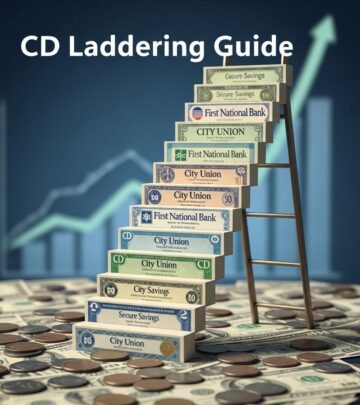
A CD ladder is a strategic savings approach that addresses one of the fundamental challenges facing certificate of deposit investors: the trade-off between earning higher interest rates and maintaining access to your money. Rather than depositing all your savings into a single long-term CD, a CD ladder distributes your investment across multiple certificates of deposit with staggered maturity dates. This strategy allows you to capture the attractive yields that longer-term CDs offer while ensuring that a portion of your funds becomes available regularly—typically every 6 to 12 months.
The beauty of a CD ladder lies in its flexibility and simplicity. You might open a 1-year CD, a 2-year CD, a 3-year CD, a 4-year CD, and a 5-year CD, each holding an equal portion of your investment. As each CD matures, you have the freedom to reinvest that money into a new long-term CD, withdraw it for other purposes, or adjust your strategy based on current market conditions. This approach solves the classic CD dilemma, allowing you to achieve both higher yields and liquidity without compromise.
How CD Ladders Work
Understanding the mechanics of a CD ladder is essential before implementing this strategy. When you create a CD ladder, you’re essentially spreading your total investment across multiple CDs with different maturity dates. For example, if you have $5,000 to invest, you might split it into five $1,000 portions, each deposited into a CD with a different term length.
The power of laddering becomes evident over time. Consider a typical ladder structure with current rates: a 1-year CD earning 3.75% APY, a 2-year CD earning 4.00% APY, a 3-year CD earning 4.15% APY, a 4-year CD earning 4.20% APY, and a 5-year CD earning 4.25% APY. In the first year, your 1-year CD matures, returning your original $1,000 plus approximately $37.50 in interest. Rather than simply spending these funds, you reinvest the $1,037.50 into a new 5-year CD at the prevailing rate. This process repeats annually, and by the end of five years, you’ve transformed your entire ladder into five 5-year CDs all earning top-tier rates, while maintaining annual access points.
Why Consider a CD Ladder?
The advantages of a CD ladder strategy extend beyond the basic concept. With current top 5-year CD rates hovering around 4.00% APY, laddering offers an attractive middle ground between the instant access of savings accounts and the commitment of long-term bonds. A $10,000 CD ladder could earn approximately $2,200 in interest over five years, compared to just $500 in a traditional savings account earning 1% APY—a remarkable difference of $1,700.
CD ladders work best for medium-term financial goals spanning 2 to 5 years, such as saving for a home down payment or purchasing a vehicle. They provide significantly better returns than savings accounts while maintaining the security of FDIC insurance (up to applicable limits) and regular liquidity. However, CD ladders are not appropriate for emergency funds, which should remain in high-yield savings accounts offering instant access without penalty.
Step-by-Step Guide to Building Your CD Ladder
Step 1: Decide Your Structure
The first critical decision is determining your ladder’s architecture. You need to choose how many CDs you want to include—typically three to five is standard—and identify your longest maturity date.
Common ladder structures include:
- More aggressive liquidity: 6-month, 1-year, and 18-month CDs for investors prioritizing frequent access to funds
- Standard structure: 1-year, 2-year, 3-year, 4-year, and 5-year CDs, the most commonly recommended approach
- Maximum yield focus: All 5-year CDs opened at staggered 1-year intervals for those prioritizing returns over frequent liquidity
The number of rungs you add to your ladder should align with your financial goals, risk tolerance, and liquidity needs. A three-rung ladder is simpler to manage but offers less frequent access points, while a five-rung ladder provides more flexibility but requires more active monitoring.
Step 2: Split Your Investment Equally
Once you’ve determined your ladder structure, divide your total investment equally across all CDs. If you have $5,000 to invest across five CDs, you’d deposit $1,000 in each. If you’re starting with $10,000, you’d allocate $2,000 per CD. This equal distribution ensures balanced access to your funds and simplifies reinvestment calculations.
Of course, your ladder doesn’t need to remain static. You can always add additional rungs or increase existing deposits as your financial situation improves. Many investors start with a modest three-rung ladder and expand as they accumulate more capital.
Step 3: Set Up Reinvestment Reminders
The most crucial maintenance task in managing a CD ladder is setting calendar reminders approximately 30 days before each CD matures. This advance notice gives you adequate time to:
- Research and compare current CD rates across multiple banks—rates change constantly and can vary significantly
- Decide whether to reinvest to maintain your ladder structure, withdraw the funds for other purposes, or adjust your strategy
- Avoid automatic rollovers at your current bank’s rates, which may be substantially lower than rates available elsewhere
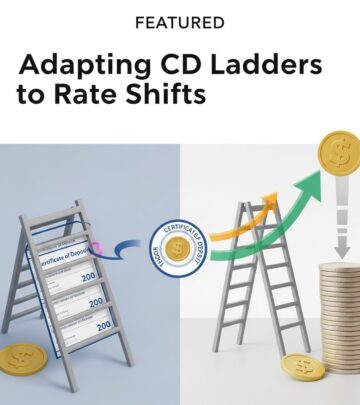
Many banks default to rolling maturing CDs into new CDs at their current rates, which is often their least competitive offering. By proactively managing your rollovers, you ensure optimal returns on your reinvested capital.
Real-World Example of a CD Ladder
Let’s examine a concrete example with actual numbers to illustrate how a CD ladder performs over time. Suppose you invest $5,000 across five CDs with the following structure and current rates:
- $1,000 in 1-year CD at 3.75% APY
- $1,000 in 2-year CD at 4.00% APY
- $1,000 in 3-year CD at 4.15% APY
- $1,000 in 4-year CD at 4.20% APY
- $1,000 in 5-year CD at 4.25% APY
Here’s how your ladder develops:
Year 1: Your 1-year CD matures with $1,037.50 (principal plus interest). You reinvest this entire amount into a new 5-year CD at the current rate (let’s assume 4.25% APY).
Year 2: Your 2-year CD matures with approximately $1,081.60. You reinvest this into another new 5-year CD.
Years 3-5: Continue this pattern, reinvesting each maturity into a new 5-year CD.
By Year 5: Your entire ladder consists of five 5-year CDs, all earning top-tier rates, with one maturing annually. Your total interest earned over the five-year period amounts to approximately $1,100.
This example demonstrates how a CD ladder transforms your savings structure, progressively shifting toward higher-yield long-term CDs while maintaining regular access points.
Alternative CD Ladder Strategies
Bullet CD Ladder
A bullet CD ladder differs fundamentally from the traditional ladder approach. Instead of having CDs mature at regular intervals, all your CDs mature simultaneously at a specific target date. You might open a five-year CD now, a four-year CD next year, and a three-year CD the following year—all strategically maturing in the same target year.
This approach works particularly well for planned major expenses such as a down payment on a home or college tuition. You know exactly when all your funds will be available, allowing precise financial planning for a significant expense.
Barbell Strategy
A CD barbell strategy takes a different approach by combining short-term liquidity with long-term yield maximization while intentionally avoiding medium-term CDs. This strategy is particularly effective when the yield curve is flat or inverted.
For example, with a $10,000 investment, you’d place 50% ($5,000) in short-term 6-month CDs and the other 50% ($5,000) in long-term 5-year CDs, completely skipping the 2-year and 3-year options. This approach provides both immediate access to funds through the short-term CDs while maximizing returns through the extended-term CDs. It’s particularly valuable when shorter-term rates are competitive with longer-term rates, eliminating the traditional advantage of extended commitments.
Alternative CD Products to Enhance Your Strategy
Step-Up CDs
Step-up CDs feature predetermined rate increases that occur automatically on scheduled dates during the CD’s term, regardless of market conditions. The rate increases are fixed when you open the CD, so you know exactly what your rate progression will be. When comparing step-up CDs to traditional fixed-rate CDs, focus on the blended APY across the entire term. In the current environment where automatic increases provide certainty, step-up CDs warrant careful consideration.
Bump-Up CDs
Bump-up CDs typically allow you to request one rate increase during the term if market rates rise. However, current market conditions make this feature less valuable since interest rates are expected to decline rather than increase. The primary disadvantage is that you’re limited to a single rate increase request, and you must actively monitor rates and request the adjustment—if you miss the opportunity, you’ve lost the benefit.
Add-On CDs
Add-on CDs permit you to make additional deposits during the CD’s term, which can be valuable if you anticipate bonuses, tax refunds, or other lump-sum income. However, these products are relatively rare in today’s market and often carry lower yields than comparable traditional CDs, making them less attractive for most savers.
Current CD Rate Environment
As of November 2025, the CD rate landscape remains favorable for savers. Top 5-year CD rates hover around 4.00-4.25% APY, with some institutions offering rates up to 4.50% for 6-month jumbo CDs requiring minimum deposits of $50,000. Online banks consistently outperform traditional brick-and-mortar institutions, often offering rates a full percentage point or higher. The current environment makes laddering particularly attractive, as these elevated rates lock in substantial returns for the ladder’s duration.
Maximizing Your CD Ladder Returns
To optimize the interest you earn on your CD ladder, implement these proven strategies:
- Compare rates aggressively: Research and compare rates across multiple banks and credit unions before making deposits
- Prioritize online banks: Online institutions typically offer superior rates compared to traditional banks
- Set reminders: Use calendar alerts to track maturity dates and reinvestment opportunities
- Monitor market conditions: Stay informed about rate trends to make informed decisions about reinvestment
- Consider rate increases: If market rates rise significantly before your CD matures, evaluate whether a bump-up option is available
Frequently Asked Questions
Q: Are CD ladders suitable for emergency savings?
A: No. Emergency funds should remain in high-yield savings accounts offering instant access without penalties. CD ladders work best for medium-term goals (2-5 years away) where you can afford to have funds temporarily locked away.
Q: How much money do I need to start a CD ladder?
A: There’s no minimum. Many banks have minimum deposits as low as $500 per CD. You could start with as little as $2,500 across five CDs ($500 each) or begin with a three-rung ladder using $1,500 total.
Q: What happens if I need to withdraw money before my CD matures?
A: Most CDs charge early withdrawal penalties if you access your funds before maturity. These penalties typically range from 3 to 12 months of interest, depending on the CD’s term. This is why CD ladders are designed for funds you won’t need until at least one rung matures.
Q: Should I reinvest into the same bank?
A: Not necessarily. When a CD matures, shop around for the best available rates rather than accepting your current bank’s rollover offer. You can move your money to a different institution if they offer significantly better rates.
Q: Can I adjust my CD ladder after creating it?
A: Absolutely. You can add additional rungs, increase deposits as your financial situation improves, or modify your reinvestment strategy as market conditions change. Your ladder is flexible and adaptable to your evolving needs.
References
- CD Ladder: What It Is And How to Build One — Bankrate. 2025. https://www.bankrate.com/banking/cds/cd-ladder-guide/
- Best CD Rates Of November 2025 — Bankrate. 2025. https://www.bankrate.com/banking/cds/cd-rates/
- CD Calculator – Free Calculator for Certificate of Deposits — Bankrate. 2025. https://www.bankrate.com/banking/cds/cd-calculator/
- A Smart Way to Combat Economic Rollercoasters: CD Ladders — Kiplinger. 2025. https://www.kiplinger.com/personal-finance/cd-rates/smart-way-to-combat-economic-rollercoasters-cd-ladders
- Top 18 Tips for CD Savers — Bankrate. 2025. https://www.bankrate.com/banking/cds/tips/
- 6 Top Tips for Choosing the Best CD for Your Money — Bankrate. 2025. https://www.bankrate.com/banking/cds/top-tips-for-choosing-best-cd/
Similar Articles








Read full bio of Sneha Tete