CD Interest Taxation Guide
Navigate the tax rules for certificate of deposit earnings with expert insights on reporting, rates, and strategies to optimize your returns.
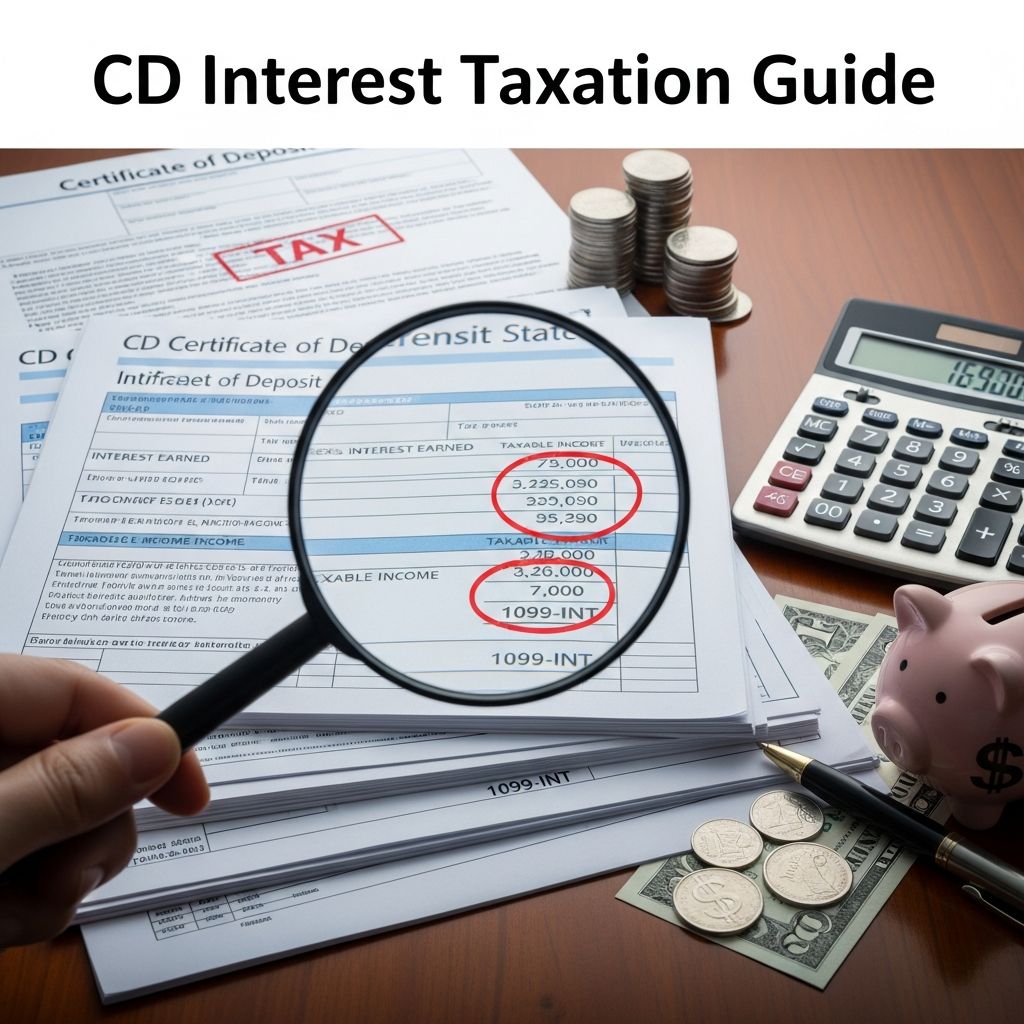
Certificate of deposit (CD) interest is taxed as ordinary income at your federal income tax rate, reported annually regardless of withdrawal, with banks issuing Form 1099-INT for earnings over $10.
Understanding CDs and Their Taxable Nature
Certificates of deposit represent fixed-term savings instruments offered by banks and credit unions, providing higher interest rates than standard savings accounts in exchange for locking funds until maturity. The Internal Revenue Service (IRS) classifies all interest generated from CDs as ordinary income, similar to wages or other earned compensation, subjecting it to federal income tax rates that range from 10% to 37% based on your taxable income and filing status. This taxation applies even if the funds remain untouched, emphasizing the importance of planning for tax liabilities when investing in CDs.
Unlike capital gains from stocks or bonds, which may qualify for preferential rates, CD yields do not receive such treatment. For instance, a CD yielding 5% APY for someone in the 22% tax bracket effectively nets about 3.9% after federal taxes, further reduced by potential state taxes and inflation. Investors must account for this when comparing CD returns to other investments.
Federal Tax Rates Applicable to CD Earnings
The federal tax brackets for 2025, adjusted for inflation, determine the rate on CD interest. These progressive rates apply to ordinary income, including CD yields.
| Tax Rate | Single Filer Income | Married Filing Jointly |
|---|---|---|
| 10% | Up to $11,925 | Up to $23,850 |
| 12% | $11,926 – $48,475 | $23,851 – $96,950 |
| 22% | $48,476 – $103,350 | $96,951 – $206,700 |
| 24% | $103,351 – $197,300 | $206,701 – $394,600 |
| 32% | $197,301 – $250,525 | $394,601 – $501,050 |
| 35% | $250,526 – $626,350 | $501,051 – $751,600 |
| 37% | Over $626,350 | Over $751,600 |
Data sourced from IRS guidelines via financial analyses. Higher brackets erode more of the yield; for example, $1,000 in interest at 37% leaves $630 after tax.
Annual Taxation Timing for CD Interest
Taxes on CD interest accrue in the calendar year the interest is credited or made available, not upon maturity or withdrawal. This rule holds for both short-term (under one year) and long-term CDs.
- Short-term CDs: All interest earned within the year is reported on that year’s return, even if maturity occurs later.
- Long-term CDs: Banks calculate and credit interest annually, issuing a 1099-INT each year for the portion earned in that calendar year. A 5-year CD at 4% might generate taxable interest of about 0.8% of principal yearly.
This annual reporting prevents deferral outside qualified accounts, requiring savers to set aside funds for taxes proactively.
Reporting CD Income on Your Tax Return
Banks must send Form 1099-INT by January 31 if you earn $10 or more in interest. Box 1 lists taxable interest. Report this on Schedule B (Interest and Ordinary Dividends) of Form 1040, Line 2b, integrating it into your adjusted gross income (AGI).
Even without a 1099-INT for smaller amounts, self-reporting is mandatory. For Schedule B totals over $1,500, additional IRS questions apply to verify foreign accounts or nominee interest.
Practical Example: $20,000 CD at 5% APY
Principal: $20,000 matures to $21,000. Taxable: $1,000 interest. In 22% bracket, federal tax ≈ $220. Original principal remains tax-free as return of capital.
State Tax Variations on CD Interest
Most states tax CD interest as ordinary income, mirroring federal treatment, but rates differ. Nine states exempt it from state income tax: Alaska, Florida, Nevada, New Hampshire, South Dakota, Tennessee, Texas, Washington, Wyoming. Residents of high-tax states like California (up to 13.3%) face compounded burdens. Always check state revenue department rules, as some offer credits or deductions.
Penalties and Deductions for Early Withdrawals
Withdrawing from a CD before maturity incurs a penalty, typically 3-12 months’ interest. This penalty is deductible as an adjustment to interest income on Form 1040, Schedule 1, reducing taxable interest. For example, a $500 penalty on $1,000 interest nets $500 taxable. Documentation from the bank is essential for claiming this.
Tax-Advantaged Strategies: CDs in Retirement Accounts
To sidestep immediate taxation, place CDs in tax-sheltered vehicles:
- Traditional IRA/401(k): Contributions may be deductible; interest grows tax-deferred until withdrawal, taxed as ordinary income then.
- Roth IRA: Post-tax contributions; qualified withdrawals (after age 59½ and 5-year holding) are tax-free, including interest.
- Other options: Health Savings Accounts (HSAs) or 529 plans offer similar deferral or tax-free growth for qualified uses.
These accounts limit annual contributions and impose withdrawal rules, but they preserve full compounding power.
Strategies to Minimize CD Tax Impact
Beyond retirement accounts, consider:
- Laddering CDs across maturities to manage liquidity and tax timing.
- Comparing brokered CDs, which may offer flexibility but similar tax rules.
- Tax-loss harvesting in taxable portfolios to offset CD income.
- Residing in no-income-tax states for state-level savings.
Consult a tax professional for personalized advice, especially with complex portfolios.
Frequently Asked Questions
Do I pay taxes on CD interest if I don’t withdraw it?
Yes, taxes apply in the year interest is credited, even if reinvested or inaccessible.
What if my CD spans multiple years?
Expect a 1099-INT annually for that year’s accrued interest.
Is principal from a matured CD taxable?
No, only interest portions are taxed; principal is your after-tax investment return.
Can I deduct CD penalties?
Yes, early withdrawal penalties reduce reported interest income.
Are brokered CDs taxed differently?
No, same ordinary income rules apply.
Planning Ahead for CD Investments
In a rising rate environment, CDs attract conservative investors, but tax drag can diminish appeal. Calculate after-tax yields using tools or advisors: APY × (1 – marginal rate). For 2026 projections, monitor Federal Reserve actions, as higher rates boost yields but also tax bills. Diversify with tax-efficient assets like municipal bonds or equities for long-term growth.
Stay compliant by tracking 1099-INTs and integrating CD income into quarterly estimates if substantial. Electronic filing simplifies Schedule B integration.
References
- How are CDs Taxed? Learn More About the Process — Annuity.org. 2025. https://www.annuity.org/personal-finance/banking/certificate-of-deposit/taxation/
- How Are CDs Taxed? Learn the Tax Implications — BMO. 2025. https://www.bmo.com/en-us/main/personal/bank-accounts/savings-and-cds/certificates-of-deposit/how-are-cds-taxed/
- How does a certificate of deposit (CD) work? — Citizens Bank. 2025. https://www.citizensbank.com/learning/how-does-a-cd-work.aspx
- Understanding How Certificates of Deposit Are Taxed — RetireGuide. 2025. https://www.retireguide.com/retirement-planning/investing/certificate-of-deposit/taxes/
- Paying Tax On CD Interest — Bankrate. 2025. https://www.bankrate.com/banking/cds/paying-tax-on-cd-interest/
Similar Articles








Read full bio of Sneha Tete