Cash-Out Refinance: 6-Step Guide To Access Home Equity
Unlock your home equity with a cash-out refinance: learn how it works, eligibility rules, and smart strategies to maximize benefits while minimizing risks.

Accessing the equity in your home can provide a valuable source of funds for various needs, and a cash-out refinance offers one effective method to achieve this. This approach involves securing a new mortgage larger than your current one, using the excess to pay off the old loan and delivering the remaining amount to you in cash.
Understanding Home Equity and Its Role
Home equity represents the portion of your property’s current market value that you truly own, calculated by subtracting your outstanding mortgage balance from the appraised value. For instance, if your home is appraised at $400,000 and you owe $250,000, your equity stands at $150,000.
Building equity occurs through consistent mortgage payments that reduce principal, as well as property value appreciation over time. This accumulated value becomes a financial asset that lenders view favorably for loans, as it serves as collateral.
The Mechanics of a Cash-Out Refinance
In a cash-out refinance, you replace your existing mortgage with a new loan for a higher principal amount. The lender applies the proceeds to settle your prior mortgage in full, covers closing fees, and disburses the balance to you directly, often via check or wire transfer.
Consider a scenario where your home value is $300,000 with $200,000 remaining on your mortgage, yielding $100,000 in equity. Opting for a cash-out refinance up to 80% of the home’s value allows a new loan of $240,000. After paying off the $200,000 balance and fees, you could receive approximately $35,000-$40,000 in cash.
The new mortgage resets your repayment schedule, potentially altering interest rates, term length, and monthly payments. Early in the term, more of your payments cover interest rather than principal, similar to any standard mortgage.
Key Qualification Criteria
Lenders impose specific standards to approve cash-out refinances, ensuring borrowers can manage the increased debt. Primary requirements include:
- Credit Score: Typically a minimum of 620 for conventional loans, with higher scores unlocking better rates.
- Debt-to-Income Ratio (DTI): Generally capped at 43%, comparing total monthly debts to gross income.
- Equity Position: At least 20% equity must remain post-refinance to sidestep private mortgage insurance (PMI).
- Seasoning Period: Ownership for at least six to twelve months, depending on loan type.
- Income and Employment: Stable income verified by pay stubs, tax returns, and two years of employment history.
| Requirement | Typical Threshold | Purpose |
|---|---|---|
| Credit Score | ≥620 | Assesses repayment reliability |
| DTI Ratio | ≤43% | Ensures affordable payments |
| Remaining Equity | ≥20% | Reduces lender risk |
| Homeownership Duration | 6-12 months | Verifies stable ownership |
These factors influence not only approval but also the loan-to-value (LTV) ratio, often limited to 80% for conventional cash-out refinances.
Step-by-Step Application Process
Navigating a cash-out refinance involves several structured phases:
- Equity Assessment: Estimate available cash by calculating 80% of your home’s appraised value minus current mortgage balance.
- Lender Selection: Compare rates and terms from multiple providers, considering fees and customer service.
- Application Submission: Provide documentation including income proof, tax returns, bank statements, and mortgage details.
- Appraisal and Underwriting: A professional appraiser evaluates your property; underwriters review your financials.
- Loan Estimate Review: Examine the detailed breakdown of terms, costs, and projected payments.
- Closing: Sign documents, pay fees, and receive funds shortly after.
The entire process mirrors buying a home, typically spanning 30-45 days.
Strategic Uses for Cash-Out Funds
While versatile, cash-out refinances shine in targeted applications:
- Debt Consolidation: Pay off high-interest credit cards or personal loans at lower mortgage rates.
- Home Upgrades: Fund renovations that boost property value, like kitchen remodels or energy-efficient improvements.
- Education Expenses: Cover tuition without depleting savings accounts.
- Emergency Reserves: Build liquidity for unexpected medical or repair costs.
Avoid using funds for depreciating assets like vacations, as this increases long-term debt against your home.
Financial Pros and Potential Drawbacks
Advantages
- Lump-sum cash access without separate loans.
- Potentially lower interest rates than unsecured debt.
- Flexible use of funds with no restrictions.
- Opportunity to secure better mortgage terms.
Disadvantages
- Higher overall mortgage balance and payments.
- Closing costs averaging 2-6% of loan amount.
- Risk of foreclosure if unable to repay.
- Reset amortization extends payoff timeline.
Weigh these against your long-term plans; staying in the home long enough to recoup costs is crucial.
Comparing Alternatives to Cash-Out Refinance
| Option | Fund Access | Impact on Mortgage | Interest Type | Best For |
|---|---|---|---|---|
| Cash-Out Refinance | Lump sum | Replaces existing loan | Fixed or adjustable | Debt consolidation, large projects |
| HELOC | Line of credit | Second lien | Variable | Ongoing needs, flexibility |
| Home Equity Loan | Lump sum | Second lien | Fixed | Predictable payments |
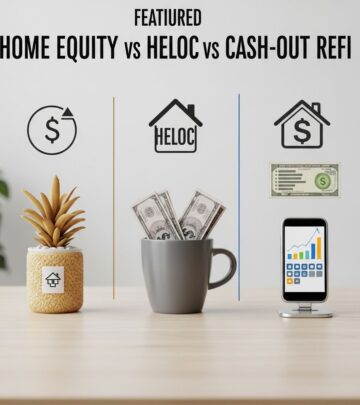
A Home Equity Line of Credit (HELOC) allows draws over time without altering your primary mortgage, featuring variable rates. Home equity loans provide fixed-rate lump sums as secondary mortgages. Choose based on rate stability needs and repayment flexibility.
Navigating Costs and Rate Considerations
Expect closing costs such as appraisal fees ($300-$500), origination fees (0.5-1%), title insurance, and prepaid items. Shop lenders to minimize expenses.
Current market rates for cash-out refinances often trail standard refinances slightly due to higher risk. Monitor Federal Reserve policies and housing trends for optimal timing.
Special Programs for Veterans and Others
VA-backed cash-out refinances offer favorable terms for eligible veterans, replacing existing loans with potentially no down payment required. Freddie Mac guidelines support various cash-out options with minimum credit scores of 620 and seasoning rules.
Frequently Asked Questions
Can I use cash-out refinance funds for anything?
Yes, there are no usage restrictions, though wise choices like investments in your home yield the best returns.
How much equity do I need?
Typically enough to borrow up to 80% LTV while retaining 20% equity post-transaction.
Does it affect my credit score?
The hard inquiry and new account may dip your score temporarily, but on-time payments can improve it long-term.
Is it better than a HELOC?
It depends: cash-out consolidates into one payment but resets terms; HELOCs preserve your original rate.
What if rates are higher now?
Still viable if cash needs outweigh rate increases, especially for high-interest debt payoff.
Making the Right Decision
A cash-out refinance empowers homeowners to leverage equity strategically, but demands careful financial review. Consult lenders, run projections, and align with your goals for optimal outcomes.
References
- What is a Cash-Out Refi & How Does It Work? — Academy Bank. 2023. https://www.academybank.com/article/what-is-a-cash-out-refi-and-how-does-it-work
- Cash-Out Refinance: What You Need to Know — Navy Federal Credit Union. 2024-01-15. https://www.navyfederal.org/makingcents/home-ownership/cash-out-refinance.html
- Cash-Out Refinancing: What It Is, How It Works — Bankrate. 2025-10-20. https://www.bankrate.com/mortgages/cash-out-refinancing/
- Cash Out Refinance vs Home Equity Line of Credit — Bank of America. 2024. https://www.bankofamerica.com/mortgage/learn/cash-out-refinance/
- Cash-out Refinance — Freddie Mac. 2025. https://sf.freddiemac.com/working-with-us/origination-underwriting/mortgage-products/cash-out-refinance
- Cash-Out Refinance Loan — U.S. Department of Veterans Affairs. 2025-11-01. https://www.va.gov/housing-assistance/home-loans/loan-types/cash-out-loan/
Similar Articles








Read full bio of Sneha Tete