Cash-Out Refinance: Benefits and Risks
Unlock your home equity wisely: Explore the advantages, drawbacks, and smart strategies for cash-out refinancing to achieve your financial goals.

A cash-out refinance allows homeowners to replace their existing mortgage with a larger loan, receiving the difference in cash to use for various needs. This strategy taps into built-up home equity, offering flexibility but requiring careful evaluation of long-term impacts.
Understanding Home Equity and Refinancing Basics
Home equity represents the portion of your property’s value that you own outright, calculated as the current market value minus any outstanding mortgage balance. For instance, if your home is appraised at $400,000 and you owe $100,000, your equity stands at $300,000.
Traditional refinancing, or rate-and-term refi, simply adjusts the interest rate or loan term on your current mortgage without changing the principal. In contrast, cash-out refinancing increases the loan amount beyond the remaining balance, providing immediate funds while resetting your mortgage terms.
How Cash-Out Refinancing Operates Step by Step
The process mirrors a standard mortgage application but with added cash disbursement. Here’s a breakdown:
- Assess Equity: Lenders typically cap new loans at 80% of your home’s value (loan-to-value or LTV ratio), ensuring you retain at least 20% equity post-refinance.
- Apply and Qualify: Submit financial documents for credit checks, income verification, and debt-to-income (DTI) ratio evaluation, often requiring a minimum credit score of 620 and DTI under 36%.
- Appraisal and Underwriting: A professional appraiser values your home; underwriters review eligibility, including seasoning periods like six months of ownership for conventional loans.
- Close and Receive Funds: Sign documents, pay closing costs (2-6% of loan amount), and get cash shortly after, minus fees which can be rolled into the loan.
Example: With a $350,000 home, $200,000 owed, and 80% LTV max, you could borrow $280,000, netting $80,000 cash after payoff.
Key Advantages of Choosing Cash-Out Refinance
This option shines for homeowners with significant equity seeking cost-effective borrowing.
| Benefit | Description | Potential Savings Example |
|---|---|---|
| Lower Interest Rates | Often cheaper than credit cards (avg. 20%+ APR) or personal loans, with mortgage rates around 6-7%. | Consolidate $30k debt at 7% vs. 20%: ~$500/month savings. |
| Debt Consolidation | Combine high-interest debts into one lower-rate mortgage payment. | Reduce total interest over time. |
| Flexible Use | Fund renovations, education, or emergencies without restrictions. | Boost home value via improvements. |
| Fixed Rates | Switch from adjustable-rate mortgages (ARMs) to stable payments. | Predictable budgeting. |
Many use proceeds for value-adding projects, potentially increasing resale value and offsetting costs.
Potential Drawbacks and Hidden Costs
While appealing, cash-out refis extend mortgage debt, amplifying risks.
- Increased Total Debt: You’re borrowing against future home value; market dips could lead to owing more than the home’s worth (underwater mortgage).
- Higher Monthly Payments: Larger principal often means bigger payments, straining budgets if rates rise.
- Closing Costs: Expect $5,000-$10,000+ in fees for appraisals, origination, and title work, which may not be recouped quickly.
- Equity Reduction: Less ownership stake means higher risk in foreclosure scenarios.
- Tax Implications: Cash isn’t always deductible; consult IRS rules on home equity loan interest.
Amortization resets, shifting early payments back to interest-heavy, delaying principal reduction.
Who Qualifies? Essential Eligibility Criteria
Not everyone can access this tool. Lenders scrutinize:
- Credit Score: 620+ for conventional; higher for best rates.
- Equity Threshold: Minimum 20% post-cash-out.
- DTI Ratio: Ideally ≤36%, including new payment.
- Seasoning: 6-12 months on current mortgage.
- Stable Income: Verified employment and reserves.
FHA and VA options exist for lower scores/equity, but with stricter limits.
Strategic Uses: Making the Most of Your Cash
Home Upgrades That Pay Off
Investing in kitchens, bathrooms, or energy-efficient features can yield 70-80% ROI on resale, per remodeling reports, while building more equity.
Eliminating High-Interest Debt
Target credit cards or auto loans; a 7% mortgage vs. 18% card APR saves thousands long-term.
Other Smart Applications
- Education funding without private student loans.
- Emergency reserves or medical bills.
- Investment seed money, though risky if markets falter.
Avoid non-essential spending to prevent financial overextension.
Comparing Alternatives to Cash-Out Refinance
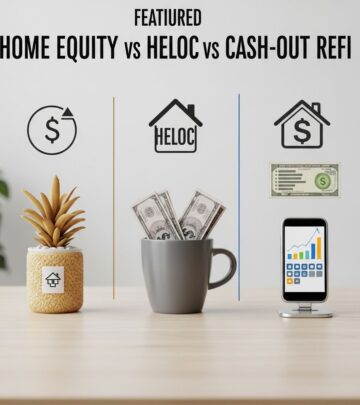
| Option | Pros | Cons | Best For |
|---|---|---|---|
| Home Equity Loan | Fixed lump sum; second mortgage. | Two payments; higher rates. | Stable income seekers. |
| HELOC | Flexible draw; variable rates. | Rate fluctuations; balloon risk. | Ongoing projects. |
| Personal Loan | No collateral; quick approval. | High rates (10-36%); short terms. | Small amounts. |
| Credit Cards | Convenience; rewards. | Very high APR; low limits. | Short-term only. |
Weigh based on amount needed, rates, and risk tolerance.
Practical Tips Before Proceeding
- Shop Lenders: Compare at least three for rates/fees; use online calculators.
- Forecast Payments: Use tools to project affordability amid rate changes.
- Consult Advisors: Financial planners ensure alignment with goals.
- Time the Market: Refi when rates drop or equity peaks.
- Plan Exit: Consider how long you’ll stay in the home to break even on costs.
Frequently Asked Questions (FAQs)
Can I use cash-out refinance for anything?
Yes, funds are unrestricted, from renovations to investments, but wise use maximizes benefits.
How much equity do I need?
Typically enough for 20% LTV post-refi, so at least 20-25% current equity depending on cash desired.
What’s the breakeven on closing costs?
Divide fees by monthly savings; e.g., $6,000 fees saving $200/month = 30 months.
Does it affect my credit score?
Hard inquiries drop it temporarily (5-10 points); new mortgage utilization impacts initially.
Is it better than a HELOC?
Refi offers single payment/lower rates but resets mortgage; HELOC provides flexibility without full refinance.
Final Thoughts on Smart Equity Access
Cash-out refinancing empowers homeowners to leverage equity effectively, but success hinges on disciplined use and thorough planning. Evaluate your finances holistically to ensure it advances rather than hinders your objectives.
References
- About the Cash-out Refinance — FHA.com. 2023. https://www.fha.com/define/cash-out-refinance
- Cash-Out Refinancing: What It Is, How It Works — Bankrate. 2025-03-15. https://www.bankrate.com/mortgages/cash-out-refinancing/
- Cash-Out Refinance: How It Works and What to Know — NerdWallet. 2025-02-28. https://www.nerdwallet.com/mortgages/learn/refinance-cash-out
- What Is a Cash Out Refinance & How Does It Work? — Freedom Mortgage. 2024-11-10. https://www.freedommortgage.com/learning-center/articles/cash-out-refinance
- Cash-Out Refinance Transactions — Fannie Mae Selling Guide. 2025-01-20. https://selling-guide.fanniemae.com/sel/b2-1.3-03/cash-out-refinance-transactions
- Cash-Out Refinance: What You Need to Know — Navy Federal Credit Union. 2024-12-05. https://www.navyfederal.org/makingcents/home-ownership/cash-out-refinance.html
Similar Articles








Read full bio of Sneha Tete