Cash on Cash Return: Definition, Formula & Calculation
Learn to recognize horse colic symptoms and implement effective prevention strategies for equine health.

What is Cash on Cash Return?
Cash on cash return, also known as cash yield, is a fundamental metric used in real estate investing to measure the annual pre-tax cash flow generated by an investment property relative to the initial equity investment made by the investor. This metric provides investors with a practical understanding of the cash returns they can expect on their actual cash outlay in a particular year.
The cash on cash return is expressed as a percentage and represents a snapshot of returns during a specific time period, typically one year. Unlike some other return metrics that account for the entire holding period or potential future sales, cash on cash return focuses on the immediate annual cash flow yield. This makes it particularly useful for investors who prioritize consistent cash flow and want to understand their current year returns.
Real estate investors frequently use cash on cash return as a quick assessment tool to determine whether a property warrants further detailed analysis. It helps investors evaluate whether the annual cash flow generated by a property justifies the equity invested, providing a clear picture of cash distributions relative to out-of-pocket equity contributions throughout the investment holding period.
Understanding the Cash on Cash Return Formula
The formula for calculating cash on cash return is straightforward and consists of two primary components:
Cash on Cash Return (%) = Annual Pre-Tax Cash Flow ÷ Invested Equity
Annual Pre-Tax Cash Flow: This is the annual pre-tax income generated by the property investment, calculated after deducting all financing costs such as mortgage payments and interest. It represents the actual cash available to the investor before income taxes are paid.
Invested Equity: This represents the initial cash equity investment made at the time of purchase, excluding any financing from loans or mortgages. It is the actual out-of-pocket capital contributed by the investor to acquire the property.
The metric is calculated on a post-financing basis, meaning financing costs are already deducted from the cash flow. This “levered” metric accounts for the impact of debt financing on the property’s returns, showing investors exactly what cash return they receive relative to their equity investment.
How to Calculate Cash on Cash Return
Calculating cash on cash return involves several steps. First, you need to determine the property’s net operating income (NOI) by subtracting all operating expenses from the property’s gross revenue. Operating expenses typically include maintenance costs, property taxes, insurance, utilities, and labor expenses.
Next, calculate the annual debt service by determining the total annual mortgage payments (principal and interest). Subtract the annual debt service from the NOI to obtain the annual pre-tax cash flow. This figure represents the actual cash available to the investor after all operating expenses and loan payments have been covered.
Finally, divide this annual pre-tax cash flow by the total equity investment to arrive at the cash on cash return percentage. The result represents how much annual cash return the investor receives for every dollar of equity invested in the property.
Practical Example of Cash on Cash Return Calculation
Consider a real estate investment scenario to illustrate this calculation:
- Property purchase price: $1,000,000
- Loan amount: $800,000
- Equity investment (down payment): $200,000
- Annual net operating income: $60,000
- Annual debt service (mortgage payments): $35,000
Using these figures, the annual pre-tax cash flow equals $60,000 minus $35,000, which is $25,000. Dividing the $25,000 annual pre-tax cash flow by the $200,000 equity investment yields a cash on cash return of 12.5%.
This 12.5% cash on cash return indicates that the investor receives $0.125 in annual cash flow for every dollar of equity invested. In this scenario, the investor would recover 12.5% of their initial equity investment annually through cash flow.
Cash on Cash Return vs. Capitalization Rate (Cap Rate)
While both metrics are used in real estate analysis, cash on cash return and cap rate serve different purposes and use different calculations.
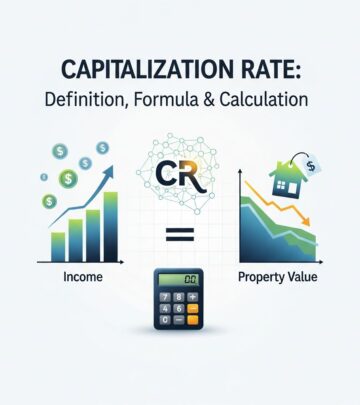
Cap Rate Formula: Cap Rate (%) = Net Operating Income (NOI) ÷ Property Value
Cash on Cash Return Formula: Cash on Cash Return (%) = Annual Pre-Tax Cash Flow ÷ Invested Equity
The primary difference lies in their denominators. The cap rate divides NOI by the total property value (the market value of the entire property), while cash on cash return divides the levered pre-tax cash flow by only the equity contributed by the investor.
Additionally, cap rate uses NOI, which does not account for financing costs, whereas cash on cash return factors in debt service payments. This means cash on cash return reflects the actual cash impact of financing decisions, while cap rate provides an unlevered view of property fundamentals independent of financing structure.
The cap rate remains constant regardless of how a property is financed, while cash on cash return varies based on financing decisions and debt levels. Investors use both metrics for different purposes: cap rate for comparing properties on an unlevered basis, and cash on cash return for understanding actual cash returns on their specific equity investment.
Cash on Cash Return vs. Return on Investment (ROI)
Cash on cash return and return on investment (ROI) are distinct metrics that measure returns differently and serve different analytical purposes.
Cash on Cash Return: Measures the annual pre-tax cash flow relative to the initial equity investment. It represents a single-year snapshot and is calculated on a levered basis, accounting for financing costs.
Return on Investment (ROI): Calculates the total return across the entire holding period of the investment. ROI is cumulative and typically incorporates the eventual sale price of the property, appreciation, and all cash flows received throughout the holding period.
Cash on cash return provides a short-term perspective on annual yield, answering the question: “What cash am I receiving this year on my invested equity?” In contrast, ROI provides a comprehensive long-term view, answering: “What is my total return from the time I purchased until I sell?”
Cash on cash return is ideal for investors prioritizing immediate cash flow, while ROI is better suited for those evaluating the complete investment performance over multiple years. Many sophisticated investors use both metrics together to understand both current year performance and long-term investment returns.
The Impact of Leverage on Cash on Cash Return
Leverage, or the use of borrowed money to finance an investment, significantly affects cash on cash return calculations. When a property is financed with debt, the cash on cash return is generally higher than if the property were purchased entirely with cash, assuming the property generates positive cash flow after debt service.
Consider a property valued at $10,000,000 that generates $500,000 in annual NOI. If purchased entirely with cash, the cash on cash return would be 5.0% ($500,000 ÷ $10,000,000). However, if the same property is financed with $3,000,000 in equity and $7,000,000 in debt at 4% annual interest, the annual debt service would be $280,000, resulting in annual pre-tax cash flow of $220,000. The cash on cash return would then be 7.3% ($220,000 ÷ $3,000,000).
This additional 2.3% return illustrates the power of positive leverage, where borrowed funds amplify returns on the equity invested. However, leverage also increases risk, as debt service obligations must be met regardless of property performance. Investors must carefully balance the benefits of leverage against increased financial obligations and risk exposure.
Standard Cash on Cash Return Benchmarks
Real estate investors typically consider cash on cash returns in the 8% to 12% range as acceptable benchmarks, though these standards vary based on several factors:
- Market conditions and interest rate environment
- Economic sentiment and outlook
- Property type and location
- Individual investment firm criteria and requirements
- Risk tolerance and return expectations
Higher cash on cash returns may indicate exceptional value or increased risk, while lower returns might suggest a competitive market or value-add opportunities. Investors should compare cash on cash returns across similar properties and markets to identify relative value. Properties offering returns significantly above or below benchmark levels warrant additional investigation to understand the underlying factors driving these differences.
When to Use Cash on Cash Return
Cash on cash return is particularly valuable in specific investment scenarios:
- Income-Focused Investing: When prioritizing consistent annual cash flow over long-term appreciation
- Quick Initial Screening: As a napkin test to rapidly determine if a property merits deeper analysis
- Financing Decisions: When evaluating how different debt structures affect actual cash returns on equity
- Comparative Analysis: When comparing multiple investment opportunities on a consistent basis
- Investor Communication: When explaining returns to limited partners or passive investors in simple, understandable terms
Limitations of Cash on Cash Return
While useful, cash on cash return has limitations that investors should understand. It only reflects a single year’s performance and does not account for property appreciation, principal paydown on the loan, or changes in cash flow over time. It also ignores tax implications, though it is calculated on a pre-tax basis. Additionally, cash on cash return does not capture the investor’s total return, including eventual sale proceeds or long-term wealth accumulation through equity appreciation and loan paydown.
The metric is also sensitive to timing and assumes current conditions continue indefinitely, which may not reflect market dynamics. Investors relying solely on cash on cash return may miss important investment considerations related to long-term value creation and total return potential. For comprehensive analysis, cash on cash return should be used alongside other metrics like cap rate, internal rate of return (IRR), and return on investment.
Frequently Asked Questions
What is a good cash on cash return?
A good cash on cash return typically ranges from 8% to 12%, depending on market conditions and investment criteria. However, acceptable returns vary by market, property type, and individual investor requirements. Comparing returns across similar properties in the same market provides the best benchmark for evaluating whether a return is competitive.
How does cash on cash return differ from ROI?
Cash on cash return measures annual pre-tax cash flow relative to equity invested, providing a single-year snapshot. ROI calculates total cumulative return over the entire holding period, including appreciation and sale proceeds. Cash on cash return focuses on current year yield, while ROI encompasses total investment performance.
Can cash on cash return be negative?
Yes, cash on cash return can be negative if the property’s operating expenses and debt service exceed its revenue, resulting in negative annual cash flow. This typically occurs in value-add properties expected to generate returns primarily through appreciation rather than cash flow, or in underperforming properties requiring repositioning.
Why is leverage important in cash on cash return calculations?
Leverage amplifies returns on invested equity by using borrowed funds. When a property generates positive cash flow after debt service, borrowing increases the cash on cash return on the equity invested. However, leverage also increases risk and financial obligations that must be met regardless of property performance.
Should I use cash on cash return as my only investment metric?
No, cash on cash return should be used alongside other metrics like cap rate, IRR, and total ROI for comprehensive analysis. Cash on cash return only reflects current year cash flow and does not account for appreciation, loan paydown, or long-term value creation. A complete investment analysis incorporates multiple metrics and perspectives.
References
- Cash on Cash Return | Formula + Calculator — Wall Street Prep. 2024. https://www.wallstreetprep.com/knowledge/cash-on-cash-return/
- Cash-on-Cash Return (COCR) in Real Estate — J.P. Morgan Chase. 2024. https://www.jpmorgan.com/insights/real-estate/commercial-term-lending/cash-on-cash-return-cocr-in-real-estate
- Return metrics explained: Cash-on-cash return in real estate investing — Plante Moran. 2023. https://www.plantemoran.com/explore-our-thinking/insight/2023/plante-moran-reia/cash-on-cash-return-in-real-estate-investing
- Cash on cash return — Wikipedia. https://en.wikipedia.org/wiki/Cash_on_cash_return
Similar Articles








Read full bio of medha deb