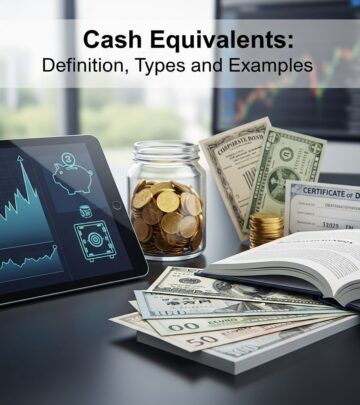
Cash Investments: 4 Core Options For Liquidity And Safety
Discover how cash investments offer liquidity, safety, and modest returns for short-term financial needs and emergency funds.

Cash investments, often referred to as cash equivalents, represent short-term financial instruments that prioritize liquidity and capital preservation while generating modest interest income. These options allow investors to access funds quickly with minimal risk of principal loss, distinguishing them from higher-volatility assets like stocks or bonds.
Why Choose Cash Investments?
In an unpredictable economic landscape, cash investments serve as a cornerstone for financial stability. They are ideal for parking funds needed within months or a few years, covering emergencies, or bridging gaps between larger investment moves. Unlike traditional savings accounts, these vehicles often yield higher returns due to their investment in short-term debt securities.
The primary appeal lies in their
high liquidity
—the ability to convert to cash swiftly without significant value erosion. For instance, investing $1,000 typically allows retrieval of the full principal plus interest, barring rare market disruptions. This stability comes at the cost of lower returns, which may not always outpace inflation, but provides peace of mind for conservative savers.Core Types of Cash Investments
Cash investments encompass several variants, each balancing liquidity, yield, and security differently. Understanding these helps tailor choices to specific needs.
Money Market Mutual Funds
Money market mutual funds pool investor money into ultra-short-term, high-quality debt like government securities and commercial paper, aiming to maintain a stable $1 per share value. They offer superior liquidity, often allowing check-writing or same-day transfers, with minimum check amounts around $500.
Categories include government funds (investing in Treasuries), prime funds (corporate debt), and municipal funds (tax-exempt). Yields track federal interest rates closely, typically exceeding savings accounts, though they lack FDIC insurance—relying instead on quality holdings. Vanguard and similar providers make them accessible via brokerage accounts.
Bank Money Market Accounts
Offered by banks, these accounts blend checking-like access with higher yields than standard savings, requiring larger minimum balances. They support checks, withdrawals, and transfers, insured up to $250,000 by the FDIC.
Interest rates are competitive but often trail uninsured options. They suit those prioritizing government-backed safety alongside daily liquidity.
Certificates of Deposit (CDs)
CDs are time-bound deposits with banks or credit unions, locking funds for terms from one month to years in exchange for fixed interest rates. Early withdrawals incur penalties, reducing liquidity compared to funds.
FDIC or NCUA insurance covers up to $250,000, making them secure. Longer terms yield more, appealing for known short-term horizons. Credit union share certificates mirror CDs with similar terms.
U.S. Treasury Bills (T-Bills)
T-Bills are government-issued, short-term securities maturing in under a year, sold at discounts and redeemed at face value. Backed by the U.S. government, they carry virtually no credit risk, though uninsured. Highly liquid via secondary markets, they offer competitive yields for safety-focused investors.
Comparing Cash Investment Options
The table below summarizes key attributes for quick comparison:
| Investment Type | Liquidity | Insurance | Typical Yield | Best For |
|---|---|---|---|---|
| Money Market Funds | High (checks/transfers) | No (private options rare) | Above savings | Daily access, low risk |
| Money Market Accounts | High | FDIC up to $250K | Moderate | Insured liquidity |
| CDs | Low (penalties) | FDIC/NCUA up to $250K | Higher for terms | Known timelines |
| T-Bills | High (secondary market) | Gov’t backed | Competitive | Ultra-safety |
Data drawn from standard characteristics; yields fluctuate with rates.
Risks and Limitations
While low-risk, cash investments face
inflation risk
—returns may lag rising prices, eroding purchasing power. A $10,000 investment at 4% over 18 years grows to $20,300 nominally, but equals $10,150 adjusted for 4% inflation, less after taxes.- Interest Rate Risk: Yields drop in low-rate environments.
- Credit Risk: Minimal for government-backed; higher for prime funds (though rare breaks occur).
- Opportunity Cost: Forgoing higher long-term growth from stocks/bonds.
Funds can “break the buck” in crises, though reforms post-2008 enhance stability. Always assess time horizon: short-term favors cash; longer suits growth assets.
Strategies for Maximizing Cash Investments
To optimize, ladder CDs across maturities for steady access and rates. Blend insured accounts with T-Bills for diversification. Monitor Fed rates, as they drive yields. For tax efficiency, opt for municipal money market funds.
In portfolios, allocate 3-6 months’ expenses to cash equivalents, scaling with risk tolerance. Superannuation or retirement plans often include cash options for stability.
When Cash Investments Fit Your Plan
Use for emergency funds, down payment savings, or awaiting opportunities. They complement broader strategies: pair with bonds for medium-term, equities for long-term. Time, yield, and risk interplay—safer options yield less but preserve capital.
Frequently Asked Questions (FAQs)
What is the safest cash investment?
U.S. Treasury bills or FDIC-insured CDs/accounts offer top safety.
Do cash investments beat inflation?
Rarely long-term; they prioritize preservation over growth.
Are money market funds FDIC-insured?
No, but invest in low-risk assets for stability.
How do current rates compare?
Track Fed funds rate; check providers for latest.
Can I lose money in cash investments?
Principal is stable, but inflation/taxes reduce real value.
Cash investments anchor financial plans with reliability. Evaluate liquidity needs, risk appetite, and goals to select optimally.
References
- Cash Investments — Texas State Securities Board. Accessed 2026. https://www.ssb.texas.gov/sites/default/files/uploads/voi/articles/cash_investments.html
- What are cash investments? — Vanguard. Accessed 2026. https://investor.vanguard.com/investor-resources-education/understanding-investment-types/what-are-cash-investments
- How do cash investments work? — Colonial First State. Accessed 2026. https://www.cfs.com.au/personal/investment/cash-investments
- 7 ways to earn more on your cash — Fidelity Investments. Accessed 2026. https://www.fidelity.com/learning-center/trading-investing/managing-cash
- Types of Investments — Canadian Securities Administrators. Accessed 2026. https://www.securities-administrators.ca/investor-tools/understanding-your-investments/types-of-investments/
Similar Articles








Read full bio of medha deb