Cash Equivalents: Definition, Types, and Examples
Understanding cash equivalents: Short-term, liquid investments that strengthen financial stability.
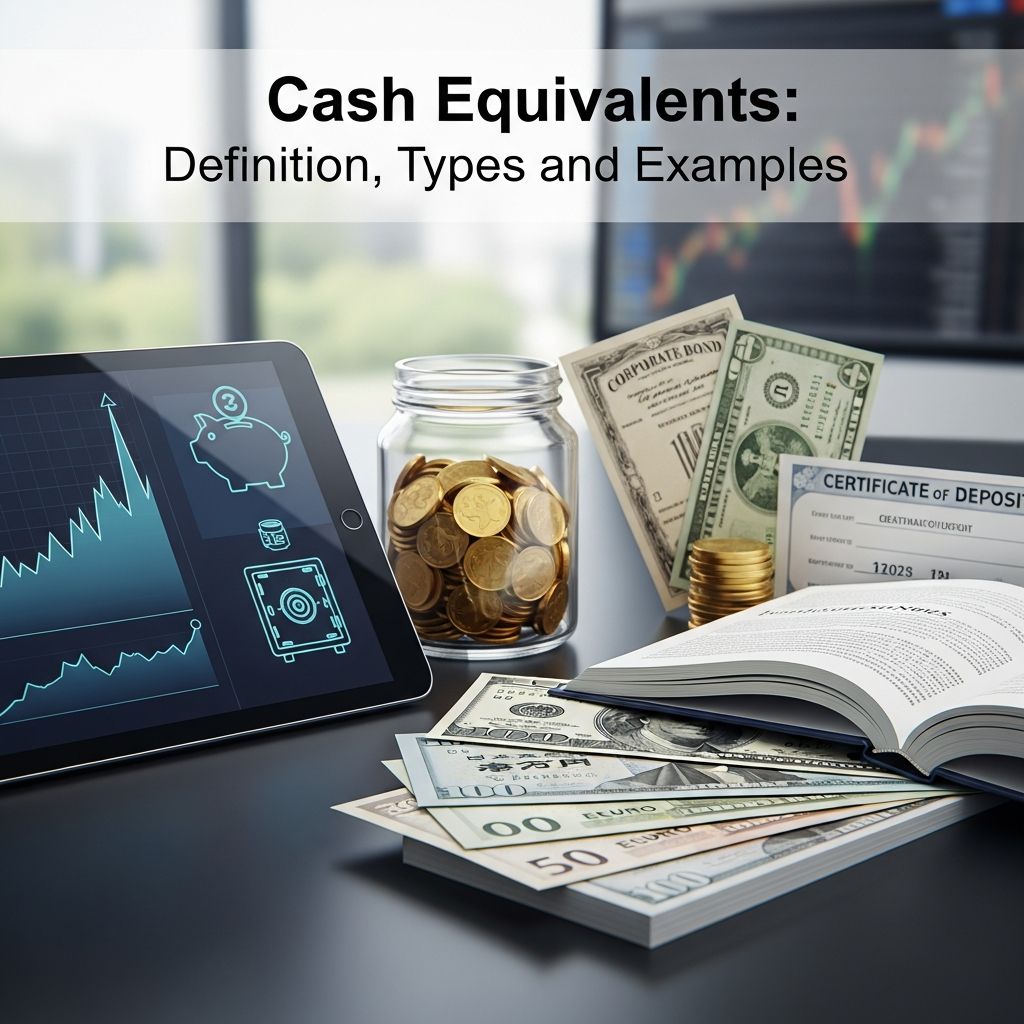
Cash equivalents are short-term, highly liquid investments that play a critical role in corporate finance and personal investment strategies. Understanding what qualifies as a cash equivalent is essential for accurate financial reporting, cash flow management, and strategic financial planning. These investments represent some of the safest and most accessible ways to preserve capital while maintaining flexibility for operational needs.
What Are Cash Equivalents?
Cash equivalents are defined as short-term, highly liquid investments that can be quickly converted into cash while incurring minimal or no loss in value. Under Generally Accepted Accounting Principles (GAAP), the Financial Accounting Standards Board (FASB) defines cash equivalents as “short-term, highly liquid investments that are readily convertible to known amounts of cash and so near their maturity that they present insignificant risk of changes in value.”
The International Financial Reporting Standards (IFRS) provide a nearly identical definition under IAS 7: Statement of Cash Flows, describing cash equivalents as “short-term, highly liquid investments that are readily convertible to known amounts of cash and subject to an insignificant risk of changes in value.” This consistency across accounting standards ensures that financial statements are comparable across different organizations and jurisdictions.
Cash and cash equivalents are listed as current assets on the balance sheet, typically at the top, as they represent the most liquid assets a company possesses. This positioning reflects their immediate availability for paying obligations, funding operations, or seizing business opportunities.
Key Characteristics of Cash Equivalents
For an asset to qualify as a cash equivalent, it must meet specific criteria that distinguish it from other investments:
Short-Term Maturity
The most defining characteristic of cash equivalents is their brief maturity period. Generally, only investments with original maturities of three months or less qualify as cash equivalents. This three-month threshold is crucial because it ensures that the investment can be converted to cash quickly without significant delay. It’s important to note that the original maturity matters, not the remaining maturity. For example, a three-year Treasury Note purchased three months before maturity qualifies as a cash equivalent, but a Treasury Note purchased three years ago does not become a cash equivalent simply because it now has three months remaining until maturity.
High Liquidity
Cash equivalents must be highly liquid, meaning they can be converted into cash very easily without substantial transaction costs or delays. This liquidity is what distinguishes cash equivalents from other short-term investments that might take weeks or months to sell. The ability to access funds quickly is essential for companies that need to manage their working capital effectively and maintain operational flexibility.
Low Risk
Cash equivalents present insignificant risk of changes in value due to market fluctuations or interest rate movements. They are typically backed by creditworthy institutions or governments, making them among the safest investments available. This low-risk characteristic ensures that companies can rely on the stated value of these investments without worrying about erosion of capital due to market conditions.
Common Examples of Cash Equivalents
Multiple types of investments qualify as cash equivalents under accounting standards and regulatory guidelines. Understanding these examples helps financial professionals identify which investments should be classified appropriately on financial statements.
Treasury Bills and Treasury Notes
Treasury bills (T-bills) and Treasury notes are among the most common cash equivalents. T-bills are short-term debt instruments issued by the U.S. government with maturities of one year or less. Treasury notes with maturities of three months or less also qualify as cash equivalents. These instruments are backed by the full faith and credit of the U.S. government, making them extremely safe investments.
Commercial Paper
Commercial paper represents short-term debt instruments issued by corporations and financial institutions to finance working capital. These instruments typically mature within 90 days and are backed by the issuer’s creditworthiness. They provide companies with an efficient way to raise short-term funds while offering investors a higher yield than government securities with comparable maturities.
Certificates of Deposit (CDs)
Certificates of deposit with maturities of three months or less qualify as cash equivalents. CDs are deposit accounts offered by banks and credit unions that pay a fixed interest rate for a specified period. However, only CDs that can be accessed without penalty within the three-month window qualify for this classification. Longer-term CDs do not qualify as cash equivalents.
Money Market Funds
Money market funds are mutual funds that invest in short-term debt instruments such as Treasury bills, commercial paper, and banker’s acceptances. These funds offer investors liquidity, stability, and modest returns. They are particularly popular for companies seeking to hold excess cash reserves while generating modest returns. Money market funds are typically highly liquid and carry minimal credit risk.
Banker’s Acceptances
Banker’s acceptances are short-term credit instruments that are guaranteed by a bank. These instruments are commonly used in international trade finance and typically mature within 90 days. Because they carry the guarantee of a creditworthy financial institution, they present minimal risk to investors.
Repurchase Agreements (Repos)
Repurchase agreements involve the sale of a security with an agreement to repurchase it at a future date, typically within a short timeframe. When a repo matures in under three months and carries minimal credit risk, it qualifies as a cash equivalent. The critical factor in classification is the maturity of the repurchase agreement itself, not the maturity of the underlying securities securing the transaction.
Short-Term Government Bonds
Government bonds with remaining maturities of three months or less from the purchase date qualify as cash equivalents. These instruments are backed by sovereign governments and carry minimal default risk.
Cash Versus Cash Equivalents: Understanding the Distinction
While cash and cash equivalents both appear together on balance sheets as current assets, important differences exist between them:
| Characteristic | Cash | Cash Equivalents |
|---|---|---|
| Definition | Physical currency and readily available bank balances | Short-term investments convertible to cash within three months |
| Liquidity | Instantly available for use | Highly liquid but requires conversion |
| Risk | Virtually no risk; no market fluctuation | Minimal risk; insignificant changes in value |
| Time to Access | Immediate | Up to three months |
| Examples | Physical currency, checking accounts, savings accounts | Treasury bills, commercial paper, money market funds |
Cash refers to both physical currency (notes and coins) and balances in bank accounts that are readily available for immediate use. Cash can be used instantly for any payment or transaction without conversion. Cash equivalents, by contrast, must first be converted into cash, typically taking anywhere from a few days to three months depending on the specific investment.
Accounting Standards and Regulatory Definitions
The classification of cash equivalents is governed by specific accounting standards that ensure consistency in financial reporting. Organizations must follow these standards when preparing financial statements for external stakeholders.
Under GAAP and the Financial Accounting Standards Board (FASB) standards, cash equivalents are defined with specific characteristics that must be met simultaneously. The Accounting Standards Codification (ASC) provides detailed guidance on which investments qualify, emphasizing that both original maturity and the nature of the investment must be considered.
Many organizations also develop written policies that specify which short-term, highly liquid investments they treat as cash equivalents. These policies ensure consistency in financial reporting and provide transparency to stakeholders about how the organization classifies its most liquid assets.
Why Cash Equivalents Matter in Financial Management
Cash equivalents serve several important functions in corporate and personal finance. They provide a mechanism for earning modest returns on excess cash reserves while maintaining ready access to funds. For companies with seasonal business patterns or variable cash inflows, holding cash equivalents allows management to deploy capital efficiently while preserving flexibility.
From an accounting perspective, accurate classification of cash equivalents is essential for preparing reliable financial statements and cash flow statements. Investors, creditors, and regulators rely on accurate classification to assess a company’s liquidity position and financial health. Misclassification of investments could distort financial metrics and lead to incorrect financial decisions.
Factors to Consider When Selecting Cash Equivalents
When organizations decide which short-term investments to hold, several factors influence the decision:
Yield Considerations: Different cash equivalents offer varying interest rates. Treasury bills typically offer lower yields, while commercial paper and money market funds may offer slightly higher returns. Organizations must balance yield with safety and liquidity.
Credit Quality: While all cash equivalents present minimal credit risk, some carry slightly higher yields due to issuer characteristics. Government-backed instruments like Treasury bills carry virtually no credit risk, while commercial paper depends on corporate creditworthiness.
Liquidity Needs: Organizations with frequent cash needs may prefer investments that can be liquidated instantly, such as money market funds, while those with more predictable cash flows might invest in instruments with longer terms within the three-month window.
Frequently Asked Questions
Q: What is the primary purpose of classifying investments as cash equivalents?
A: The primary purpose is to provide accurate financial reporting by grouping the most liquid assets together on the balance sheet. This classification helps stakeholders understand a company’s liquidity position and immediate ability to meet financial obligations.
Q: Why is the three-month maturity threshold so important?
A: The three-month threshold ensures that investments can be converted to cash quickly enough to meet immediate operational needs. Investments exceeding this period may not be sufficiently liquid to qualify as cash equivalents, even if they are otherwise low-risk.
Q: Can a long-term investment become a cash equivalent as it approaches maturity?
A: No. What matters is the original maturity date of the investment, not its remaining maturity. A Treasury note purchased three years ago does not qualify as a cash equivalent merely because it has three months remaining until maturity. However, a Treasury note purchased when it had three months remaining would qualify.
Q: How do international standards differ from U.S. GAAP regarding cash equivalents?
A: The IFRS definition under IAS 7 is nearly identical to the U.S. GAAP definition, ensuring consistency in financial reporting across different countries. Both standards emphasize liquidity, short-term maturity, and minimal risk of value changes.
Q: What distinguishes money market funds from other cash equivalents?
A: Money market funds are mutual funds that invest in a diversified portfolio of short-term instruments. This diversification provides an additional layer of safety compared to individual instruments and offers professional management while maintaining high liquidity.
Q: Are restricted cash equivalents included on the balance sheet?
A: Restricted cash and restricted cash equivalents should be included in the cash and cash equivalent balances on the statement of cash flows, though they may be separately presented on the balance sheet depending on the nature and extent of the restrictions.
References
- Examples of Cash Equivalents — Financial Management Service, State of Texas. Accessed 2025. https://fmx.cpa.texas.gov/fmx/training/wbt/cashflow/281.php
- What are Cash Equivalents? Importance in 2025 — Intuit QuickBooks. 2025. https://quickbooks.intuit.com/r/accounting/cash-equivalents/
- Cash and Cash Equivalents: Definition, Types & How It Works — Bill.com. Accessed 2025. https://www.bill.com/learning/cash-and-cash-equivalents
- Definition of Cash and Cash Equivalents — Deloitte DART (ASC 230-10). Accessed 2025. https://dart.deloitte.com/USDART/home/codification/presentation/asc230-10/roadmap-statement-cash-flow/chapter-4-cash-cash-equivalents/4-1-definition-cash-cash-equivalents
- Cash Equivalent/Short-Term Investments — State Board for Community and Technical Colleges (SBCTC). Accessed 2025. https://www.sbctc.edu/colleges-staff/programs-services/accounting-business/clam/accounting-for-cash-and-equivalents/cash-equivalent-investments.aspx
Similar Articles








Read full bio of Sneha Tete