Cash Back or Points: Best Rewards?
Discover whether cash back or points credit cards suit your lifestyle better with our in-depth comparison of rewards, redemption, and value.
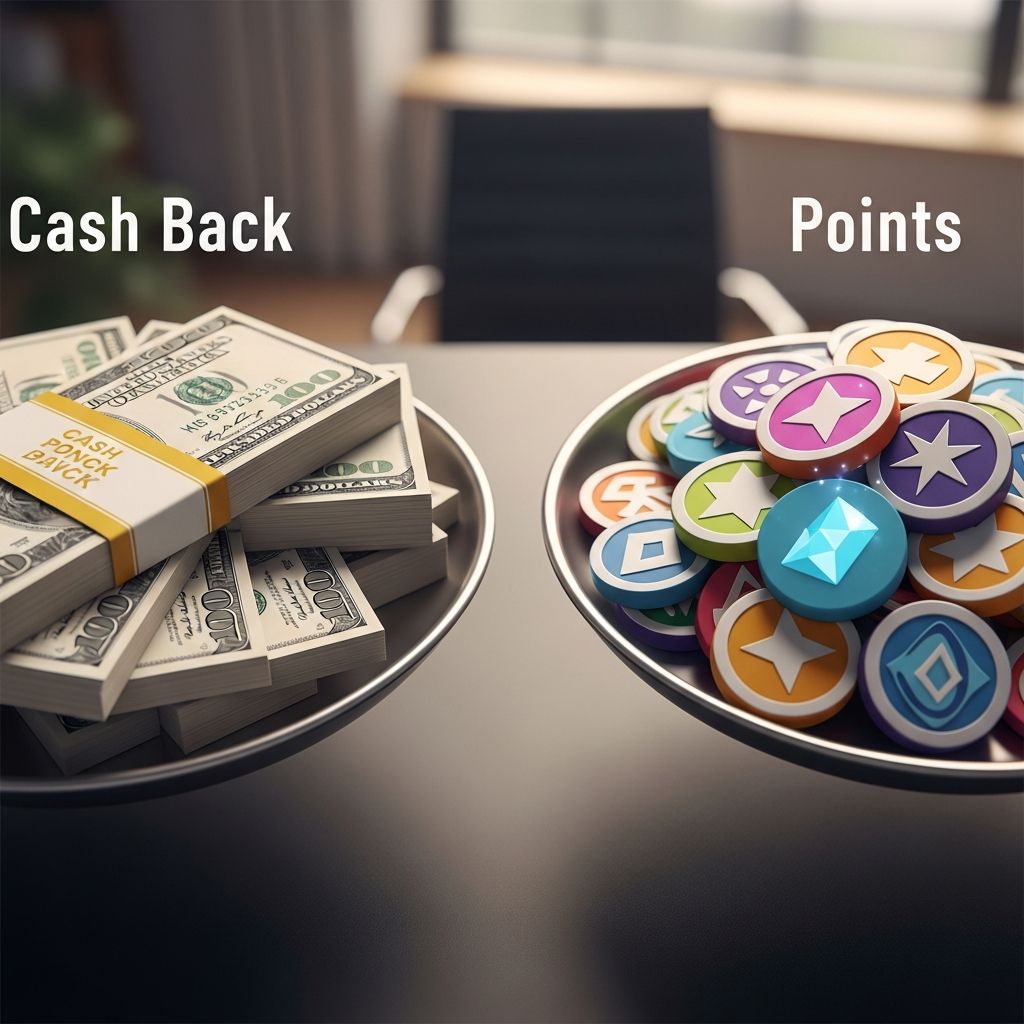
Cash back credit cards provide straightforward monetary returns on spending, while points-based cards accumulate flexible rewards redeemable for travel and more. The optimal choice hinges on your purchasing patterns, travel frequency, and preference for simplicity versus potential higher yields.
Understanding Rewards Structures
Rewards credit cards fall into two primary categories: those offering cash back and those providing points or miles. Cash back delivers a percentage of your expenditure directly as money, often applied as statement credits or deposits. Points, conversely, function as currency within the issuer’s ecosystem, convertible to flights, hotels, or other perks.
Cash back’s appeal lies in its predictability. Rates typically range from 1% to 6% depending on categories like groceries or gas. Points systems vary, with values fluctuating based on redemption—often 1 cent per point for cash but up to 2 cents or more for premium travel.
How Cash Back Credit Cards Operate
Cash back cards reward users with a fixed percentage return. Flat-rate options yield consistent rewards across all purchases, such as 2% on everything. Tiered cards boost returns in specific areas: for instance, 6% on U.S. supermarkets up to an annual cap, then 1%.
Earning is automatic—no activation needed for most. Redemption options include statement credits, direct deposits, checks, or gift cards, with minimal thresholds on many cards. Rewards rarely expire if the account remains open.
Advantages of Cash Back
- Simplicity: No complex valuations; rewards equal cash value.
- Flexibility: Use earnings anywhere, from bills to emergencies.
- Low Barriers: Often no annual fees and straightforward terms.
Drawbacks of Cash Back
- Capped Value: Maximums around 6% limit upside compared to optimized points.
- Fewer Perks: Lacks elite travel benefits like lounge access.
Decoding Points and Miles Systems
Points cards earn non-monetary units redeemable primarily for travel. Airlines and hotels partner with issuers, allowing transfers for bookings. Welcome bonuses can be substantial, often requiring high initial spend.
Valuation depends on strategy: transfer to partners for outsized value or redeem via portals at fixed rates. Categories like dining or flights yield elevated points.
Benefits of Points Cards
- Higher Potential Returns: Strategic use yields more than cash equivalents.
- Rich Perks: Includes insurance, upgrades, and priority services.
- Bonus Opportunities: Large sign-up incentives accelerate rewards.
Challenges with Points
- Complexity: Requires research for maximum value.
- Fees: Premium cards charge annual costs, sometimes $95+.
- Expiration Risks: Points may lapse under certain conditions.
Direct Comparison: Cash Back vs. Points
| Feature | Cash Back | Points/Miles |
|---|---|---|
| Rewards Value | Fixed (1-6%) | Variable (1-2+ cents/point) |
| Best Suited For | Everyday spenders | Frequent travelers |
| Redemption Ease | Very simple | Moderate to complex |
| Annual Fees | Often $0 | Frequent, $95+ |
| Perks | Basic | Extensive travel benefits |
| Expiration | Rarely | Possible |
This table highlights key differences, drawn from multiple analyses.
Factors to Consider for Your Choice
Select based on lifestyle. Infrequent travelers benefit from cash back’s ease—no need to track devaluations or blackouts. Frequent flyers maximize points through transfers.
Evaluate spending: High grocery or gas bills favor cash back bonus categories. Travel-heavy budgets suit points. Annual fees must justify perks; calculate net value.
Sample Card Profiles
- Flat Cash Back: 2% on all purchases—ideal for simplicity.
- Bonus Cash: 6% groceries, 3% dining—family-oriented.
- Points Powerhouse: High bonuses, transfer partners—jet-setters.
Maximizing Rewards: Strategies for Success
Combine cards: Use cash back for daily needs, points for travel categories. Track bonuses and rotate spending. Redeem optimally—avoid low-value portals for points.
Monitor credit health; good scores unlock premium options. Avoid debt to preserve rewards value.
Real-World Value Calculations
Assume $25,000 annual spend: $10k groceries, $5k gas, $10k other.
- Cash Back Card (6% groceries to $6k, 3% gas, 1.5% other): ~$500 return.
- Points Card (3x groceries/gas, 1x other; 1.5 cpp avg): ~$625 equivalent.
Travelers tip scales; others favor cash.
Frequently Asked Questions
Which is easier for beginners?
Cash back—redeem anytime without strategy.
Can I convert cash to points?
Some programs allow it at fixed, often suboptimal rates.
Do points expire?
Depends on issuer; activity often prevents it.
Are there no-fee points cards?
Yes, but with modest rewards.
How to pick the best card?
Match to spending; use calculators for projections.
Final Thoughts on Rewards Optimization
Neither is universally superior—align with goals. Cash back suits low-effort savers; points reward planners. Review annually as habits evolve.
References
- Cash Back vs. Travel Rewards: How to Choose a Credit Card — Navy Federal Credit Union. 2023-2024. https://www.navyfederal.org/makingcents/credit-debt/cash-back-vs-travel-rewards-credit-cards.html
- Cash Back vs. Points: Which Rewards Credit Card Is Better? — Experian. 2024. https://www.experian.com/blogs/ask-experian/cash-back-vs-points-which-rewards-credit-card-is-better/
- Cashback vs. Miles: Which Credit Card Rewards Are Right for You? — Ramp. 2023. https://ramp.com/blog/miles-vs-cash-back
- Travel Rewards vs. Cash Back Credit Cards — Credit Karma. 2024. https://www.creditkarma.com/credit-cards/i/travel-rewards-vs-cash-back-credit-cards
- Cash Back vs. Travel Rewards: How to Choose — NerdWallet. 2024-10-15. https://www.nerdwallet.com/credit-cards/learn/cash-back-vs-travel-how-to-choose-your-credit-card-rewards
- Cash Back vs. Point Rewards: How to Choose — Capital One. 2024. https://www.capitalone.com/learn-grow/money-management/cash-back-vs-point-rewards/
Similar Articles








Read full bio of Sneha Tete