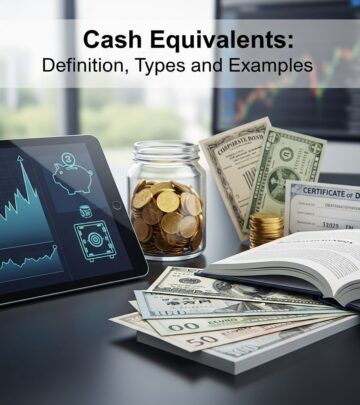
Cash and Cash Equivalents: Definition & Examples
Master the essentials of cash and cash equivalents in business accounting and financial management.

Cash and cash equivalents (CCE) represent the most liquid current assets found on a company’s balance sheet. These assets are crucial for understanding a business’s short-term financial health and operational flexibility. The term encompasses both physical currency and highly liquid investments that can be rapidly converted into known amounts of cash. For investors, creditors, and financial analysts, understanding cash and cash equivalents is essential for evaluating a company’s ability to meet its short-term obligations and fund daily operations.
What Are Cash and Cash Equivalents?
Cash and cash equivalents refer to the line item on the balance sheet that reports the value of a company’s assets that are either cash or can be converted into cash with minimal risk and delay. According to U.S. GAAP (Generally Accepted Accounting Principles), cash equivalents are defined as short-term, highly liquid investments that are readily convertible to known amounts of cash and that are so near their maturity that they present insignificant risk of changes in value because of changes in interest rates.
The critical distinction between cash and cash equivalents lies in their immediate availability. Cash represents actual currency and funds immediately available in bank accounts, while cash equivalents are short-term investments that must first be converted into cash. However, both are classified as current assets and treated with the highest priority on the balance sheet due to their liquidity characteristics.
Key Criteria for Cash Equivalents
For an investment or asset to qualify as a cash equivalent, it must meet two fundamental criteria that distinguish it from other current assets:
- Highly Liquid: The asset must be readily convertible into cash without significant penalties or delays. This means the investment can be sold or redeemed quickly on an established market or through normal banking channels.
- Short Maturity Period: The investment must have an original maturity of 90 days or less from the date of acquisition. This three-month threshold is the standard definition used under both U.S. GAAP and IFRS (International Financial Reporting Standards).
An important distinction is that the original maturity from the point of investment determines classification, not the remaining maturity. For example, a three-year Treasury note purchased three months before maturity would qualify as a cash equivalent, while a Treasury note purchased ten years ago that now has three months remaining would not, since its original maturity was ten years.
Common Examples of Cash and Cash Equivalents
Various assets are commonly classified as cash and cash equivalents on financial statements. Understanding these examples helps stakeholders interpret balance sheets and assess liquidity positions:
- Cash: Physical currency, bills, coins, checks received but not yet deposited, and balances in checking and savings accounts that allow immediate access.
- Treasury Bills (T-Bills): Short-term government debt securities issued by the U.S. Treasury with maturities of one year or less, representing some of the safest investments available.
- Commercial Paper: Unsecured short-term debt instruments issued by corporations, typically maturing within 270 days, used for financing short-term operational needs.
- Certificates of Deposit (CDs): Bank-issued investment products that allow customers to earn interest in exchange for leaving deposits untouched for a specified period, provided the maturity is 90 days or less.
- Money Market Accounts: Bank accounts that combine features of savings and checking accounts while typically offering higher interest rates for maintaining minimum balances.
- Money Market Funds: Mutual funds investing in short-term debt securities such as Treasury bills, municipal bills, and short-term corporate debt with low credit risk and high liquidity.
- Banker’s Acceptances: Short-term credit instruments guaranteed by a bank, commonly used in international trade finance to facilitate transactions between parties.
- Marketable Securities: Stocks and bonds that can be quickly sold and converted to cash, though classification depends on company accounting policies and investment intent.
Cash vs. Cash Equivalents: Key Differences
While both cash and cash equivalents are highly liquid current assets, important distinctions exist between them:
| Characteristic | Cash | Cash Equivalents |
|---|---|---|
| Availability | Immediately available for use without conversion | Requires conversion before use, typically within 90 days |
| Risk Level | Virtually no risk; does not fluctuate with market conditions or interest rates | Minimal risk but subject to interest rate and market changes near maturity |
| Form | Physical currency and demand deposits in bank accounts | Short-term investments and securities with high liquidity |
| Conversion Time | Instant—can be used immediately for transactions | May take days to weeks to convert; maturity is 90 days or less |
| Interest or Returns | May earn minimal interest in savings accounts but primarily holds value | Typically generates interest income or dividend returns |
Why Cash and Cash Equivalents Matter
Cash and cash equivalents are presented as the first line item in the current assets section of the balance sheet, reflecting their supreme importance in assessing financial health. Their prominence stems from several factors:
- Liquidity Assessment: These assets are essential for calculating key liquidity ratios that measure a company’s ability to meet short-term obligations.
- Operational Necessity: Businesses require adequate cash and equivalents to fund daily operations, pay employee salaries, purchase inventory, and manage unexpected expenses.
- Financial Flexibility: Strong cash positions enable companies to pursue growth opportunities, weather economic downturns, and maintain operations during revenue disruptions.
- Creditor Confidence: Lenders and investors view substantial cash reserves as indicators of financial stability and reduced default risk.
Cash and Cash Equivalents in Liquidity Ratios
Cash and cash equivalents are fundamental components in calculating three critical liquidity measures used by financial analysts and investors:
- Cash Ratio: Calculated as Cash and Cash Equivalents divided by Current Liabilities, this ratio provides the most conservative measure of liquidity, showing what percentage of current liabilities can be paid immediately with available cash and equivalents.
- Current Ratio: Computed as Current Assets divided by Current Liabilities, this broader metric includes cash and equivalents plus other current assets, indicating whether a company can cover short-term obligations.
- Quick Ratio: Determined by (Cash and Cash Equivalents plus Accounts Receivable) divided by Current Liabilities, this ratio excludes inventory to provide a more stringent liquidity measure.
Classification Considerations and Accounting Policies
While the 90-day maturity rule provides a clear framework, companies maintain discretion in classifying certain assets. Marketable securities, for instance, may sometimes be classified as cash equivalents depending on a company’s specific accounting policies and investment intentions. Companies typically disclose these classification decisions in the footnotes to their financial statements, providing transparency about their liquidity position and accounting methodology.
The flexibility in classification reflects the principle that cash equivalents should align with a company’s actual investment strategy and short-term cash management practices. A security that one company classifies as a cash equivalent might be classified as a marketable security by another, based on different operational needs and investment horizons.
Cash and Working Capital
Cash and cash equivalents significantly contribute to a company’s net working capital (NWC), which equals current assets minus current liabilities. Working capital is critical for funding business operations within a 12-month period and supporting inventory purchases, operating expenses, and capital acquisitions. Companies with excess cash typically invest these surplus amounts in cash equivalents, recognizing that these instruments offer safety and liquidity characteristics nearly equivalent to maintaining cash reserves.
Frequently Asked Questions
Q: What is the primary difference between cash and cash equivalents?
A: Cash is immediately available currency and funds in bank accounts, while cash equivalents are short-term investments that must be converted into cash. Both are highly liquid, but cash requires no conversion process.
Q: Why is the 90-day maturity threshold important?
A: The 90-day threshold ensures that cash equivalents will mature into cash within a reasonably short timeframe, making them virtually as reliable as cash for meeting immediate obligations. This standard is consistent across U.S. GAAP and IFRS.
Q: Can all marketable securities be classified as cash equivalents?
A: No, only those with original maturities of 90 days or less qualify. Stocks, long-term bonds, and other longer-term investments are typically classified as marketable securities rather than cash equivalents, even if they are easily tradable.
Q: How do companies use cash equivalents in practice?
A: Companies invest excess cash in cash equivalents to earn modest returns while maintaining maximum liquidity and minimal risk. This strategy allows businesses to optimize their working capital without compromising their ability to meet operational needs.
Q: Are cash and cash equivalents considered current assets?
A: Yes, both are classified as current assets and typically appear as the first line item on the balance sheet, reflecting their highest liquidity priority.
Q: What types of investments typically do not qualify as cash equivalents?
A: Longer-term securities such as common stocks, long-term bonds, derivatives, and any investments with original maturities exceeding 90 days are not classified as cash equivalents, regardless of how easily they can be converted to cash.
References
- Cash and Cash Equivalents — Wikipedia. Accessed November 2025. https://en.wikipedia.org/wiki/Cash_and_cash_equivalents
- Cash and Cash Equivalents: Finance and Valuation Guide with Examples — Corporate Finance Institute. Accessed November 2025. https://corporatefinanceinstitute.com/resources/accounting/cash-equivalents/
- Cash and Cash Equivalents Definition + Examples — Wall Street Prep. Accessed November 2025. https://www.wallstreetprep.com/knowledge/cash-equivalents/
- Cash and Cash Equivalents (CCE): Definition; Types & How It Works — Bill.com. Accessed November 2025. https://www.bill.com/learning/cash-and-cash-equivalents
Similar Articles








Read full bio of medha deb