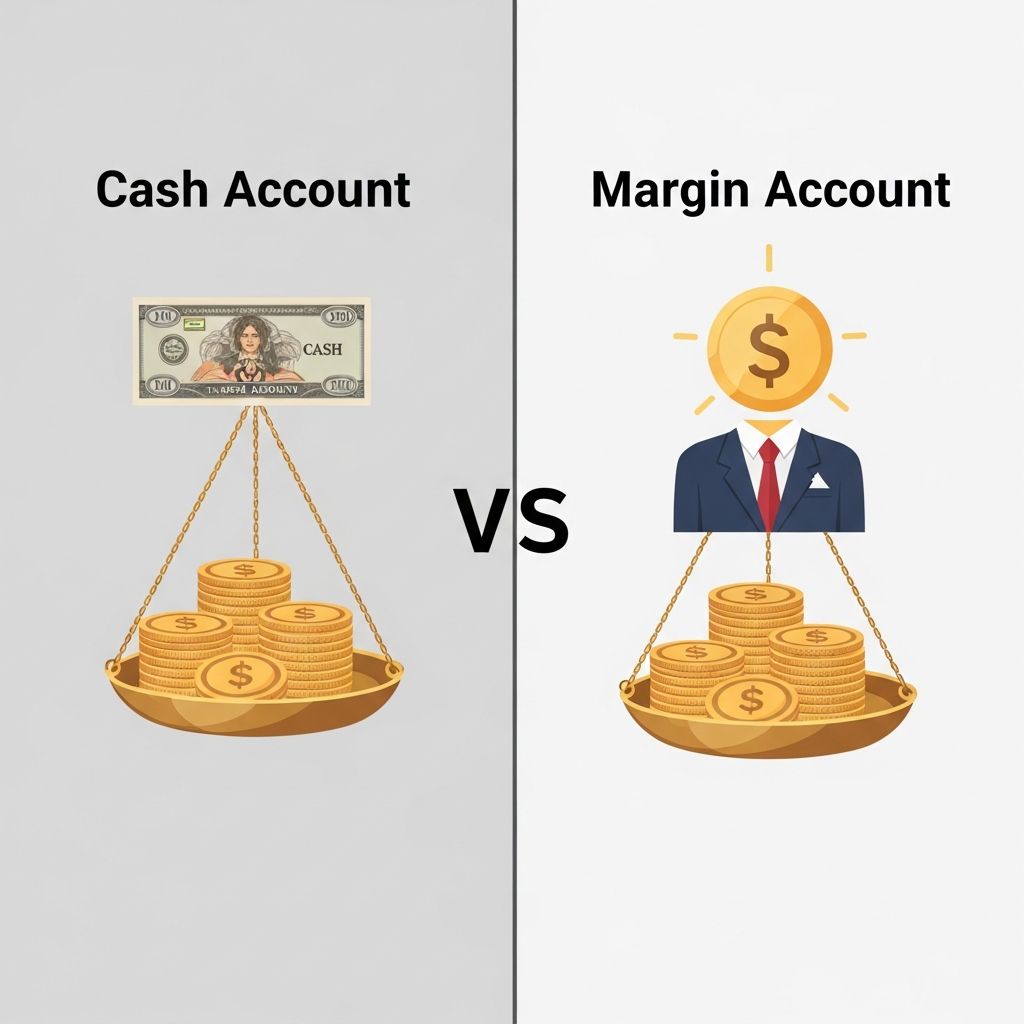
Cash Account vs. Margin Account: Key Differences
Understand the key differences between cash and margin accounts for smarter investing decisions.
What is a Cash Account?
A cash account is the most straightforward type of brokerage account available to investors. It operates on a simple principle: you can only buy and sell securities using the cash you have already deposited into the account. Cash accounts represent the foundational investment vehicle for most individual investors, particularly those just starting their investment journey. When you place an order to purchase securities in a cash account, the transaction settles within one business day (T+1) according to current Securities and Exchange Commission (SEC) regulations that took effect in 2024.
With a cash account, you maintain complete control over your funds without borrowing from your brokerage. This straightforward structure makes cash accounts ideal for investors who prefer simplicity and want to avoid the complexities associated with borrowed money. Cash accounts can typically hold stocks, exchange-traded funds (ETFs), mutual funds, and fixed-income products, though individual brokerages may impose additional restrictions on which securities they allow.
What is a Margin Account?
A margin account operates on an entirely different principle than a cash account. With a margin account, qualified investors can borrow money directly from their brokerage firm to purchase securities. This borrowed money is collateralized by the securities you hold in the account, effectively giving you more purchasing power than your actual cash deposit would allow. Margin accounts are specifically designed for investors who want to amplify their investment positions and are willing to accept the associated risks that come with leverage.
Margin accounts enable investors to trade advanced investment products and strategies that are unavailable in cash accounts. These include naked or uncovered options, multi-leg options spread strategies such as vertical spreads or iron condors, and futures contracts. Additionally, margin accounts allow investors to engage in short selling, a strategy where you profit if a security’s price declines. The regulatory framework for margin accounts is considerably more complex than that of cash accounts, requiring investor approval and adherence to strict margin maintenance requirements.
Key Differences Between Cash and Margin Accounts
Understanding the fundamental differences between these two account types is essential for selecting the appropriate investment vehicle for your financial goals and risk tolerance.
Leverage and Buying Power
The most significant distinction between cash and margin accounts is access to leverage. Leverage allows you to borrow cash from your brokerage and use eligible securities as collateral to establish larger positions than your actual cash would otherwise permit. With a margin account, your buying power extends beyond your deposited cash. For example, if you deposit $3,000 into a margin account and the security has a 50% margin requirement, you would have total buying power of $6,000, allowing you to purchase up to $6,000 worth of that security. In contrast, a cash account limits you to investing only the $3,000 you have on hand, with no borrowing capability.
Margin Maintenance Requirements
Margin accounts are subject to strict regulatory requirements designed to protect both investors and brokerages. In the United States, federal rules require brokers to maintain a minimum 25% equity requirement, meaning the value of your margin loan cannot exceed 75% of your overall account balance. This is known as the maintenance margin. Some brokers impose even higher equity requirements to reduce their risk exposure.
If your account value falls below the maintenance margin requirement, you will receive a margin call. This demand requires you to deposit additional cash, deposit more marginable securities, or sell a portion of your securities to restore your account to the required maintenance level. Failure to meet a margin call can result in your brokerage forcibly liquidating positions in your account to bring it back into compliance.
Interest and Loan Terms
When you borrow money through a margin account, you are essentially acquiring a loan from your brokerage. This loan comes with interest charges that accrue based on the brokerage’s policy and the prevailing interest rate environment. You must repay your margin loan, including all accrued interest, regardless of whether your investments gain or lose value. However, the interest charges on margin loans are tax-deductible in many jurisdictions, providing some tax benefit to investors who utilize margin.
Settlement and Fund Access
Cash accounts and margin accounts treat trade settlement differently, which can impact your ability to execute trades quickly. With the T+1 settlement cycle, securities typically settle one business day after you sell them. In a cash account, you may not be able to use the proceeds from a sale until the trade fully settles, which can limit your ability to quickly reinvest those funds into new positions. Conversely, in a margin account, you can essentially use unsettled funds however you wish when making other investments, providing greater flexibility and capital efficiency for active traders.
Risk Comparison
The risk profile differs dramatically between cash and margin accounts, particularly during market downturns.
Limited Downside in Cash Accounts
Cash accounts provide built-in downside protection because you can only lose the money you have invested. If you invest $3,000 in a cash account and that investment declines by 5%, your account value drops to $2,850—a loss of $150. Your maximum loss is capped at your initial investment. This characteristic makes cash accounts suitable for conservative investors and those who cannot afford to lose more than their initial capital.
Amplified Losses in Margin Accounts
Margin accounts amplify both gains and losses because you are investing with borrowed money in addition to your own capital. If you invest $3,000 in your own cash plus an additional $3,000 borrowed on margin (total $6,000) in a security, and that investment declines by 5%, the value drops to $5,700. After repaying the $3,000 borrowed, you would be left with $2,700—a loss of $300 plus any interest owed on the loan. Beyond the financial loss, such a decline would likely trigger a margin call, requiring immediate action to prevent forced liquidation of your positions.
Forced Liquidation Risk
Perhaps the most dangerous aspect of margin accounts is the possibility of forced liquidation. During a significant market downturn or if specific holdings decline substantially, your brokerage can force you to sell securities at unfavorable prices to meet margin requirements. This forced selling occurs regardless of your investment thesis or long-term outlook, potentially locking in losses at the worst possible time.
Return Potential Comparison
Lower Returns in Cash Accounts
Because cash accounts only allow you to invest the cash you have deposited, your return potential is constrained by the size of your initial investment. If you invest $100 in an ETF through a cash account and that ETF gains 10%, you earn $10. While this represents a solid 10% return, the absolute dollar gain is limited to your invested capital.
Amplified Returns in Margin Accounts
Margin accounts enable you to amplify returns through leverage. If you invest $100 of your own cash while borrowing an additional $100 on margin to invest $200 in that same ETF that gains 10%, you would earn $20 on your $200 investment. This represents a 20% return on your actual $100 cash investment—double the return you would have achieved in a cash account, ignoring interest costs. This leverage advantage explains why active traders and experienced investors often prefer margin accounts for aggressive growth strategies.
Real-World Example
Consider an investor with $10,000 in capital. If they invest $10,000 in cash to buy 100 shares of a stock at $100 per share, and that stock rises to $200 per share, the investment doubles to $20,000, netting a $10,000 gain. However, if they invest $10,000 of their own cash plus borrow an additional $10,000 on margin to buy 200 shares at $100 per share, the total investment of $20,000 doubles to $40,000. After repaying the $10,000 borrowed (ignoring interest), they are left with $30,000, which represents a tripled return on their original $10,000 cash investment.
Advantages and Disadvantages Summary
| Feature | Cash Account | Margin Account |
|---|---|---|
| Buying Power | Limited to deposited cash | Extends beyond deposited cash via leverage |
| Maximum Loss | Limited to initial investment | Can exceed initial investment |
| Margin Calls | Not applicable | Possible if account value drops |
| Options Trading | Basic options only | All options strategies allowed |
| Short Selling | Not allowed | Allowed |
| Complexity | Simple and straightforward | Complex with regulatory requirements |
| Interest Costs | None | Yes, but tax-deductible |
When to Choose Each Account Type
Cash Accounts Are Best For:
Cash accounts are ideal for beginning investors who are still learning investment fundamentals and building their knowledge base. They work well for buy-and-hold investors who purchase securities intending to hold them for extended periods regardless of short-term price fluctuations. Investors who prioritize capital preservation and want to avoid the risk of forced liquidation should choose cash accounts. Additionally, those who cannot afford potential losses exceeding their initial investment should stick with cash accounts. Conservative investors with a low risk tolerance, retirees living on fixed incomes, and anyone who values simplicity over maximum returns benefit from cash accounts.
Margin Accounts Are Best For:
Margin accounts suit experienced investors who fully understand leverage, market dynamics, and risk management. Active traders who frequently buy and sell securities can benefit from the capital efficiency and flexibility that margin provides. Investors interested in trading advanced strategies—such as options spreads, futures, or short selling—require a margin account, as these strategies are unavailable in cash accounts. Those with sufficient capital reserves to handle margin calls and potential losses should consider margin accounts. Sophisticated investors pursuing aggressive growth strategies and those seeking to maximize returns through leverage may find margin accounts appropriate.
Regulatory and Account Approval Considerations
Margin accounts are more heavily regulated than cash accounts and require investor approval before you can open one. Your brokerage will assess your investment experience, financial situation, and investment objectives to determine if you qualify for a margin account. Opening a margin account typically requires a minimum deposit, often ranging from $2,000 to $25,000 depending on the brokerage and regulatory requirements. Cash accounts, by contrast, can often be opened with minimal deposits and require no special approval process.
Frequently Asked Questions
Q: Can I switch between a cash account and a margin account?
A: Yes, most brokerages allow you to convert between account types. However, you must close any margin positions and pay off any outstanding margin loans before converting a margin account to a cash account. Converting from cash to margin requires meeting your brokerage’s margin approval requirements.
Q: What happens if I cannot meet a margin call?
A: If you fail to meet a margin call within the specified timeframe (usually 2-5 business days), your brokerage has the right to liquidate securities in your account without your permission to bring your account into compliance with maintenance margin requirements. This forced liquidation can lock in losses at the worst possible time.
Q: Are there any fees associated with margin accounts?
A: Margin accounts typically do not come with additional account fees beyond standard trading commissions and the interest charged on borrowed funds. However, interest rates on margin loans can vary significantly between brokerages and market conditions.
Q: Can I trade mutual funds in a cash account?
A: While regulatory bodies may permit mutual fund trading in cash accounts, individual brokerages often restrict this capability. Check with your specific brokerage to determine which securities are tradeable in your cash account.
Q: What is the difference between maintenance margin and initial margin?
A: Initial margin is the percentage of a security’s purchase price you must deposit when initially buying it on margin. Maintenance margin is the minimum percentage of equity you must maintain in your account to keep your positions open. Maintenance margin requirements are typically lower than initial margin requirements.
Q: How do interest charges on margin loans work?
A: Margin interest is calculated daily based on the amount borrowed and the broker’s current margin interest rate. The interest typically compounds and is added to your account statement monthly. Interest charges accrue regardless of whether your investments gain or lose value, though in many jurisdictions these charges are tax-deductible.
References
- Margin Account vs. Cash Account — Wealthsimple. 2025. https://www.wealthsimple.com/en-ca/learn/margin-account-vs-cash-account
- Cash Account Vs Margin Account | 2025 Investing Guide — Business Insider. 2025. https://www.businessinsider.com/personal-finance/investing/cash-vs-margin-account
- Cash Account vs Margin Account: Key Differences — SoFi. 2025. https://www.sofi.com/learn/content/cash-account-vs-margin-account/
- Cash vs. Margin Accounts: What is the Difference? — Tastytrade. 2025. https://tastytrade.com/learn/accounts/account-resources/margin-vs-cash-accounts/
- Cash vs. Margin Account — Firstrade Securities. 2025. https://www.firstrade.com/resources/guides/margin/margin-vs-cash
- The Difference Between a Cash Account and Margin Account — Questrade. 2025. https://www.questrade.com/learning/investment-concepts/cash-101/what-s-the-difference-between-a-cash-account-and-margin-account
Similar Articles








Read full bio of Sneha Tete