Car Loan Monthly Payments Explained
Discover how loan amounts, rates, terms, and credit scores shape your car payment—and strategies to keep costs manageable.

Monthly car loan payments typically range from about $537 for used vehicles to $767 for new ones, shaped primarily by the borrowed amount, interest rate, and repayment duration. These figures reflect national averages and can vary widely based on individual financial profiles and market conditions.
Core Elements Driving Your Payment Amount
Understanding the building blocks of a car loan payment is essential for any prospective buyer. The principal—the portion of the vehicle’s price financed after down payment—forms the foundation. Interest accrues on this principal at the annual percentage rate (APR), adding to each installment. The loan term, or number of months to repay, spreads this total cost, influencing both monthly obligations and overall expenses.
Taxes, fees, and optional add-ons like extended warranties can inflate the financed amount, embedding these extras into regular payments. Lenders divide the total repayable sum across the term to arrive at the fixed monthly figure, assuming a standard amortizing loan where early payments favor interest and later ones reduce principal more aggressively.
Average Payments Across Vehicle Types
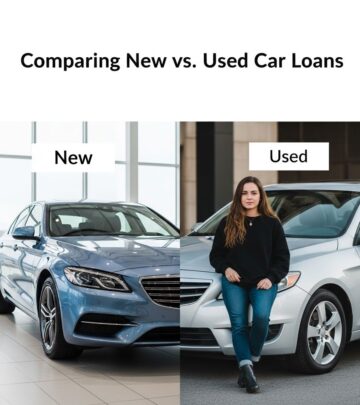
Recent data highlights distinct differences between new and used car financing. For new cars, borrowers face an average monthly outlay of $767 on loans around $43,582 at 6.37% APR over nearly 69 months, with average credit scores near 753. Used car loans average $537 monthly for $27,528 financed at 11.26% APR over about 68 months, tied to scores around 689.
These benchmarks underscore higher rates for pre-owned vehicles due to perceived risk, despite lower principal amounts. Superprime borrowers (scores 781+) enjoy payments as low as $748 new or $535 used, while deep subprime (300-500) see $767 new and $558 used, often with terms pushing 73 months.
| Credit Tier | New Car Payment | Used Car Payment |
|---|---|---|
| Superprime (781+) | $748 | $535 |
| Prime (661-780) | $773 | $523 |
| Near Prime (601-660) | $810 | $545 |
| Subprime (501-600) | $792 | $557 |
| Deep Subprime (300-500) | $767 | $558 |
This table illustrates payment stability across tiers for used cars but wider variance for new ones, driven by larger loan sizes.
Payment Projections for Common Loan Sizes
For a $10,000 loan over five years, new car buyers at 6.35% APR pay roughly $195 monthly, rising to $221 for used at 11.62%. Doubling to $20,000 scales payments to $390 new or $441 used. A $30,000 loan hits $585 new versus $662 used, and $40,000 demands $780 new or $882 used—exceeding typical new car averages.
| Loan Amount | New (6.35%, 60 mo) | Used (11.62%, 60 mo) |
|---|---|---|
| $10,000 | $194.96 | $220.53 |
| $20,000 | $389.92 | $441.06 |
| $30,000 | $584.88 | $661.59 |
| $40,000 | $779.84 | $882.12 |
These estimates assume no down payment and standard terms; real-world adjustments like trade-ins or deposits lower them proportionally.
Credit Score’s Pivotal Role
Your FICO score dictates eligibility for favorable rates. Superprime profiles secure 4.66% on new cars and 7.70% used, yielding lower payments on larger sums like $41,695 new or $29,836 used over 64-66 months. Subprime tiers endure 13-21% APRs, inflating costs despite shorter terms in some cases.
| Credit Tier | New APR | Used APR | Avg New Loan | Avg Used Loan |
|---|---|---|---|---|
| Superprime | 4.66% | 7.70% | $41,695 | $29,836 |
| Prime | 6.27% | 9.98% | $45,944 | $28,770 |
| Near Prime | 9.57% | 14.49% | $45,944 | $26,425 |
| Subprime | 13.17% | 19.42% | $40,646 | $23,231 |
| Deep Subprime | 16.01% | 21.85% | $36,236 | $21,427 |
Improving credit by even 50 points can slash rates significantly, underscoring pre-purchase score checks.
Impact of Loan Duration Choices
Shorter terms raise monthly burdens but curb total interest. A $25,000 loan at 9% APR costs $622 over 48 months ($4,862 interest) versus $451 over 72 months ($7,446 interest). For $15,000 at 7.5%, three years demands $467 monthly ($1,798 interest), four years $363 ($2,409), and five $301 ($3,034).
- Opt for 36-48 months if budget allows: Saves thousands in interest despite higher payments.
- Extend to 60-72 months for affordability: Payments drop, but lifetime costs rise.
- Avoid 84+ months: Interest dominates, risking negative equity.
Beyond the Loan: Full Ownership Costs
Limit auto expenses—including payments, insurance, fuel, and maintenance—to 20% of net monthly income. Some cap loan payments at 10-15% of take-home pay.[10] Factor in:
- Insurance: $100-200+ monthly, higher for new/luxury models.
- Fuel: Varies by efficiency and mileage.
- Maintenance: $500-1,000 yearly, more for used cars.
- Depreciation: New cars lose 20% value immediately.
Down payments of 10-20% reduce principal and may unlock better rates, while trade-ins offset costs similarly.
Strategies to Minimize Monthly Burdens
Secure pre-approval from banks, credit unions, or online lenders to lock competitive rates. Shop multiple offers, prioritizing APR over advertised payments. Larger down payments or shorter terms cut interest accrual. Refinancing post-purchase can lower rates if credit improves or markets shift.
Consider certified pre-owned vehicles for new-like warranties at used-car pricing. Timing purchases during promotions or year-end clearances often yields rebates or 0% financing for qualified buyers.
Using Calculators for Precision
Online tools from banks and automakers estimate payments by inputting price, down payment, APR, and term. For instance, a $30,000 car with $2,500 down at 5% over 36 months yields ~$824. These simulate scenarios, revealing total interest and affordability.
Frequently Asked Questions
What is a good monthly car payment?
A sustainable payment stays under 10-15% of take-home pay, with total car costs below 20% of net income.[10]
How does down payment affect payments?
It reduces principal directly; 20% down on $30,000 lowers the loan to $24,000, cutting payments proportionally.
Are longer terms worth it?
They ease monthly cash flow but increase total interest—compare via calculators.
Can I lower payments after signing?
Refinance if rates drop or credit rises; some lenders allow recasting with lump sums.
What credit score for best rates?
Above 781 unlocks prime rates; below 600 expect subprime pricing.
Key Takeaways for Smart Borrowing
Align loans with budget realities, prioritizing credit health and down payments. Use data-driven tools to forecast and negotiate confidently, ensuring vehicle ownership enhances rather than strains finances.
References
- Car Loan Monthly Costs — Experian. 2024-12-31. https://www.experian.com/blogs/ask-experian/car-loan-monthly-cost/
- Average Car Payments in 2026: What To Expect — Bankrate. 2026-03-01. https://www.bankrate.com/loans/auto-loans/average-monthly-car-payment/
- Car Affordability Calculator — Kelley Blue Book. 2025-01-15. https://www.kbb.com/car-affordability-calculator/
- What’s the Average Car Payment Per Month? — NerdWallet. 2025-12-31. https://www.nerdwallet.com/auto-loans/learn/average-monthly-car-payment
- What a Car Loan Costs — Banzai. 2024-06-01. https://banzai.org/wellness/resources/what-a-car-loan-costs
Similar Articles








Read full bio of Sneha Tete