Car Loan Amortization: 5 Smart Ways To Cut Interest
Master the process of car loan amortization to optimize payments, reduce interest costs, and achieve financial clarity in vehicle financing.
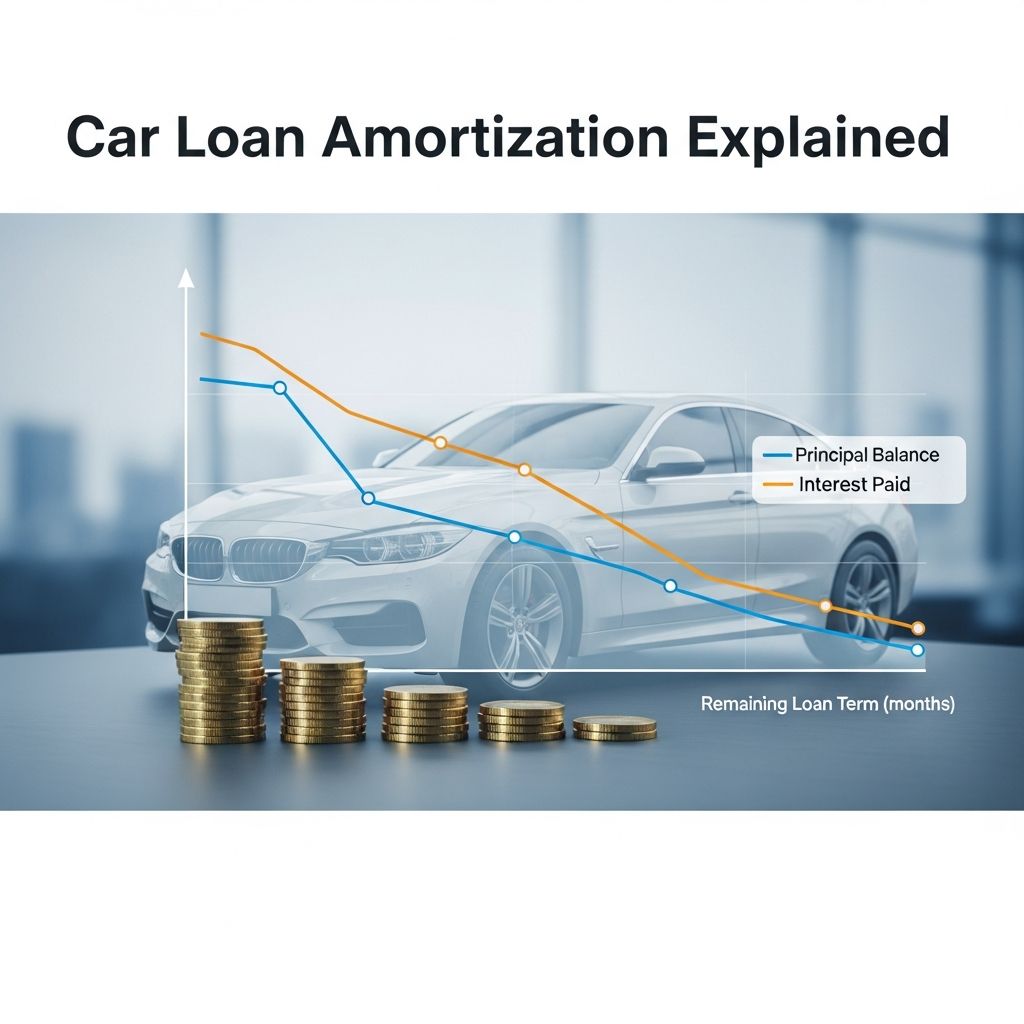
Car loan amortization describes the gradual repayment of an auto loan through fixed periodic payments that cover both principal and interest over a set term. This structured approach ensures the loan balance reaches zero by the end date, with early payments favoring interest and later ones prioritizing principal reduction.
Understanding the Fundamentals of Auto Loan Repayment
At the heart of any car loan lies the balance between the borrowed amount, known as the principal, and the interest charged by the lender. Each monthly installment remains constant, but its allocation shifts dynamically. Initially, a significant portion services the accruing interest calculated on the full outstanding balance, leaving a smaller slice for principal paydown. As the principal diminishes, interest charges decrease, allowing more of the fixed payment to accelerate principal reduction.
This mechanism applies to most standard auto loans, distinguishing them from interest-only or balloon payment structures. Borrowers benefit from predictability, as the uniform payment simplifies budgeting. However, grasping this shift empowers informed decisions, such as opting for shorter terms to curb total interest outlay.
Key Components Influencing Amortization
Several factors dictate the amortization trajectory of a car loan:
- Principal Amount: The initial loan sum, reduced by down payments or trade-ins, sets the foundation. Larger principals extend the interest burden.
- Interest Rate (APR): This percentage, often simple interest for auto loans, compounds the cost. Lower rates expedite principal reduction.
- Loan Term: Measured in months (e.g., 36 to 84), longer terms lower monthly payments but inflate total interest.
- Payment Frequency: Typically monthly, but bi-weekly options can shorten the effective term through additional principal applications.
These elements interact via mathematical formulas to generate the payment schedule. For instance, a higher down payment shrinks the principal, yielding lower interest accrual from day one.
Breaking Down a Typical Amortization Schedule
An amortization schedule is a comprehensive ledger detailing every payment’s composition across the loan’s lifespan. Presented as a table, it includes columns for payment number, due date, total payment, interest portion, principal portion, and ending balance.
Consider a $30,000 loan at 7% APR over 60 months. The fixed monthly payment calculates to approximately $594. In month one, about $175 covers interest on the full principal, with $419 reducing the balance to $29,581. By month two, interest drops to $173, boosting principal paydown to $421.48. This progression continues, with the schedule revealing cumulative interest and precise payoff timelines.
| Payment # | Month | Total Payment | Interest | Principal | Balance |
|---|---|---|---|---|---|
| 1 | 1 | $594.04 | $175.00 | $419.04 | $29,580.96 |
| 2 | 2 | $594.04 | $172.56 | $421.48 | $29,159.48 |
| 30 | 30 | $594.04 | $102.35 | $491.69 | $15,234.67 |
| 60 | 60 | $594.04 | $9.93 | $584.11 | $0.00 |
This snapshot illustrates the front-loaded interest pattern, a hallmark of amortizing loans.
Mastering the Amortization Formula
Calculating the fixed monthly payment relies on the standard loan amortization formula:
M = P × [r(1 + r)^n] / [(1 + r)^n - 1]
Where:
- M = monthly payment
- P = principal loan amount
- r = monthly interest rate (annual APR / 12)
- n = total number of payments
For subsequent payments, interest is (current balance × r), with the remainder applied to principal.
Online calculators or spreadsheets simplify this. Input your loan details to generate custom schedules, forecasting total costs and equity buildup. Excel’s PMT function, for example, yields M directly: =PMT(r, n, -P).
Strategies to Optimize Your Amortization
Beyond passive repayment, proactive tactics can reshape amortization favorably:
- Increase Down Payment: Reduces principal, slashing interest from inception.
- Shorten Loan Term: Elevates monthly payments but curtails total interest. A 48-month vs. 60-month term on $25,000 at 4% APR saves over $500 in interest.
- Extra Principal Payments: Target early in the term to compound savings, as they diminish the base for future interest.
- Bi-Weekly Payments: Yield one extra full payment annually, accelerating payoff without budget strain.
- Refinance: If rates drop, recalibrate to lower APR or term, resetting amortization positively.
Always confirm prepayment penalties with lenders, though most auto loans permit them freely.
Common Pitfalls in Car Loan Amortization
Overlooking amortization details invites surprises. Many focus solely on monthly affordability, ignoring lifetime costs. Extended terms (72+ months) now prevalent, amplify interest exponentially while risking negative equity if vehicle values depreciate faster than payoff.
Additionally, fees embedded in APR can distort early payments. Simple interest loans recalculate daily or monthly on balances, so timely payments prevent accrual spikes. Misallocating payments—e.g., late fees not covering principal—prolongs the schedule.
Real-World Impacts and Long-Term Benefits
Amortization transparency fosters financial discipline. Schedules reveal equity growth, informing decisions like trading in or selling. For a $25,000 loan at 4% over 60 months, total interest hits $2,625; shortening to 48 months drops it to $2,095, despite higher monthlies ($564 vs. $460).
Understanding this empowers negotiation: seek lower rates or terms upfront. Post-purchase, tracking via lender portals or apps ensures accuracy, catching errors promptly.
Frequently Asked Questions
What exactly is car loan amortization?
It’s the systematic repayment of a car loan via fixed payments that blend principal and interest, gradually eliminating the debt over the term.
Do all auto loans use amortization?
Yes, nearly all standard auto loans are fully amortizing, structuring payments to zero the balance by maturity.
How do I obtain my amortization schedule?
Lenders provide it at closing or via online accounts. Alternatively, use free calculators with your loan terms.
Can extra payments shorten amortization?
Absolutely—directing extras to principal reduces future interest and accelerates payoff.
What’s the impact of a higher interest rate on amortization?
Higher rates front-load more interest, slowing principal reduction and increasing total costs.
Tools and Resources for Amortization Management
Leverage free online amortization calculators from reputable financial sites to simulate scenarios. Spreadsheet templates automate schedules, incorporating variables like extra payments. Mobile apps from lenders offer real-time tracking, payment previews, and payoff estimators.
For precision, consult official loan documents or credit union tools, ensuring alignment with your contract’s APR and fees.
References
- What is Car Loan Amortization? – NerdWallet — NerdWallet. 2023-10-15. https://www.nerdwallet.com/auto-loans/learn/what-is-auto-loan-amortization
- Understanding the Amortization Formula for Your Car Loan — Oreate AI. 2024-05-20. https://www.oreateai.com/blog/understanding-the-amortization-formula-for-your-car-loan/cacf8d9f4f264d7048606b95df8889ed
- What is amortization and how does it work? — Fidelity Investments. 2024-02-10. https://www.fidelity.com/learning-center/personal-finance/what-is-amortization
- What Car Loan Amortization Is & How It Works — SoFi. 2024-01-22. https://www.sofi.com/learn/content/what-is-car-loan-amortization/
- Car Loan Amortization Schedule: How Does It Work? — Capital One. 2023-11-08. https://www.capitalone.com/cars/learn/managing-your-money-wisely/car-loan-amortization-schedule-how-does-it-work/1195
Similar Articles








Read full bio of medha deb